Mill at the wrong time, or on the wrong surface, and you risk wasting good material, chewing into a base that wasn't ready to be exposed, or forcing a costly rework six months down the road. This guide breaks down what asphalt milling actually involves, the scenarios where it makes sense, the warning signs that tell you to hold off, and the best practices that keep a milling project on schedule and on budget.
Key Takeaways
- Milling removes damaged surface layers while preserving the base underneath
- Best suited for sound subgrades with surface cracking, rutting, or drainage issues
- Skipping assessments or milling a failed base risks early resurfacing failure
- Poor tooling adds as much downtime and rework risk as bad weather
- Tooling that handles asphalt, concrete and rebar without a change-out removes the biggest scheduling variable on mixed-material jobs
What is Asphalt Milling?
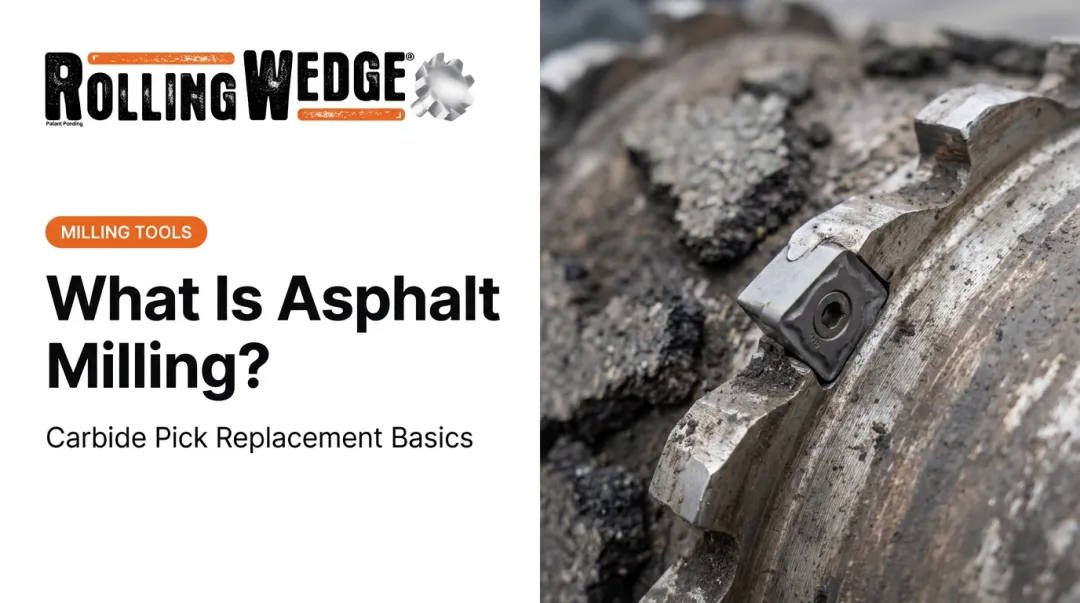
Asphalt milling, also called cold planing or profiling, uses a rotating drum lined with carbide cutting tools to grind away the top layer of pavement. A conveyor system loads the milled material, known as reclaimed asphalt pavement (RAP), directly into waiting trucks. The base underneath stays untouched, which is exactly the point.
How deep that cut goes varies by project, though. The Federal Highway Administration recognizes five milling classes (Class I through V), but these aren't fixed depth categories: they describe purpose, not inches. Here's the breakdown:
| Class | Purpose |
|---|---|
| I | Removes surface irregularities |
| II | Mills to a uniform plan depth |
| III | Mills to uniform depth plus cross-slope |
| IV | Removes entire asphalt surfacing down to base or subgrade |
| V | Mills to variable depths per project plans |
Actual cut depth depends on the project's engineering plans, not a standard chart. That's why a pre-project assessment matters more than a generic depth rule of thumb.
Once collected, crews screen, crush, and reuse RAP as recycled pavement mix, base material, or patching stock. This recycling process drives much of milling's cost savings. According to the National Asphalt Pavement Association's 2021 RAP benefits report, the U.S. industry reused roughly 89.2 million tons of RAP annually, saving an estimated $3.3 billion a year compared to sourcing virgin materials.
Asphalt Milling vs. Micro-Milling vs. Full-Depth Reclamation
These three terms get used interchangeably, but they solve different problems:
- Standard milling cuts deeper and leaves a coarser texture, suited for correcting profile, rutting, or general surface distress
- Micro-milling uses closely spaced teeth for a thin, fine-texture removal. Georgia DOT specifications, for example, call for no more than 1/16 inch of ridge-to-valley variation
- Full-depth reclamation (FDR) treats the entire asphalt layer plus 4 to 12 inches of underlying material, reserved for cases where the base itself has failed
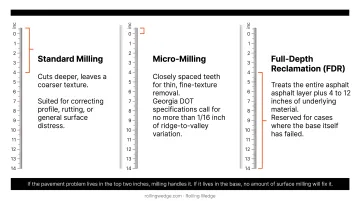
If the pavement problem lives in the top two inches, milling handles it. If it lives in the base, no amount of surface milling will fix it.
When Should You Use Asphalt Milling? Best Timing Scenarios
The "right time" to mill isn't a calendar date. It's a function of pavement condition, project goals, and site-specific realities working together.
Based on Pavement Condition
Milling makes sense when the surface shows cracking, rutting, raveling, or oxidation, but coring confirms the base and subgrade remain structurally sound.
Pavement suffering from deep, load-related cracking or a failing subgrade won't respond to milling alone. That's a full-depth reclamation (FDR) situation, and treating it as a milling job just delays the real fix.
Based on Project Goals
Beyond fixing distress, milling gets scheduled to:
- Correct drainage issues caused by an uneven surface profile
- Level a rough surface before a new overlay goes down
- Adjust grade near curbs, manholes, or guardrails
Common trigger points include parking lots and roadways approaching their resurfacing age, or sites where clearance adjustments are needed around fixed structures.
Based on Environmental and Scheduling Factors
Weather governs the overlay side of the equation more than the milling side. Dry, moderate conditions support proper compaction and bonding once new asphalt goes down. Beyond weather, scheduling has to account for:
- Traffic disruption windows: High-traffic roads often get milled at night to minimize closures
- Municipal budget cycles: Many public projects follow fiscal-year construction windows
- Contractor availability: Milling crews and paving crews often need back-to-back scheduling to avoid an exposed surface sitting too long
- Water access: Conventional systems rely on water to manage cutting heat, which adds a supply and refill dependency to remote or urban sites
Based on Surface Material Complexity
Mixed-material job sites, such as asphalt patched with concrete or pavement with embedded rebar, complicate timing considerably. And here the industry's standard answer creates its own delay.
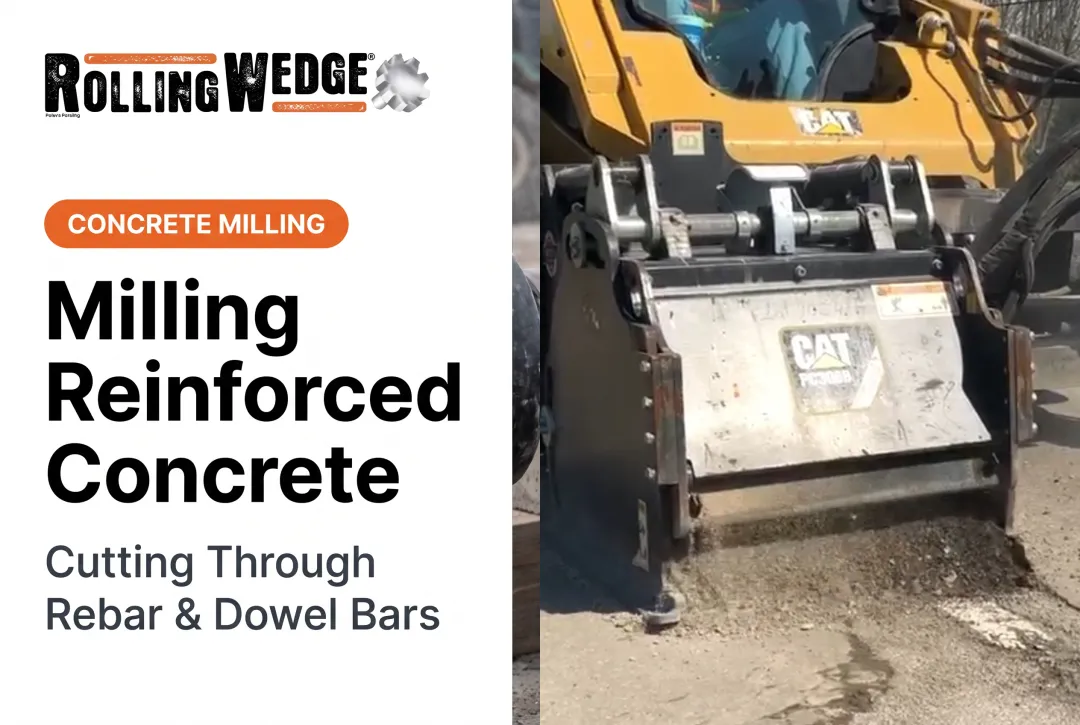
The conventional milling market has a pick for every situation: one carbide pick for asphalt, a different one for concrete. When the surface composition changes partway through a job, someone has to change out every pick on the drum to suit the new material. On a mixed-surface site that is not a minor pause — it is hours of labour, repeated each time the material changes. Traditional carbide setups can also jam or stall outright on rebar.
Rolling Wedge approaches milling from the opposite direction. Rather than smashing the asphalt repeatedly with fixed carbide picks, Rolling Wedge Asphalt Milling cutters roll over the material using a rolling-wedging-lifting action that exploits the pavement's low tensile strength, about a fifth of its compressive strength, instead of fighting the material head-on. The same drum cuts asphalt, concrete and rebar-reinforced sections in a single pass, without stopping to swap tools.
That difference in cutting action changes three things operators feel immediately:
- No bounce. Fixed picks strike and rebound, sending chatter back through the drum, the hydraulics and the seat. Rolling cutters never develop that rebound. It is the single most commonly reported difference, and customers frequently place a second order after one day on the machine on the strength of it alone.
- No heat, no seizing. Because the tools are always turning rather than being impacted into the material all day, they do not build heat and they do not seize up.
- No cutting water. Water is only needed where dust suppression is required on site, not to manage tool temperature.
For a contractor bidding a mixed-surface job, single-pass capability can shrink the project timeline enough to change which week the crew books the machine.

Field Proof: Milling a Roadway Joint Through Steel Dowel Bars
Claims about tool durability are easy to make and hard to verify. A documented carbide cutter assessment on a 24-inch Caterpillar PC306B milling drum puts numbers behind this one.
The job involved milling a roadway joint. Roadway joints are held in alignment by dowel bars — solid steel, and not something a milling crew sets out to cut. The Rolling Wedge tools milled straight through them. Tool marks from the cut across the dowel bars are visible in the assessment photos once the spoil was cleaned out.
The more telling detail is what happened next: the same drum, with the same tools, went on to mill additional concrete sections. Concrete is material much of the industry avoids entirely, and this drum reached it after cutting through solid steel.
Here is what the drum carried and what came back damaged:
| Tool type | Count | Cutting edges | Damaged | Damage rate |
|---|---|---|---|---|
| Large 3.75" Rolling Wedge cutters | 28 | 252 | 2 | 0.8% |
| Small 2.50" Rolling Wedge cutters | 2 | 18 | 0 | 0% |
| Carbide picks | 8 | 8 | 1 | 12.5% |
| Total | 38 | 278 | 3 | 1.1% |
Each Rolling Wedge cutter carries 9 carbide teeth. Across 278 total cutting edges, 3 were damaged — 1.1%. Both affected large cutters lost a single tooth each and remained usable, needing no replacement; a Milling Tool stays in service with one or two teeth missing and is only replaced at three or more. One sat mid-drum and the other on an outside edge. The small cutters showed no damage at all, only light, ordinary wear.
The carbide picks on the same drum, cutting the same material on the same pass, tell the other half of the story: one of eight broke to the point of having no carbide left. That is a 12.5% failure rate against 0.8% on the large rolling cutters — a direct comparison, under identical conditions, on a single drum.
Signs It's the Right Time — and When to Avoid Milling
Signs the Pavement Is Ready for Milling
Look for these indicators before scheduling the planer:
- Visible surface distress (cracking, rutting, or shoving) while the base underneath remains firm
- Drainage complaints tied to an uneven surface profile, not a collapsed base
- A resurfacing cycle already on the books where milling is the planned first step
When You Should Avoid Milling
There are a handful of conditions where milling either won't help or will actively make things worse:
- Base or subgrade failure. If cores show a compromised base, milling the surface just delays a full-depth reclamation project that's coming anyway
- Freezing or wet conditions. This is an overlay constraint rather than a tooling one: cold or saturated conditions prevent the new asphalt from compacting properly, undermining the bond before it even forms
- Hidden moisture damage. An Oregon DOT investigation into I-84 rutting found trapped moisture between pavement lifts caused delamination, with milling identified as a likely contributor to bond failure
Core for hidden moisture damage before milling, and don't leave a milled surface exposed to rain any longer than necessary. Milling too deep, or milling without confirming what's underneath, doesn't just waste a pass of the planer. It can accelerate failure of the new surface you just paid to install.
Best Practices for Timing and Executing Asphalt Milling Projects
Getting the timing right starts before the machine ever shows up on site.
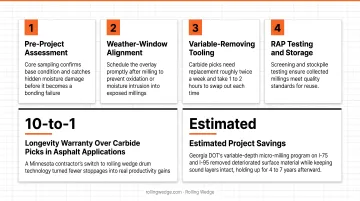
- Run a pre-project assessment. Core sampling confirms base condition and catches hidden moisture damage before it becomes a bonding failure later.
- Align milling with weather windows. Schedule the overlay promptly after milling to prevent oxidation or moisture intrusion into exposed millings.
- Choose tooling that removes variables instead of adding them. Traditional carbide picks need replacement roughly twice a week and take 1 to 2 hours to swap out each time — before counting the change-outs forced by a switch from asphalt to concrete. Tooling that cuts every material on the drum takes that variable off the schedule entirely.
- Test and store RAP properly. Screening and stockpile testing ensure the collected millings meet quality standards for reuse rather than becoming unusable waste.
Tooling choice deserves special attention because it directly affects how much of your schedule gets eaten by maintenance. Operating lives of 10x and longer than carbide picks have been reported for Rolling Wedge tools in asphalt applications:
| Metric | Carbide Picks | Rolling Wedge Tools |
|---|---|---|
| Cutting action | Repeated impact into the material | Rolling Wedge, always turning |
| Replacement cycle | Twice a week | 1 to 3 months |
| Installation time | 1 to 2 hours | 20 minutes |
| Vibration / bounce | Chatter through drum and cab | None reported by operators |
| Heat and seizing | Builds heat, can seize | Stays cool, does not seize |
| Cutting water | Typically required | Dust suppression only |
| Material change | Swap every pick on the drum | Same tools across materials |
A Minnesota contractor's experience in the Making the Cut case study shows how fewer stoppages translate into real productivity gains on the ground.
There's a supporting case study on the recycling side too. Georgia DOT's variable-depth micro-milling program on I-75 and I-95, aimed at removing deteriorated surface material while keeping sound layers intact, was credited with an estimated $11 million in project savings and held up well for 4 to 7 years afterward. Matching technique to site conditions and timing is what delivers results like these.
Conclusion
There's no single "best time" to mill asphalt. It depends on pavement condition, project goals, and the environmental and scheduling constraints of the specific job. Correct timing paired with dependable Milling Tools, such as Rolling Wedge's rolling-wedge cutting inserts, drives better cost efficiency, more sustainable material reuse, reduced downtime, and longer pavement life.
Contractors and municipalities that assess condition first and choose dependable tooling get more value out of every project — fewer stoppages, less guesswork, and a surface that lasts.
Frequently Asked Questions
What is Asphalt Milling?
Asphalt milling is the process of removing the top layer of deteriorated pavement using a cold planer, leaving the structural base intact. The removed material is typically recycled rather than discarded.
Is Asphalt Milling Worth It?
When the base is structurally sound, milling is generally cost-effective and sustainable, offering major savings over full pavement replacement. It also produces reusable RAP material, adding recycling value on top of the labor savings.
Can the Same Drum Mill Asphalt and Concrete?
With conventional tooling, no — the industry standard is a dedicated pick per material, meaning every pick on the drum gets changed when the surface changes. Rolling Wedge cutters mill asphalt, concrete and rebar-reinforced sections with the same tools in a single pass.
What Causes Milling Machine Bounce, and Can It Be Avoided?
Bounce comes from fixed carbide picks striking the pavement and rebounding, sending chatter back through the drum, hydraulics and operator seat. A rolling cutting action removes the impact that creates it, which is the difference operators most often notice on day one.
Do Milling Tools Need Water?
Conventional systems commonly use water to manage the heat generated by repeated impact. Rolling Wedge tools are always turning rather than being impacted into the material, so they do not build that heat — water is only used where dust suppression is required.
How Much Will 1 Ton of Asphalt Millings Cover?
Coverage depends on compacted thickness and project density, so there's no universal rate. The FHWA estimates compacted RAP weighs 100 to 125 pounds per cubic foot, a figure engineers use to calculate coverage for specific jobs.
What Will Harden Asphalt Millings?
Compaction with a roller, combined with the natural bitumen binder in the material, hardens millings over time, often within about 24 hours under good conditions. Older or drier material may need a rejuvenator to restore proper binding.
How Deep Does Asphalt Milling Typically Go?
Depth depends on the milling class and project plans rather than a fixed standard. Class I addresses shallow surface irregularities, while Class IV removes the entire asphalt layer down to the base or subgrade.
What's the Difference Between Asphalt Milling and Full-Depth Reclamation?
Milling removes only the surface asphalt layer while the base stays intact. Full-depth reclamation treats the entire asphalt section plus several inches of underlying material, used when the base itself needs rebuilding.