Introduction
Milling reinforced concrete means mechanically removing concrete with a rotating drum while the cutting system hits embedded steel, including rebar and dowel bars. It sounds straightforward until the drum actually hits steel.
This guide is written for US contractors, municipalities, roadway rehabilitation crews, and Skidsteer operators who need production, surface quality, and equipment protection to hold up on real jobsites.
Here's the problem: most discussions treat "reinforced concrete" like one uniform material. It isn't. Bar size, spacing, concrete strength, dowel layout, and cutting depth all change how a pass behaves.
Iowa DOT's own specification defines this kind of work as controlled surface removal, called "scarifying", to a contract-specified depth—not blanket permission to cut through anything buried in the slab.
We'll cover how the process actually works, what changes the outcome, where it gets used, what commonly goes wrong, and when a different method makes more sense.
Key Takeaways
- Reinforcement layout, tool design, and machine capacity determine milling results, not the drum alone
- Rebar and dowel bars behave differently: dowels concentrate at joints and often run larger in diameter
- Unknown subsurface conditions (post-tensioning, utilities, structural steel) demand verification before milling starts
- The right cutting system reduces tool changes and vibration, but no tool suits every reinforcement configuration
- Sawing, coring, hydrodemolition, or breaking may outperform milling when precision or structural risk is high
What Is Milling Reinforced Concrete and Why Is It Used?
Concrete milling uses a rotating drum fitted with cutting tools to break and evacuate material from a slab, pavement, bridge deck, or other hard surface. It's typically a shallow-to-moderate removal process, not full-depth demolition.
The goal is usually one of these:
- Remove a damaged or contaminated surface layer
- Correct pavement elevation or profile
- Strip a failed patch or old joint repair
- Prepare a surface for an overlay or reconstruction
Iowa DOT's Section 2214 specification calls this kind of work "scarifying" and ties removal depth strictly to the contract documents, according to Iowa DOT Section 2214. That's an important distinction: it describes bounded surface removal, not a claim that any planer can sever whatever steel happens to sit underneath.
Milling vs. Sawing, Coring, and Breaking
Milling isn't the only removal method, and it isn't always the right one.
- Sawing creates narrow, precise cuts along a controlled line
- Coring produces round penetrations for utilities or testing
- Breaking or demolition uses impact to fragment large sections
- Milling removes material progressively across a wider surface at a set depth
Reinforcement changes the milling task because steel stays embedded while concrete comes out around it. That interruption can raise tool loading, vibration, heat, and debris, and it can leave an uneven finish when the cutting system isn't matched to the job.
Common applications include:
- Pavement rehabilitation and profile correction
- Bridge-deck surface removal
- Failed-repair and joint transition work
- Drainage preparation
- Mixed asphalt-concrete passes in a single run
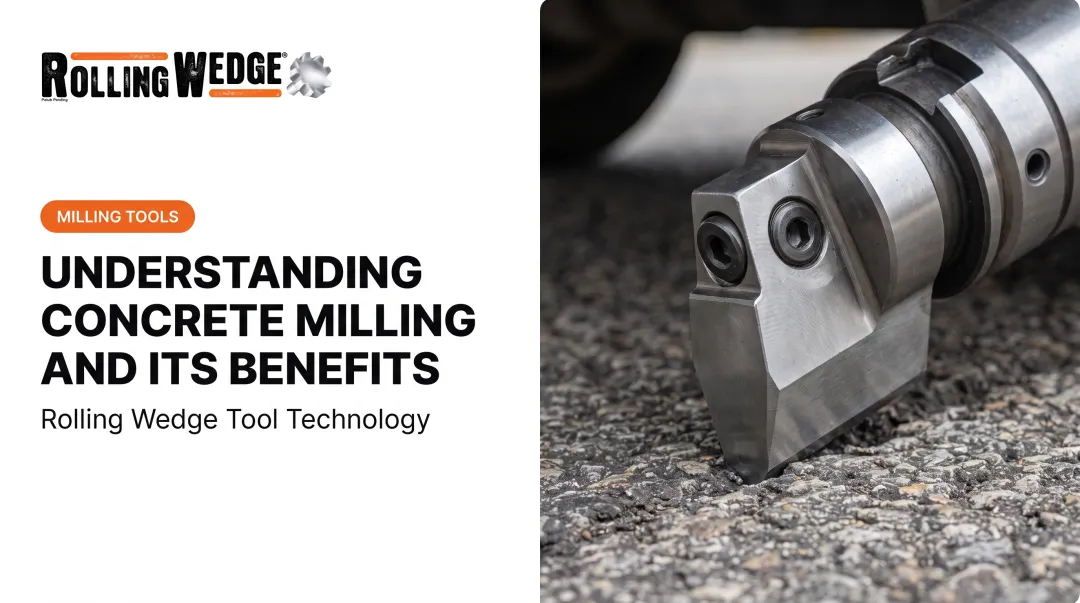
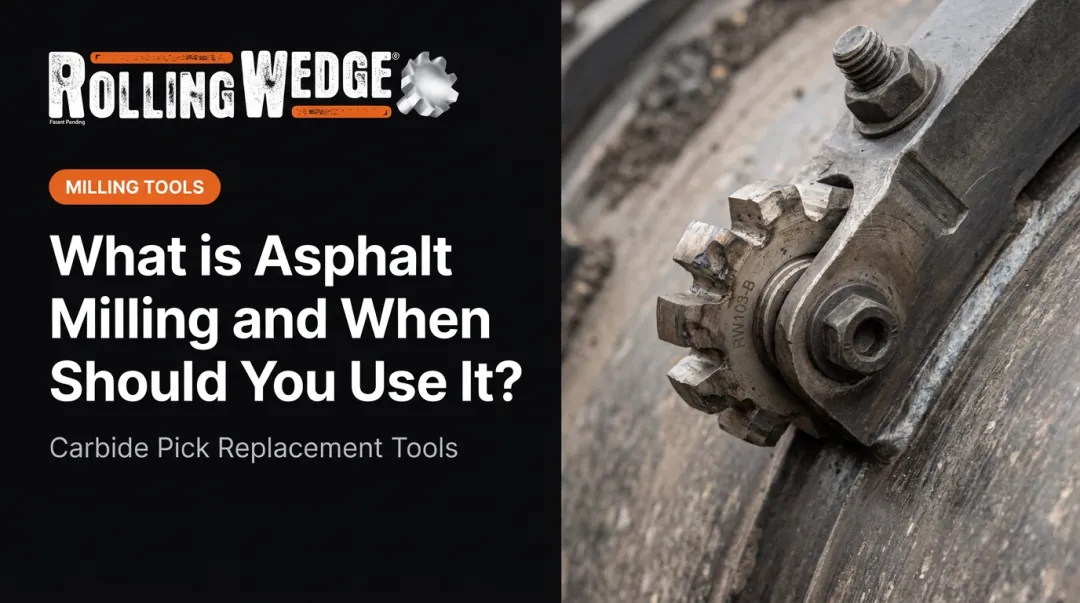
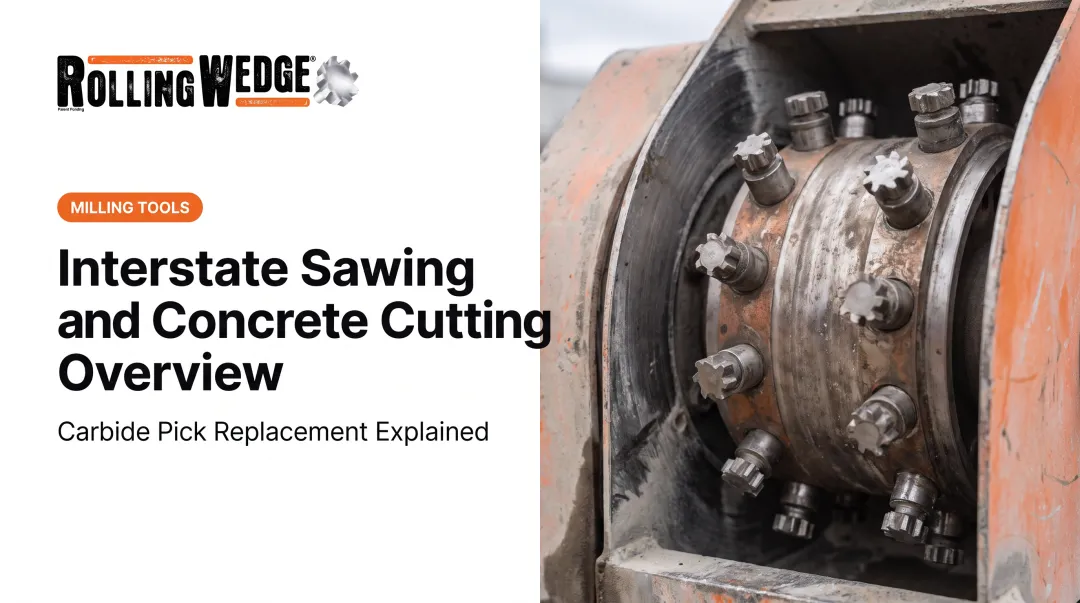
Rolling Wedge Milling Tools are designed to mill asphalt and concrete in the same pass, without a mid-pass tool swap. They are supplied on a Rolling Wedge Milling Drum that installs into a compatible Skidsteer planer attachment, or fitted to a large milling machine; Rolling Wedge supplies the Milling Drum and Milling Tools, not the Skidsteer, attachment, or machine.
How Milling Through Rebar and Dowel Bars Works
The overall sequence runs from assessment to inspection: assess the concrete and reinforcement, set up a compatible machine and drum, engage the surface and manage the cutting path, then verify the result before moving on.
Step 1: Assess the Concrete and Reinforcement
Before the drum touches the surface, review drawings, repair records, prior scanning data, and exposed edges to identify likely rebar, dowel locations, post-tensioned elements, conduits, and slab thickness.
Ground-penetrating radar helps here, but it has real limits. FHWA's own guidance notes that a top mat of steel can obscure a lower mat, and thick concrete cover can prevent a detectable response entirely, per FHWA's GPR reinforcement-locating guidance.
A clean scan doesn't guarantee a steel-free depth. When reinforcement is unknown, engineering review belongs in the plan, not just a scan.
Step 2: Set Up the Machine and Cutting System
Match horsepower, drum width, cutting depth, and hydraulic capacity to the concrete condition and reinforcement you expect to hit. Tooth geometry, spacing, holder condition, and tool material all affect how the system engages steel without seizing.
Rolling Wedge Milling Tools use a wheel-and-shaft design that rolls, wedges, and lifts material rather than relying purely on carbide-pick impact. The action is built around a simple fact: concrete's tensile strength runs at roughly 20% of its compressive strength, so a wedging motion can fracture it more predictably than a straight hammer strike.
Rolling Wedge reports that its Milling Tools cut through many grades of rebar, wire mesh, and some concrete joint dowel bars without jamming or stalling, because the tools keep rotating rather than seizing. Rolling Wedge's Owner's Manual also calls for inspecting Milling Tools daily in concrete, versus weekly in asphalt. That said, capability still depends on the actual bar size and concrete condition on a given job, not a blanket guarantee.
Step 3: Engage, Fracture, Lift, and Discharge Material
Teeth enter the concrete, create a localized fracture, wedge material away from the substrate, and lift it into the discharge path. When the cutting path reaches rebar or a dowel, steel can resist penetration, shift the force direction, or raise vibration and noise.
Dowel bars deserve separate attention here. Because they concentrate at joints rather than spreading evenly like typical rebar, they can create a different load pattern that calls for altered pass planning or joint-specific removal limits.
Step 4: Control the Pass and Verify the Result
Feed speed, cutting depth, pass overlap, and dust control all need active management, especially when the operator feels a stall, excessive vibration, or unexpected resistance.
After each pass, inspect for:
- Consistent depth across the cut
- Exposed or protruding steel
- Loose concrete, spalling, or gouging
- Damage outside approved limits
Document anything unusual before continuing to the next section, including damaged tools, depth deviations, and unexpected reinforcement.

Where Milling Reinforced Concrete Is Applied and Key Factors That Affect Results
Reinforced-concrete milling shows up across:
- Roadway and pavement rehabilitation
- Bridge and parking-deck maintenance
- Industrial slabs and airport infrastructure
- Overlay preparation on existing concrete
It is also common on mixed-material work: asphalt and concrete in the same pass, joint edges, patched sections, and intersections.
Typical triggers include surface deterioration, failed patches, elevation correction, contaminated layer removal, and joint rehab ahead of a new overlay. Pavement programs are often cyclical and schedule-driven. Structural repairs and joint work are usually condition-based and project-specific.
What Changes Cutting Resistance
Several variables shift how a pass behaves:
- Concrete: strength, aggregate hardness, slab thickness, moisture, and delamination
- Reinforcement: bar diameter, steel grade, spacing, depth, congestion, and bonded vs. loose steel
- Equipment: horsepower, drum width, tooth geometry, holder condition, and operator visibility
An aggressive pass boosts output but raises vibration, tool wear, and surface irregularity. A controlled pass protects finish and tool life, at the cost of production rate. Crews set that balance from depth targets, steel risk, and acceptance criteria—not from a single default setting.

Safety and Pre-Milling Checklist
Plan for traffic control, flying debris, silica exposure, and hearing protection before the first cut.
On silica, OSHA's Table 1 controls apply to small drivable milling machines with water sprays and surfactant. The large-drivable-mill entry is limited to asphalt only, not concrete, under OSHA 1926.1153. Do not assume that entry covers a reinforced-concrete job.
Before milling, confirm:
- Drawings and scan results are on hand
- Target depth and reinforcement assumptions are documented
- Machine and drum selection match the expected material
- Exclusion zones and dust controls are set
- Replacement tools and emergency procedures are ready
- Acceptance criteria are agreed with the owner or engineer
Common Issues and Misconceptions — and When Milling May Not Be Appropriate
The biggest misconception: assuming every milling drum cuts every type of reinforced concrete the same way. Capability depends on steel size, reinforcement density, concrete properties, depth, and tool design, not the brand on the machine.
Even when the drum can cut the steel, reinforcement still matters afterward. Exposed steel may need trimming, protection, or engineer review depending on project requirements.
Reading the Warning Signs
| Symptom | Likely Cause |
|---|---|
| Jams or stalls | Unsuitable settings, worn tools, or congested steel |
| Excessive vibration | Hidden reinforcement or improper depth |
| Broken or fast-worn teeth | Tool mismatch for concrete strength or steel grade |
| Uneven depth | Machine instability or operator response to resistance |
| Poor material discharge | Drum congestion or incorrect feed speed |
Most of the symptoms above point to setup, tool condition, or congested steel during routine rebar work. High-risk unknowns are a different category: post-tension cables, embedded utilities, or insufficient concrete cover. Those situations call for scanning and engineering review before a drum ever engages the surface.
Milling may not be the right call when:
- Reinforcement is highly congested
- The job requires deep structural removal
- Precise, narrow slots are needed
- Work happens in confined or vertical spaces
- Specific bars or dowels must be preserved
In those cases, other methods fit better:
- Sawing for controlled cut lines
- Coring for penetrations
- Hydrodemolition when reinforcement must stay intact
- Breakers for bulk demolition
Owner specifications, engineer direction, and manufacturer guidance should control the final method choice—not a general assumption about what milling can do.

Conclusion
Milling reinforced concrete comes down to a handful of variables working together: tool geometry, drum design, machine capacity, reinforcement layout, and operator control. Get those aligned and the pass runs clean. Miss one, and you're looking at stalls, wear, or a surface that doesn't meet spec.
Rebar and dowel bars aren't the same planning problem, especially at joints, congested sections, or anywhere post-tensioned elements might be present. Verify conditions first. Choose equipment for the material actually in front of you, not the material you assumed would be there.
Contractors and municipalities weighing tooling options can compare a Rolling Wedge Milling Drum and Milling Tools setup against conventional carbide-pick tooling on the factors that drive total cost:
- Tool replacement frequency
- Installation time
- Downtime
- Surface quality
Any performance comparison should rest on documented data for the job at hand, not a general claim about what milling tools can do. To get that data on your own reinforced surfaces, contact Rolling Wedge for a Milling Drum or Milling Tools quote, or ask about the 20-day Rolling Wedge Milling Drum evaluation for qualifying customers.
Frequently Asked Questions
Can you mill through reinforced concrete?
Yes. Some milling systems and tooling can remove reinforced concrete that contains rebar or dowels. Suitability still depends on reinforcement type, concrete strength, machine capacity, and tool design for that job.
Can a concrete milling machine cut through rebar?
Milling through or across reinforcement is not the same as precision steel cutting. Confirm the machine and tooling are rated for the rebar size and grade on site before assuming compatibility.
What happens when a milling drum hits rebar?
Expect higher resistance, vibration, noise, and tool loading. Control feed speed and depth, and stop immediately if the response suggests a jam, tool damage, or an unsafe condition.
Can milling remove concrete around dowel bars?
Dowel bars at joints need particular attention to spacing, alignment, and depth limits. For precise or structural joint work, another method may outperform milling entirely.
Should concrete be scanned before milling?
Yes. Use scanning, drawings, or engineering review whenever reinforcement, post-tensioning, conduits, or structural consequences are unknown. A clean scan does not replace project-specific approval, because detection methods have documented limits.
When is milling reinforced concrete not the right method?
Skip milling for highly congested steel, deep structural removal, precise penetrations, vibration-sensitive structures, or confined access. Evaluate sawing, coring, or hydrodemolition in those situations.