Introduction
At 5:45 a.m. on July 21, 2024, a highway construction worker drove a skidsteer onto a roadway. It veered off, overturned, and the operator died from head trauma after striking the machine's wall. OSHA classified the incident as a fatality tied to lost control and misjudging a hazardous situation.
That's the risk contractors face every time a skidsteer leaves the job site and touches pavement.
Skidsteers are built for dirt, gravel, and controlled worksite terrain. They aren't designed for traffic, road crowns, or 40-mph shoulders. Every road crossing carries real exposure: fines, stalled projects, denied insurance claims, or worse.
This guide breaks down what's legal, what's not, and how to move a skidsteer safely when the job demands it.
TL;DR
- Skidsteers usually aren't "motor vehicles" under federal rules for incidental site travel, but states can still restrict road use.
- Never move with an attachment raised or unsecured; pavement amplifies tipping risk.
- SMV emblems, flashing lights, and reflective markings must be in place before any road crossing.
- Permit, escort, and distance rules vary by state, so check local requirements first.
- Treat every road segment as a controlled maneuver, not routine driving.
Is It Legal to Drive a Skidsteer on the Road?
Federal law gives skidsteers a narrow pass, but it's easy to misread how narrow.
Under 49 CFR 390.5, a "motor vehicle" is anything mechanically propelled and used on highways to transport people or property. A "commercial motor vehicle" adds weight and passenger thresholds on top of that. Skidsteers generally don't fit either definition, as long as they aren't being used to transport something.
The Incidental Use Exception
FMCSA guidance issued in 2019 says off-road construction equipment stays outside the CMV/CDL rules when road use is occasional — driving to or from a job site, not hauling freight down the highway.
But FMCSA is explicit that this exception is construed narrowly. Its published examples include:
- Backhoes and graders
- Compactors and trenchers
- Bulldozers and scrapers
- Certain cranes
Skidsteers aren't named on that list. They likely qualify under the same logic, but the omission means operators shouldn't assume automatic coverage, especially for anything beyond a quick site-to-site hop.
States Set Their Own Rules
Federal guidance answers the CDL question. It doesn't clear you for every road.
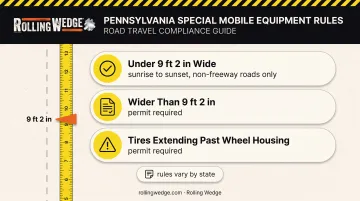
Pennsylvania is a useful example. PennDOT classifies equipment like bucket loaders under "special mobile equipment" — machinery not designed to transport people or property, only incidentally moved over a highway. Under that classification:
- Equipment up to 9 ft 2 in wide may travel between sunrise and sunset, on non-freeway roads only.
- Wider equipment needs a permit before moving.
- Tires extending past the wheel housing also trigger permit requirements.
Other states run different playbooks entirely. Some require registration or cap speed and distance; others mandate an escort for any public-road segment. Before moving equipment more than a few hundred feet on a public road, call your local permit office or police department. Don't guess based on what a neighboring state allows.
Safety Guidelines for Driving a Skidsteer on the Road
A skidsteer's road safety comes down to three things: visibility, stability, and operator discipline. The machine itself wasn't engineered with any of that in mind. It was built to pivot tight in a stockpile yard, not hold a lane at 15 mph next to a delivery van.
That means the operator has to actively compensate. Nothing about pavement travel is automatic or forgiving.
Preparing Your Skidsteer for Road Travel
Before the machine rolls onto pavement, run a real pre-trip check, not the quick glance you'd give before another lap around the site.
- Inspect tires or tracks, brakes, and lights. A machine that runs fine on dirt can behave unpredictably on hard, uneven pavement.
- Lower and lock every attachment. If you're running a milling drum (including a Rolling Wedge tool on an RW127-B mount), confirm it is fully secured and clear of the roadway so weight shift or snagging cannot throw the machine off balance.
- Verify SMV emblems, hazard lights, and reflective markings are installed and visible from a distance.
- Plan the shortest possible route and avoid peak traffic windows.
Skip any of these steps and you risk a tip or loss of control that only shows up once you are already on pavement.
Safety Precautions While Driving on the Road
Once you're moving, the rules change from what worked on-site.
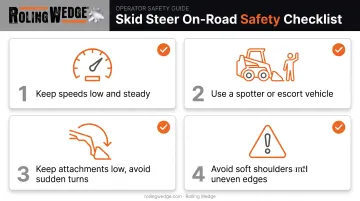
- Keep speeds low and steady. Skidsteers aren't built for the higher gear range meant for flat worksite runs, and road camber increases tip risk fast.
- Use a spotter or escort vehicle for any road crossing. Don't assume passing drivers will spot a low-profile machine in time.
- Keep attachments low and avoid sudden turns. Differential steering on hard pavement spikes tire scrub and wear versus dirt, per a John Deere representative interviewed by For Construction Pros.
- Avoid soft shoulders, drainage grates, and uneven pavement edges, which trigger sudden tipping far more easily than a worksite would.
Environmental and Traffic Considerations
Weather and road geometry both work against you in ways they don't on a job site.
- Wet pavement cuts traction fast. Just 0.002 inches of water can reduce pavement friction by 20–30%, per FHWA wet-weather research, which hits a skidsteer's grip and stopping distance hard.
- Road crown and slope shift the center of gravity more aggressively than flat worksite terrain, so plan your line accordingly.
- Coordinate with flaggers for any multi-lane crossing or active construction zone rather than timing it yourself.
Common Safety Mistakes to Avoid
Most skidsteer road incidents trace back to a handful of repeated errors:
- Skipping the pre-crossing inspection because it's "just a short trip", treating a road crossing like routine job-site driving.
- Leaving an attachment raised or unlocked while moving, which raises rollover risk and blocks forward visibility.
- Assuming a short distance means you don't need markings or a spotter. Short doesn't mean safe; it just means less time to react if something goes wrong.
- Ignoring local permit or escort requirements. An unpermitted move can leave you exposed if an incident happens. Insurers routinely check compliance before paying a claim.
None of these mistakes are hard to fix. They're just easy to skip when a crew is in a hurry.
Conclusion
Skidsteer road safety comes down to preparation and judgment. Know the legal boundaries, and inspect and secure the machine properly. Treat every road segment as a deliberate maneuver, not an extension of job-site driving.
Build road-crossing protocols into your standard safety plan now, before a rushed decision turns into a citation, a claim denial, or something worse.
Frequently Asked Questions
Will a skidsteer crack my driveway?
Machine weight combined with sharp turns, especially on tracked units, can stress residential concrete or asphalt from tire scrub during pivots. Use wider turns, go slow, or opt for wheeled units on paved surfaces where possible.
How difficult is it to operate a skidsteer?
Basic controls are quick to learn, but mastering differential steering and attachment coordination takes real practice. Get comfortable on-site before attempting road travel.
Do you need a CDL to drive a skidsteer on the road?
Generally no, for incidental road crossings under federal guidance. However, state or local permit rules may still apply, so confirm before you move.
Can you legally drive a skidsteer between job sites on public roads?
Short, incidental trips are often allowed under federal interpretation. For longer transport, use a trailer and confirm local ordinances first: rules vary widely by state.
What safety equipment is required to drive a skidsteer on a road?
SMV emblems, flashing lights, and reflective markings are the baseline. Flaggers or an escort vehicle may be required depending on the road and local rules.
Is it safer to trailer a skidsteer instead of driving it on the road?
Yes, for any distance beyond a brief crossing. Trailering removes traffic exposure, tipping risk, and the legal gray areas that come with road travel.