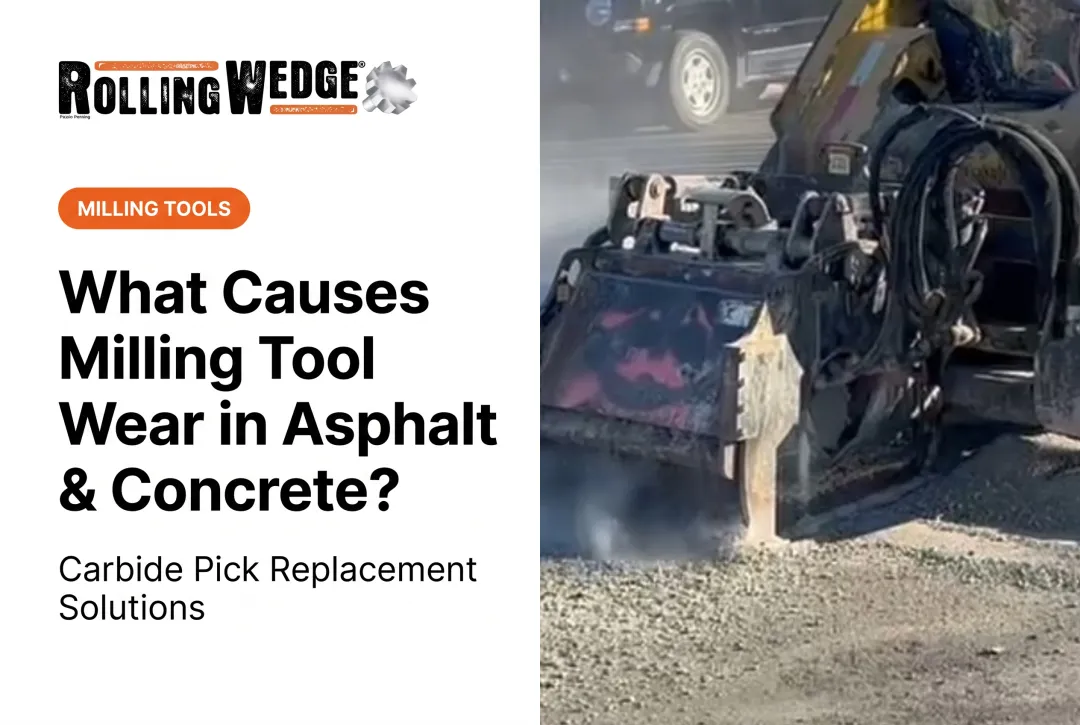
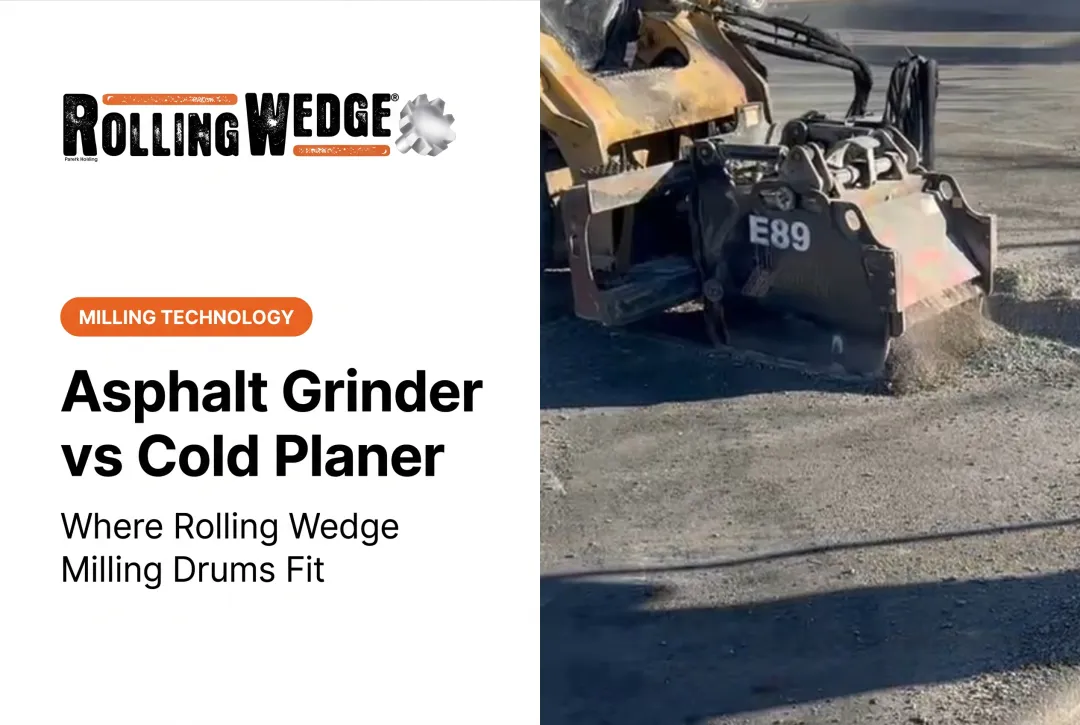
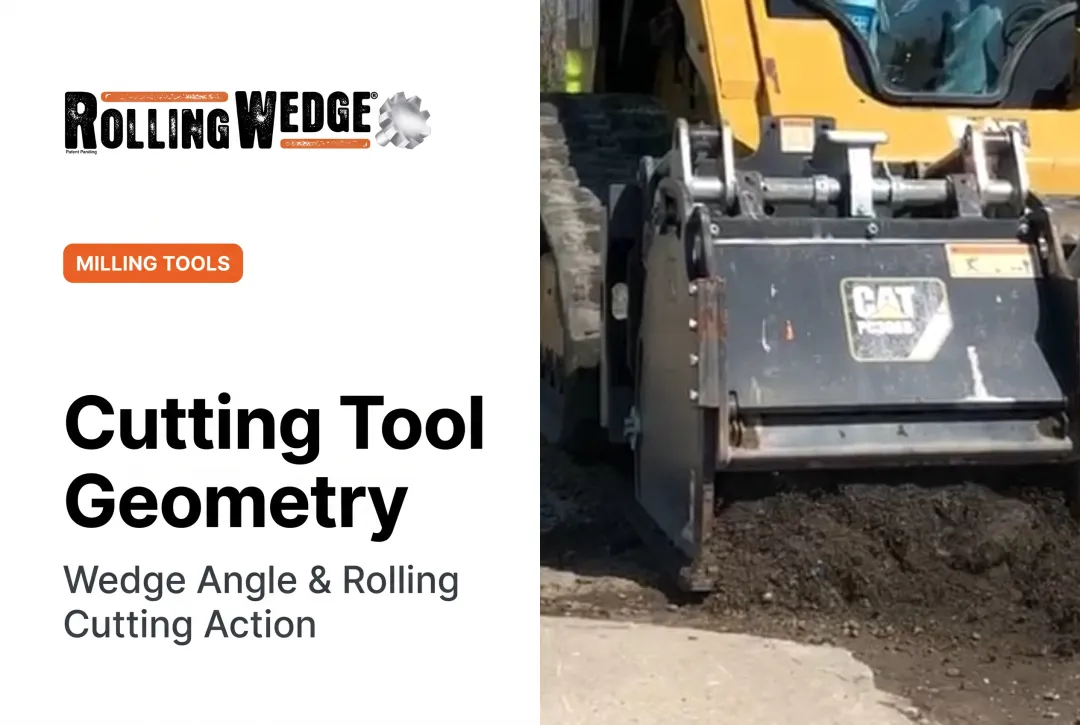
Interstate highway work is not like milling a parking lot. The surfaces are thicker, harder, and older. Rebar runs through reinforced concrete slabs at irregular depths. A single job can span miles, and every hour of unplanned downtime has real cost consequences for the crew and the agency that contracted the work.
Traditional carbide picks were not designed for this environment. They chip, they seize, they overheat on hard concrete, and they need to be swapped out twice a week under heavy use. On a long interstate rehabilitation project, that replacement cycle is not a nuisance - it is a budget and schedule problem.
The Rolling Wedge Milling Tool was built specifically to solve it.
Key Takeaways
- Rolling Wedge Milling Tools use a rolling-wedging-lifting action that works with a material's low tensile strength - not against it
- A single tool cuts asphalt, concrete, and rebar-reinforced slabs in one pass with no mid-job tool changes
- Operating lives of 10x and longer than conventional carbide picks have been reported - replacements every 1-3 months instead of twice a week
- Rolling Wedge Milling Tools never seize and never build up excessive heat, making them suited to sustained high-output interstate runs
- A 20-day Try and Buy program lets crews validate performance on their own equipment before committing
The Challenge of Cutting Concrete and Asphalt on Interstate Highways
Interstates are built to last decades under heavy load. That durability is exactly what makes milling them difficult.
Concrete highway slabs are dense and abrasive. Reinforcing steel is embedded at varying depths - sometimes near the surface, sometimes deeper, sometimes both within the same milling pass. On older interstates that have been overlaid multiple times, a single drum pass can move through asphalt, hit a concrete base, and encounter rebar, all within a few inches of depth.
Conventional cutting tools handle each of these materials differently - and often not well. Standard carbide picks are designed for asphalt. On concrete, the impact-based cutting action generates intense heat, accelerates wear, and can lock the pick in its holder. When the drum hits rebar, there is a real risk of stalling or breaking a tool outright. The result: crews stop, swap tooling, and fall behind schedule.
On an interstate job, that stop is not a five-minute inconvenience. It disrupts lane closures, burns permit windows, and can push the entire project into overtime.
How Rolling Wedge Cuts Differently
The Rolling Wedge Milling Tool does not chip or hammer. It rolls.
The tool uses a rolling-wedging-lifting cutting action that capitalizes on a fundamental property of concrete and asphalt: both materials have low tensile strength. They resist compression well but fail quickly under tension. The Rolling Wedge Milling Tool applies a rolling load that leverages that tensile weakness, lifting and fracturing material as the tool rotates forward rather than battering it repeatedly from above.
The practical difference is significant:
- No percussion. The tool does not strike the surface. It rolls through it. That reduces the bounce and vibration that carbide picks transmit through the drum and machine frame, helping protect hydraulic components.
- No smashing. Material is lifted and separated rather than pulverized. Cut quality is consistent because the cutting action stays the same whether the tool is working through asphalt or concrete.
- No seizing. Because the tool rotates freely, it does not freeze in its holder the way a static carbide pick can when exposed to heat and abrasion. A seized pick leaves a hump in the cut surface and requires a full stop to address. The Rolling Wedge Milling Tool keeps moving.
The nine carbide teeth are arranged on a rolling wheel-and-shaft assembly. The tool rolls over and away from the material, wedging and lifting it into tension rather than striking it. That rolling action is what lets the milling tool continue through rebar without jamming.
Why This Matters on Interstates: One Tool, One Pass
The operational advantage that matters most on a long interstate job is simple: Rolling Wedge Milling Tools do not require tool changes when surface conditions change.
A crew milling an interstate rehabilitation may start on an asphalt overlay, drop into a concrete base, and encounter wire mesh or rebar-reinforced sections all within a single shift. With traditional tooling, each transition is a decision point. Do you stop and swap? Do you push through and risk breaking picks? Do you accept slower production to protect the tools?
Rolling Wedge Milling Tools eliminate that decision. One tool handles:
- Asphalt - including aged, oxidized, or polymer-modified mixes
- Concrete - including dense, high-strength highway slabs
- Rebar-reinforced concrete - including sections where steel is embedded near the surface
- Mixed surfaces - asphalt overlays on concrete base, treated without stopping
There are no tool changes mid-job. The drum keeps turning and the machine keeps moving.

Rolling Wedge Milling Tool Technical Specifications
Rolling Wedge Milling Tools for Large Equipment and the skidsteer platform share the same design in different sizes - the skidsteer version measures 2.5 inches in diameter, while tools designed for large road mills measure 3.75 inches. The design and cutting principle are the same across all sizes: the same rolling-wedging-lifting action, the same nine-carbide-tooth configuration, and the same capabilities - cutting concrete, asphalt, and rebar without seizing, without excessive heat buildup, and with reported operating lives of 10x and longer than conventional carbide picks. Whether running on a skidsteer planer or a large Roadtec or Caterpillar milling machine, the Rolling Wedge cutting technology delivers the same results.
The specifications below reflect the skidsteer-platform tool:
| Specification | Value |
|---|---|
| Tool diameter | 2.5 inches |
| Carbide teeth per tool | 9 |
| Carbide per tooth | 5.1 g |
| Total carbide per tool | 45.9 g |
| Mount system | RW127-B |
| Compatible platforms | Skidsteer planers, Roadtec, Caterpillar (including CAT 246D) |
The nine-tooth design is not cosmetic. It is part of the rolling assembly that gives the tool its rebar tolerance and its resistance to seizing. The 45.9 grams of total carbide per tool represents a substantial carbide investment per unit compared to a standard pick - and that investment pays back over a replacement interval measured in months, not days.
The RW127-B mount is a direct drop-in replacement for standard pick holders on compatible drums. Installation time runs approximately 20 minutes for a full drum changeout, compared to 1-2 hours for a carbide pick drum. Eight carbide picks, four at each end of the drum, stay in place to cut square edges and corners.
The Reported 10x Lifespan Advantage
On a heavy interstate milling job, traditional carbide picks typically need replacement twice a week. That replacement schedule is not exceptional - it is the expected baseline with standard tooling under normal operating conditions.
Rolling Wedge Milling Tools are built to run 1 to 3 months under comparable conditions. The company reports operating lives of 10x and longer than conventional carbide picks on asphalt milling applications.
What that means in practice on a long project:
- Fewer stops. A job running six weeks might require two to four tool changeouts with Rolling Wedge tooling versus twelve or more with carbide picks.
- Less crew time on the ground. Each carbide pick replacement cycle takes 1-2 hours. Each Rolling Wedge Milling Tool changeout takes about 20 minutes. The math compounds fast across a multi-week project.
- Lower total tooling cost. Longer replacement intervals reduce both the number of tools consumed and the labor hours spent on replacement.
For interstate projects where the lane closure window is fixed and every hour of milling time is contracted, fewer unplanned stops directly protect the project timeline.
Never Seizes, Never Gets Hot
Sustained high-output milling is where the thermal properties of Rolling Wedge Milling Tools matter most.
Carbide picks run hot on concrete. The static cutting edge generates friction, and that friction builds heat. Hot picks wear faster, and a pick that seizes in its holder - fused in place by heat and abrasion - cannot rotate, cannot self-clear debris, and leaves an irregular hump in the cut surface. Identifying and addressing a seized pick requires stopping the machine.
The Rolling Wedge Milling Tool's rotating design means the tool continuously self-indexes. There is no fixed cutting edge building up heat at a single contact point. The tools run cool relative to carbide picks under equivalent load conditions.
On a 10-hour interstate milling shift, that thermal difference translates to:
- Consistent cut quality from the first pass to the last
- No mid-shift stops to identify and replace seized tools
- Reduced heat stress on the drum assembly and hydraulic components over a full operating day
For crews running multiple shifts on a large interstate project, the cumulative effect of fewer heat-related interruptions is measurable in production output.

Try and Buy: 20-Day Hands-On Evaluation
Rolling Wedge offers a Try & Buy (20-day evaluation) for qualifying contractors and municipalities. The program works as follows:
- 20-day evaluation period on your own equipment, on your own job sites
- Full hands-on use under real working conditions - not a controlled demo
- At the end of the 20 days: buy the tooling, or return it
The company reports that none have ever been returned.
That is a direct statement about field performance. Contractors who put Rolling Wedge Milling Tools to work on their equipment, on their surfaces, and in their operating conditions have consistently found them worth keeping.
For contractors considering a tooling upgrade before a major interstate project, the Try and Buy program removes the risk from the evaluation. There is no commitment until after you have milled with it.
To inquire about the Try and Buy program or get current pricing, contact Rolling Wedge directly at +1 (309) 322-1600.
See Rolling Wedge in Person
Rolling Wedge exhibits at the industry's premier pavement and construction trade shows. Both 2027 events are opportunities to see Rolling Wedge Milling Tools in person, speak with company representatives, and evaluate whether the technology fits your fleet.
PaveX 2027 Booth 521 - January 25-27, 2027 Savannah Convention Center, Savannah, GA
World of Asphalt 2027 Booth 1475 - March 15-17, 2027 Ernest N. Morial Convention Center, New Orleans, LA
Both events draw contractors, municipalities, and equipment operators working in road construction and rehabilitation. If you are planning attendance at either show, Rolling Wedge's booth is a practical stop for anyone evaluating milling tool technology for upcoming interstate or highway work.
Frequently Asked Questions
Can Rolling Wedge Milling Tools mill concrete on interstate highways without switching tools?
Yes. Rolling Wedge Milling Tools cut asphalt, concrete, and rebar-reinforced concrete in a single pass without requiring a tool swap. On interstates where the surface transitions between asphalt overlays and concrete base slabs, the drum continues working without stopping.
How does the rolling-wedging-lifting action differ from conventional carbide picks on hard concrete?
Carbide picks cut by impact - a static carbide edge strikes the surface repeatedly. On dense concrete, this generates heat, accelerates wear, and can cause the pick to seize in its holder. Rolling Wedge Milling Tools roll through the material, exploiting concrete's low tensile strength to lift and fracture it rather than hammering it. The result is less heat, more consistent cut quality, and no seizing.
How long do Rolling Wedge Milling Tools last compared to carbide picks on interstate work?
Rolling Wedge reports operating lives of 10x and longer than conventional carbide picks on asphalt milling applications. Under heavy use, carbide picks typically require replacement twice a week. Rolling Wedge Milling Tools are built to run 1 to 3 months under comparable operating conditions.
Do Rolling Wedge Milling Tools work on skidsteer-mounted planers as well as large milling machines?
Yes. Rolling Wedge Milling Tools and the RW127-B mount system are compatible with skidsteer-mounted planer attachments as well as large milling equipment platforms including Roadtec and Caterpillar machines. Compatibility has been confirmed on equipment including the CAT 246D. The tools used on large milling machines are larger in size than the skidsteer version, but share the same design and deliver the same cutting capabilities.
What is included in the Rolling Wedge Try and Buy program?
The Try and Buy program provides a 20-day hands-on evaluation period. Qualifying contractors use Rolling Wedge Milling Tools on their own equipment and job sites under real working conditions. At the end of the evaluation, they purchase the tooling or return it. Rolling Wedge reports none have ever been returned.
Why does rebar cause problems for carbide picks but not Rolling Wedge Milling Tools?
Standard carbide picks concentrate their cutting load on a single point. When that point contacts rebar, the full load of the drum is applied to a narrow contact area, which can stall the drum or break the tool. Rolling Wedge Milling Tools carry nine carbide teeth on a rotating assembly that rolls, wedges, and lifts material instead of striking it. That rolling action lets the tool continue through reinforcing steel without jamming or stalling.