Introduction
If you're renting a skidsteer for a trenching job or a fence post project, one question comes up fast: how deep can this thing actually dig?
Here's the catch. A skidsteer isn't a digging machine by itself. It's a power source. The depth you get depends entirely on what's bolted to the quick-attach plate — bucket, backhoe, trencher, or auger.
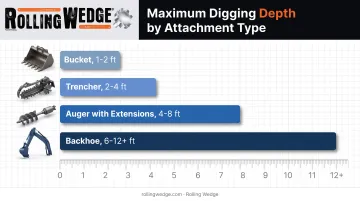
Contractors who rent a machine expecting a standard bucket's 1–2 ft of depth to match a backhoe attachment's 6–12 ft often end up short on the job site. This article breaks down real depth numbers by attachment type, the site conditions that change those numbers, and situations where digging isn't even the right call.
Key Takeaways
- Digging depth ranges from a few inches with a bucket to 10+ feet with a backhoe attachment
- Trenchers typically reach 2-4 feet; augers reach 4-8 feet with extensions
- Soil type, hydraulic flow/pressure, and operator skill can push depth above or below these ranges
- Surface removal jobs like cracked driveways need milling, not digging
What Determines How Deep a Skidsteer Can Actually Dig
Depth isn't a spec you'll find on a skidsteer's chassis. It's a derived number that comes from the attachment. Bobcat's own backhoe lineup publishes four different maximum depths (76.2, 95.1, 116.6, and 135.7 inches) across its model range, depending on boom and dipper length.
Swap the attachment, and the "digging depth" of the exact same machine changes completely.
Hydraulic flow and pressure decide how hard the attachment can work. Your skidsteer's auxiliary hydraulics supply two things:
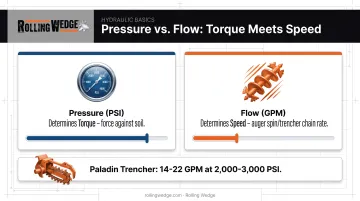
- Pressure (PSI): Determines torque, or how much force the attachment can apply against soil
- Flow (GPM): Determines speed, or how fast an auger spins or a trencher chain moves
Higher-flow, higher-pressure machines generally support more aggressive digging, but matching both numbers to the attachment matters more than chasing raw flow. Paladin's Model 625 trencher, for example, calls for 14-22 GPM at 2,000-3,000 PSI. Undershoot either number and you'll stall in tough ground long before you hit rated depth.
Factors That Change Real-World Digging Depth
Catalog numbers assume ideal conditions. Job sites rarely offer those. Four variables move the needle:
- Soil type and compaction: Sandy or loamy soil lets attachments reach full rated depth. Clay, rock, or caliche can stop a trencher or auger short of the spec.
- Attachment geometry: Boom length and cutting angle set a hard mechanical ceiling. A trencher at its recommended ~65° angle cannot dig deeper than its boom allows.
- Machine stability and counterweight: An undersized skidsteer can lose traction or tip before an attachment reaches rated depth, especially with backhoes or large-diameter augers.
- Operator skill: Technique determines how close you get to the theoretical max without stalling, drifting off-line, or binding the tool.
How Deep Can Each Skidsteer Attachment Dig?
Depth capability swings wildly depending on the tool, which is exactly why matching the attachment to the job matters more than knowing the skidsteer's horsepower.
Backhoe Attachments
Backhoes are the deepest-reaching common skidsteer attachment by a wide margin. Current Bobcat models list maximum dig depths spanning 76 to 136 inches (roughly 6.3 to over 11 feet), depending on boom and dipper configuration.
Best suited for:
- Utility trenches
- Foundation excavation
- Deep, irregularly shaped holes that a straight trencher or auger can't handle
Trencher Attachments
Trenchers work in a much narrower band. Paladin rates its trencher booms at 30, 36, 42, and 48 inches of depth, achieved at a recommended digging angle of roughly 65°. That angle isn't optional: it's the geometry that makes the rated depth possible in the first place.
Best suited for:
- Irrigation lines
- Drainage runs
- Conduit and cable trenching
Trenchers excel at narrow, linear cuts rather than wide or deep excavation.
Auger Attachments
Standard auger bits run around 48 inches physically, with 72-inch bits also available from manufacturers like Danuser. Bolt-on extensions (commonly 12, 24, 36, or even 72 inches) push effective hole depth further, often into the 6-8 foot range in favorable soil. Extensions also add torque demand and can cause the bit to drift off-line.
Best suited for:
- Fence posts
- Footings
- Sign bases
- Tree planting holes
A large-diameter auger extended to 6 feet can approach or exceed a compact skidsteer's tip-up capacity. Check your machine's rated operating capacity before stacking extensions.
Standard Buckets and Grading Attachments
Buckets are built for scraping, grading, and flattening, not depth. They're the wrong tool whenever "how deep" is the actual project requirement. Once you're past shallow surface work, efficiency drops off fast and you're better served by a purpose-built digging attachment.
Common Mistakes and Safety Considerations When Digging Deep
Rated depth is a best-case number, not a guarantee. A few mistakes come up again and again on job sites:
- Treating max rated depth as achievable everywhere. Clay, shale, and rocky soil will stop an attachment well short of its catalog spec.
- Skipping utility locates. The Common Ground Alliance found that 26.9 million Americans planned to dig without contacting 811 first. That habit risks hitting gas, electric, or fiber lines. Call before you dig, regardless of how shallow the job looks.
- Pushing past rated depth or angle. Forcing a trencher steeper than recommended, or an auger beyond its torque range, wears chains and hydraulics faster and raises stall or tip-over risk.
- Turning mid-trench. Side-loading a trencher boom while turning can bend the assembly and stall the chain. Stick to straight cuts only.
None of these are exotic risks. They're the routine mistakes that turn a half-day trenching job into an equipment repair bill.
When Milling Beats Digging: Surface Removal Alternatives
Not every job that looks like a digging problem actually is one. Removing a cracked or failing asphalt or concrete driveway is a common example. Contractors often reach for a bucket or backhoe to tear it out when the real task is surface removal, not excavation.
The problem with digging into pavement: Bucket edges and backhoe teeth are built to break and lift soil, not cut a controlled plane through asphalt or concrete. Used directly on a paved surface, they tend to crack or over-dig into material you didn't intend to touch, disturbing the subgrade underneath.
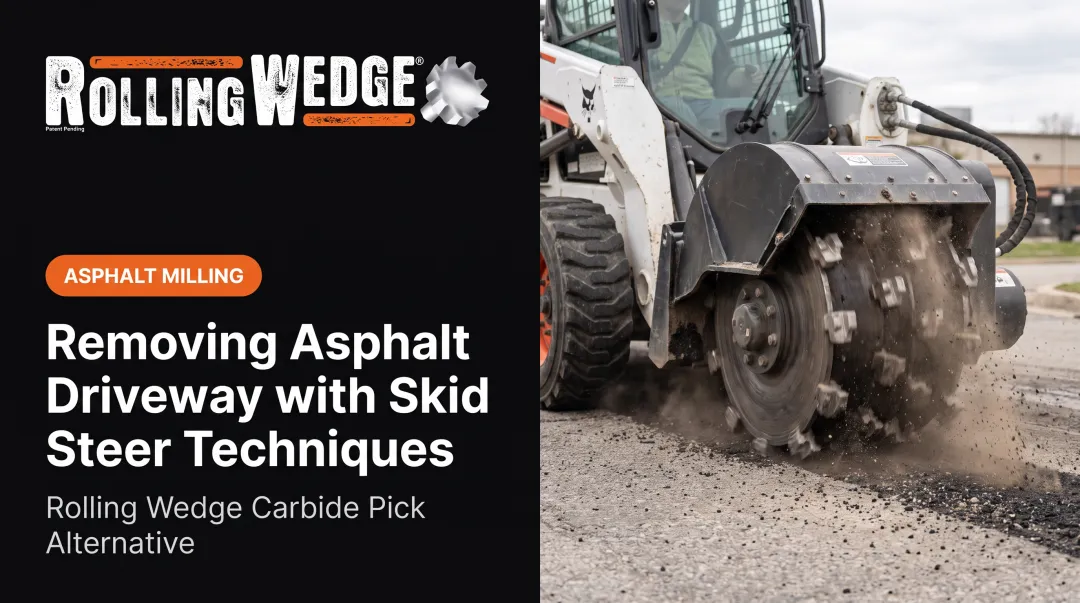
Surface milling solves that problem more cleanly than digging. Rolling Wedge supplies the Rolling Wedge Milling System for Skidsteer, a Milling Drum with 2.5-inch Rolling Wedge Milling Tools that mounts in an existing skidsteer planer, built for this kind of work. Instead of digging in, it uses a rolling-wedging-lifting cutting action: the tool rotates and rolls through the material rather than hammering into it, placing the surface in tension so it separates cleanly.
Practical advantages for driveway or lot removal:
- Mills asphalt, concrete, and mixed surfaces in a single pass without swapping tools
- Reduces vibration and bounce compared to impact-style cutting, which can ease strain on the skidsteer's hydraulics and the operator
- Suits compact skidsteer milling setups on jobsites where a full-size milling machine can't maneuver
- Tools typically need replacing every 1-3 months, versus roughly twice a week for carbide picks on comparable work
If you're unsure whether milling or digging is the right call for a specific surface removal job, Rolling Wedge also offers a Try & Buy (20-day evaluation) to test the tool before committing to a purchase.

Conclusion
How deep a skidsteer digs depends on the attachment, not the machine itself:
- Bucket: a few inches
- Trencher: 2–4 feet
- Extended auger: up to 8 feet
- Backhoe: past 10 feet
Match the attachment to the job, respect soil and safety limits, and know when surface removal calls for milling instead of digging. Get that call right and you keep the day efficient — and the budget intact.
Frequently Asked Questions
How deep can a skidsteer dig?
It depends entirely on the attachment. Buckets handle roughly 1–2 feet of shallow work, trenchers reach 2-4 feet, augers reach 4-8 feet with extensions, and backhoes can dig 6-12 feet.
Can a skidsteer lift 5,000 lbs?
Check the model's rated operating capacity (ROC). Many mid-to-large frame skidsteers exceed 5,000 lbs, while compact models fall well below it, so always verify the specific machine's spec sheet.
Will a skidsteer crack my driveway?
Using a digging attachment like a bucket or backhoe teeth directly on asphalt or concrete risks cracking or spalling the surface. A milling attachment is designed to remove surface material cleanly without that risk.
How deep can a skidsteer trencher dig?
Typically 2 to 4 feet, achieved at a recommended digging angle of roughly 65°. Boom length is the hard limiting factor regardless of soil conditions.
How deep can a skidsteer auger dig?
Standard bits reach about 4 feet. With bolt-on extensions, depth can extend to 6-8 feet or more, depending on soil and available hydraulic torque.
What's the difference between a backhoe and a bucket for digging with a skidsteer?
A backhoe is purpose-built for deep, targeted digging up to 6-12 feet. A bucket is meant for shallow surface digging, grading, and material handling, not depth.