That spread isn't a pricing error. It reflects depth, project scale, scope inclusions, and how efficiently a crew's equipment and tooling perform on any given day.
This article breaks down 2026 pricing ranges, the real cost drivers behind them, a full project cost breakdown, and how contractors can budget more accurately, including where better milling tooling can quietly reduce the total bill.
TL;DR
- Typical 2026 range: $1.20–$2.20/SY on large production runs; $14–$30+/SY on small or incidental jobs
- Price drivers up: small jobs, structures, tight access, and traffic control
- Price drivers down: large, continuous runs with simple layout
- Who pays less: DOT/highway contractors running 50,000+ SY jobs
- Who pays more: small commercial lots, utility trenches, and on-call incidental work
- Tooling impact: Rolling Wedge Milling Tools have reported operating lives of 10x and longer than conventional carbide picks - cutting changeouts, downtime, and replacement cost over the job
How Much Does Asphalt Milling Cost? (2026 Pricing Overview)
Milling is priced by square yard (SY) or lane mile. A single "average" rate is close to meaningless without knowing depth, quantity, and what's included.
Contractors regularly underbudget by:
- Assuming a quoted rate includes hauling and disposal when it doesn't
- Skipping traffic control costs because they weren't itemized separately
- Ignoring structure adjustments (manholes, valve boxes) until they show up on-site
Typical Cost Range
- Basic milling (1–2 in): $2.50–$5.00/SY
- Medium-depth milling (2–4 in): $5.00–$8.00/SY
- Deep milling (4+ in): $8.00–$12.00/SY
Real bid tabs push past these general bands at both extremes. Arkansas DOT records show milling as low as $1.20/SY on a 95,183-SY job, while small-area jobs under 600 SY ran $14.91–$20.50/SY in the same January 2025 bid data.
North Carolina's 2026 bid tabs went further still: incidental milling on 150 SY drew a low bid of $30.00/SY and a high of $115.00/SY for the same line item.
These ranges cover milling only. Overlay, striping, and hauling are separate unless your contract explicitly bundles them. Where a job lands inside—or outside—the bands usually comes down to scale and access.
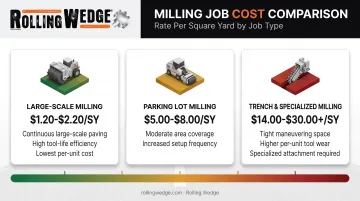
Large Production Roadway Milling
- Includes: bulk area milling, standard traffic control
- Best for: DOT/highway projects over 5,000 SY
- Typical rate: $1.20–$2.20/SY on continuous runs
Commercial Lots and Parking Areas
- Includes: depth-based milling, sweeping, partial mobilization
- Best for: municipalities, retail and commercial property owners
- Typical rate: $5.00–$8.00/SY depending on depth and access
Trench, Small-Area, or Utility-Cut Milling
- Includes: milling only, little to no economy of scale
- Best for: small utility repairs, narrow-access jobs
- Typical rate: $14.00–$30.00+/SY
Key Factors That Affect Asphalt Milling Cost
Pricing depends on job specs, site conditions, and what's actually included in the scope, not just square footage.
Depth and Depth Variability
Uniform-depth milling is straightforward: set the drum, run the pass, done. Profile milling that varies depth to fix ruts or restore drainage slope requires more operator attention and slower passes, which raises cost per SY.
Project Size and Mobilization
Small jobs under 5,000 SY absorb the same fixed mobilization cost as large ones, just spread over far fewer yards. A large-machine mill can approach 15,000 SY per day at 75 feet per minute, depending on cut depth, according to pavement industry production benchmarks. That production rate only pays off when there's enough continuous area to run it.
Scope Inclusions: Haul, Sweep, Structures
Bids diverge once haul distance, post-mill sweeping, and work around structures (manholes, valves, curb lines) enter the scope—each can add a separate line item. Reclaimed asphalt pavement (RAP) hauling and ownership terms also vary by state and contract. Federal data shows contractor ownership is the majority practice, though 20 states allow both the agency and contractor to retain RAP depending on the deal. Get RAP terms in writing before comparing bids.
Site Conditions: Traffic Control, Access, Trench Work
Trench milling and tight-access sites can run 3x to 10x the price of open production runs. Arkansas bid tabs back this up directly: mobilization and maintenance-of-traffic line items on the same lettings ranged from $35,267 up to $200,000, entirely separate from the milling rate itself.

Equipment and Tooling Efficiency
Drum tooling shapes productivity and downtime more than most estimators account for. Traditional carbide picks wear fast under impact-based cutting and often need replacement twice a week, which stacks labor and idle-machine cost into the job.
Newer rolling-wedge tooling such as Rolling Wedge Asphalt Milling uses a rolling-wedging-lifting action that works with the material's low tensile strength instead of pure impact. Documented results show:
- Tool replacement every 1–3 months instead of twice weekly
- Full 24-inch drum changeout in 20 minutes, versus 1–2 hours for carbide picks
- Reported tool lives of 10x and longer versus carbide picks in the same asphalt environment
Fewer tool swaps mean more milling hours per shift—so effective cost per SY drops even when the quoted per-yard rate looks unchanged.
Cost Breakdown of an Asphalt Milling Project
Total project cost extends well beyond the quoted per-SY milling rate.
| Cost Component | One-Time/Recurring | Description |
|---|---|---|
| Milling (per SY/lane mile) | One-time | Base cost driven by depth and area |
| Mobilization and traffic control | One-time (per project) | Setup, signage, flagging, lane closures |
| Hauling, disposal, RAP handling | One-time | Depends on contractor vs. owner RAP ownership |
| Structures and edge transitions | Variable (per structure/foot) | Manholes, valve boxes, curb tie-ins, temporary wedges |
| Tooling wear and equipment maintenance | Recurring | Carbide pick swaps add labor hours; durable tooling reduces this |
Structure adjustments carry real, itemized costs. Texas DOT's statewide average low bid for a sanitary sewer manhole adjustment sits at roughly $1,490 per unit, an expense that's easy to overlook when comparing bids on square yardage alone.
Tooling wear belongs on the bid sheet as a recurring labor cost. A crew swapping carbide picks twice weekly burns production hours on changeouts alone. A 20-minute drum changeout every 1–3 months keeps that time on the cut instead of on the shoulder.
Low-Cost vs. High-Cost Milling Jobs — What's the Difference?
Large production-scale jobs and small, complex jobs sit on opposite ends of the cost spectrum for structural reasons, not arbitrary pricing.
| Factor | Lower-cost jobs | Higher-cost jobs |
|---|---|---|
| Scale & mobilization | Large, open, production-style runs over 5,000 square yards (SY) | Small, isolated, or trench jobs under that threshold |
| Scope & access | Simple geometry, minimal structures, easy equipment access | Tight access, numerous structures, staged traffic control |
| Tooling longevity | Durable tooling with fewer replacements and less downtime | Frequent carbide pick swaps that cut into labor hours and uptime |
Tooling price tiers reinforce the same split. Rolling Wedge Milling Tools is offered with pricing available on request, with quantity-tiered volume discounts. For a contractor running multiple crews, that volume pricing stacks on the downtime savings from longer tool life.
How to Estimate and Budget for Your Milling Project
Budget from measured quantities and a written scope first—unit price alone will not protect your estimate.
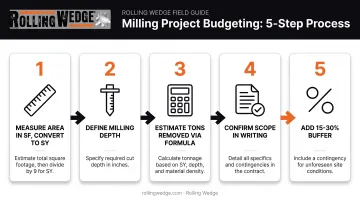
- Measure area in square feet, then convert to square yards (SF ÷ 9)
- Define exact average milling depth in inches before requesting quotes
- Estimate tons of material removed using: Tons = 0.0544 × SY × depth in inches
- Confirm in writing who handles haul/disposal, sweeping, structures, and traffic control
- Add a 15–30% buffer on commercial jobs for mobilization, structures, and site-specific add-ons
The tonnage formula assumes compacted asphalt density of about 145 lb per cubic foot, a standard figure used by state DOTs. It is a planning assumption, not a substitute for scale tickets on the job.
What Most People Miss About Asphalt Milling Cost
Even experienced buyers make the same handful of mistakes when comparing bids:
- Comparing $/SY without matching scope. Two bids at $6/SY can mean very different work once you check depth definition, haul ownership, and structure inclusions.
- Ignoring tooling choice on total cost. A lower quoted rate doesn't matter much if the crew loses hours every week to tool changeouts.
- Underestimating mobilization on small or trench jobs. Fixed costs don't shrink just because the job is small.
- Treating milling as a base fix. If the pavement structure below is compromised, milling and overlay alone won't prevent repeat costs.
Conclusion
Asphalt milling cost in 2026 spans a wide range, from roughly $1.20/SY on large production jobs to $20–$30+/SY on small or complex ones. Accurate quantity measurement and clear, written scope documentation are what prevent budget surprises.
Durable milling tooling, such as Rolling Wedge's rolling-wedging-lifting cutters, helps contractors control long-term operating costs—not just the number on the initial bid. Rolling Wedge's Milling Cost Comparison Tool (rollingwedge.com/calculator) lets you check those savings against your current carbide-pick spend.
Frequently Asked Questions
How heavy is 1 yard of asphalt milling?
One square yard milled 2 inches deep weighs roughly 218 pounds at a compacted density of 145 lb/ft³. For job tonnage, use Tons = 0.0544 × SY × depth in inches.
How long does it take asphalt millings to harden?
Milled surfaces don't chemically cure, but agencies limit exposure time before overlay, often between 48 hours and 10 days depending on the spec. Avoid opening milled areas to heavy traffic during that window.
Why can milling cost $2 per square yard on one job and $20 on another?
Quantity, mobilization, structures, and site access drive this spread. DOT bid tabs show large runs at $1.20–$2.20/SY versus small-area jobs at $14.91–$20.50/SY in the same lettings.
Is hauling and disposal usually included in a milling quote?
It varies by contractor and by state specification. RAP ownership terms differ widely, so always confirm haul and disposal responsibility in writing before comparing bids.
What comes after milling on a paving project?
Milling is typically followed by an asphalt overlay to restore the surface. For parking lots, restriping usually follows once the new surface is in place.
Does the type of milling tool affect overall project cost?
Yes. Tool wear and replacement frequency directly affect labor hours and machine downtime. Tools that last 1–3 months instead of needing twice-weekly replacement reduce recurring costs across a contract.