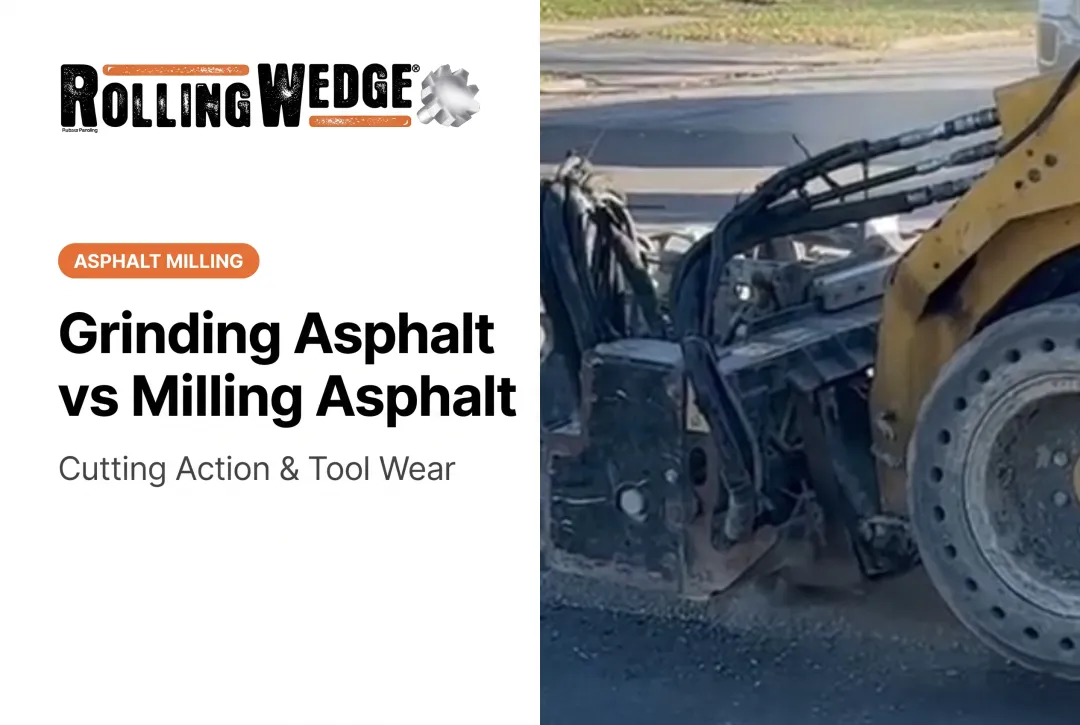
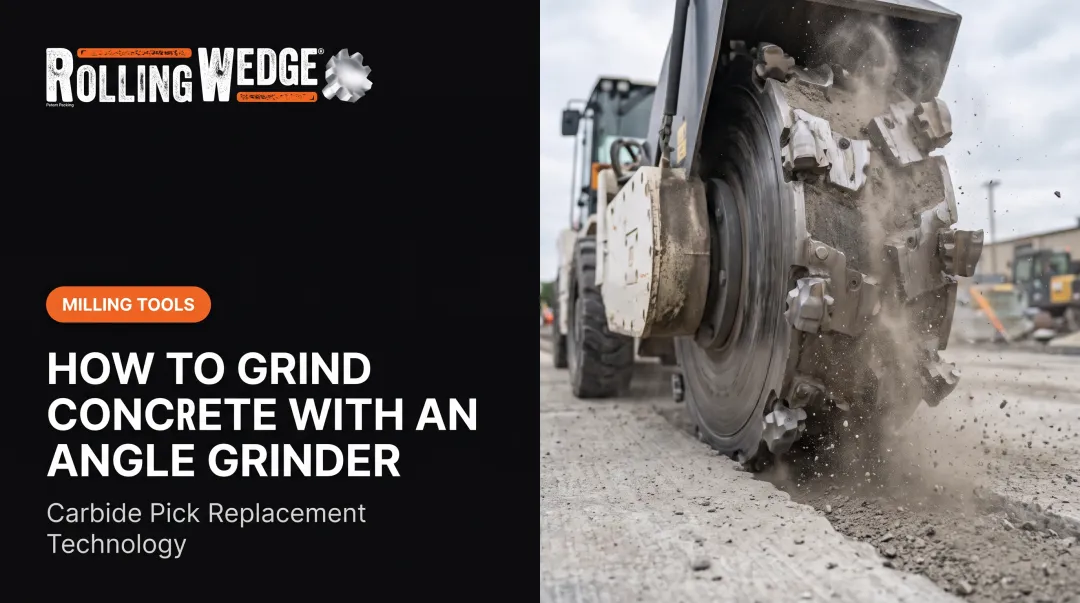
Carbide picks and rolling-wedge tools apply force to asphalt and concrete in fundamentally different ways. Picks strike the surface through repeated point impacts. Rolling-wedge tools roll, wedge, and lift material away instead.
That mechanical difference changes tool wear, machine stress, vibration, and how often a crew stops to swap tools. A 2022 Wirtgen cutting-tools brochure notes that a redesigned pick-holder profile can extend upper-toolholder life by more than 25%, though the company is clear that results vary by application. That's a useful reminder: wear numbers depend heavily on what's actually being cut.
This article breaks down the force mechanics behind both approaches, compares operational consequences, and outlines which conditions tend to favor each one.
Key Takeaways
- Carbide picks fracture pavement with point impacts; rolling-wedge tools roll, wedge, and lift via lower tensile strength
- Peak force, vibration, torque, and power draw measure different things—don't treat them as interchangeable
- Material hardness, cut depth, drum speed, and tool condition all shape real force outcomes
- Choose tools by project mix, tool-change tolerance, and total operating cost—not sticker price
- Back tool-life and productivity claims with testing, or label them company-reported
Impact Picks vs. Rolling-Wedge Cutting Action: Quick Comparison
Cutting Mechanism
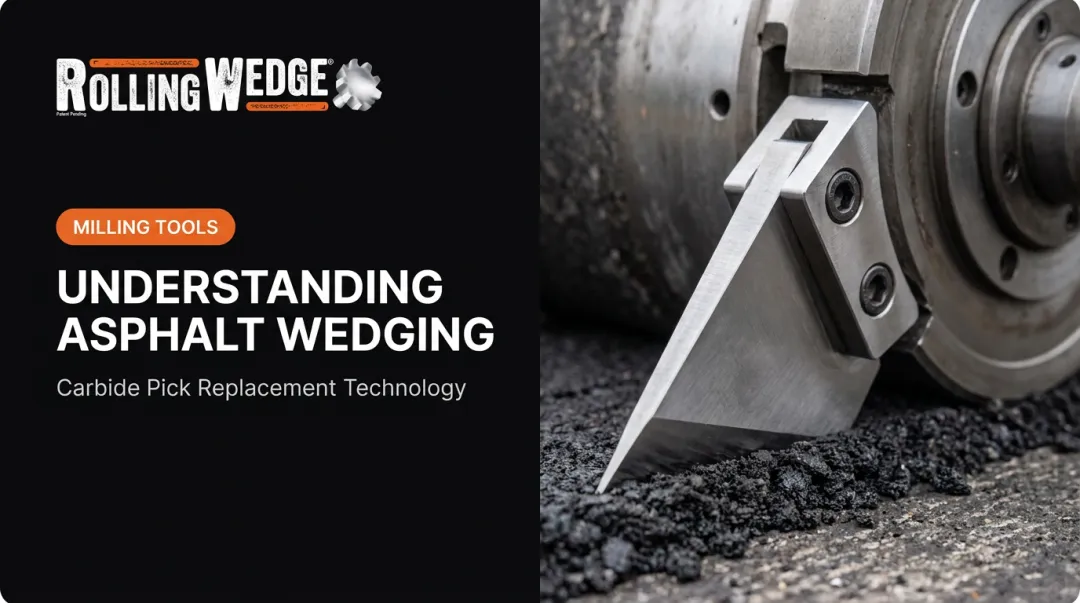
A carbide-tipped impact pick strikes the pavement as the drum rotates, fracturing material through repeated, intermittent impacts. Each tooth contacts, penetrates, breaks free a chip, then disengages before the next rotation brings it back around. Rolling-wedge tools skip the strike. The tool rolls into the material, wedges beneath it, and lifts cuttings away. Each Rolling Wedge Milling Tool uses nine carbide teeth and stays usable with one or two of them missing.
Force Profile
Impact picks generate short-duration peak loads. Those loads spike further when a tooth hits hard aggregate or embedded steel, sending shock loads through the drum and into the operator's seat. Rolling-wedge engagement spreads force across a rolling, wedging motion instead of a single strike:
- Impact picks: intermittent peak loads and shock spikes at hard inclusions
- Rolling-wedge tools: a rolling contact that puts material into tension
- Independent, matched peak-force data: not yet published — verify on your own cuts
Tool Wear and Replacement
Carbide tips wear from abrasion and heat, and can break outright against reinforcement or oversized aggregate. Worn or broken picks:
- Generate uneven contact that stresses the holder
- Run hotter under sustained friction
- Leave humps in the milled surface when one or two teeth break Rolling Wedge-reported figures versus carbide picks:
- Tool replacement: every 1 to 3 months vs. twice weekly
- Full 24-inch drum changeout: about 20 minutes vs. 1 to 2 hours These figures are reported by Rolling Wedge.

Machine and Operator Effects
Shock loading from impact picks shows up as drum bounce, hydraulic stress, and operator fatigue over a full shift. A blunted or seized tooth makes it worse—trade reporting flags dull carbide as a major driver of drum vibration. Where smoother rolling-wedge engagement holds up, crews typically see:
- Steadier forward movement with less drum bounce
- Lower strain on hydraulic components
- Less seat vibration across a full shift Rolling Wedge reports significantly reduced vibration versus traditional hammer-and-chisel milling, along with smoother, bounce-free operation.
Mixed-Material Capability
Mid-project switches between asphalt, concrete, and reinforced sections are hard on pick drums. Mesh can snag the drum; rebar-reinforced concrete often stalls it, forcing a tool swap or a route change. Rolling Wedge Milling Tools are positioned as one setup across:
- Standard asphalt
- Plain concrete
- Some grades of rebar-reinforced concrete and wire mesh Results still depend on reinforcement grade, drum configuration, and machine size—confirm coverage on your mix before assuming a single-tool pass.
What Is an Impact Pick?
An impact pick is a rotating, carbide-tipped round-shank tool mounted in a holder along a milling drum. As the drum spins, each pick moves through a repeating cycle: contact, penetration, fracture, chip removal, and disengagement before the next rotation brings it back into the material.
That cycle separates average cutting load (the steady demand the drum places on the machine over time) from the peak load generated at the instant of impact. The peak is what breaks carbide, cracks holders, and shows up as a jolt at higher advance speeds.
What Drives Cutting Force Higher
Several factors compound to raise force at the pick tip:
- Material strength – denser aggregate or higher-strength concrete resists fracture longer
- Depth of cut and forward speed – a 2025 study on asphalt-milling tooth wear found that cutting force rises with both greater milling depth and faster advance rate
- Pick spacing and drum speed – determine how often and how hard each tooth re-enters the surface
- Worn carbide or embedded metal – a dulled tip removes a smaller chip, which can understate force unless the reduced cutting depth is accounted for
The same study found a worn tooth registered lower force simply because it cut a smaller chip. Once researchers compensated for the lost depth, both friction and force increased. A quieter drum isn't automatically a healthier one.

Why CNC Formulas Don't Transfer Directly
Machining references describe cutting force as specific cutting resistance multiplied by effective chip area (Fc = kc × A). That explains why depth and chip size matter, but pavement milling isn't CNC metal cutting.
Asphalt and concrete are heterogeneous, fracture rather than shear cleanly, and vary batch to batch. Applying a shop-floor kc value to a road drum won't predict real-world force. Application-specific testing on the actual pavement remains the only reliable path.
When force stays high, the damage shows up across the machine and the crew:
- Tool breakage and holder damage
- Vibration that fatigues hydraulic lines and operators
- Drum bounce and inconsistent removal depth
- Elevated jobsite noise
Use Cases of Impact Picks
Impact picks still make sense where:
- A fleet is already configured for carbide-pick holders and inventory
- Standard asphalt rehab is the primary job type
- Replacement stock is readily available locally
- Crews have established change-out procedures
Reassess the setup when crews see:
- Frequent pick changes
- Mixed asphalt and concrete passes
- Reinforced material
- Climbing vibration and maintenance cost
Change intervals vary widely by material abrasiveness and depth. Tracking your own replacement frequency tells you more than any published average.
What Is Rolling-Wedge Cutting Action?
Rolling Wedge's cutting action skips the strike-and-fracture cycle entirely. Instead of a pick hammering into the surface, the tool uses a three-stage motion as the drum turns:
- Rolls into the material
- Wedges beneath the surface
- Lifts the material away
The RW103-B Rolling Wedge Milling Tool, seated in the RW127-B Milling Tool Mount, uses a patented wheel-and-shaft design built around that motion.
The Force Path
Force still travels from tool to material, drum, attachment, and host machine. That part doesn't change. What's different is the shape of the force curve: instead of a sharp peak at impact, engagement spreads over a rolling motion. Measurably lower shock loading vs. a matched pick drum still needs instrumented testing on the pavement you run.

Why Lifting Targets a Weaker Failure Mode
The mechanism exploits a basic material property: asphalt and concrete resist tension far less than compression. Rolling Wedge describes tensile strength as roughly 20% of compressive strength for the materials it's designed to cut. Independent concrete-industry data points the same direction: flexural strength, an indirect tension measure, typically runs well below compressive strength.
Ratios still shift with mix design and loading rate, so treat wedge-and-lift as a credible mechanism—not a fixed productivity multiplier.
Compare these metrics on your own equipment before switching:
- Shock loading and vibration at the operator's seat
- Forward-motion consistency and drum bounce
- Tool replacement frequency against your current baseline
- Hydraulic system stress over a comparable duty cycle
Use Cases of Rolling-Wedge Cutting Action
That same lift-based failure mode is what makes the tools practical across mixed job sites. Rolling Wedge Milling Tools and Milling Drums install on planer attachments for rubber-tire and tracked Skidsteers in 18, 24, 30, and 40-inch drum widths, plus larger road-milling machines. Rolling Wedge supplies the Milling Drum and Milling Tools, not the attachment or machine. Compatibility is documented for Skidsteers such as the CAT 246D and for larger Roadtec and Caterpillar platforms. Brand names indicate compatibility only; Rolling Wedge is not affiliated with these equipment manufacturers.
For contractors and municipalities running asphalt-to-concrete transitions, curb-adjacent patch repair, or utility cuts through both surfaces, a single tool that skips the mid-job swap simplifies logistics.
Each Milling Tool carries nine carbide teeth. Each Rolling Wedge Milling Drum also uses eight carbide picks, four at each drum end, alongside the Milling Tools to deliver a clean, square edge cut.
Evaluate the Rolling Wedge Milling Drum system against your own force, tool-life, and downtime numbers, and confirm compatibility for your drum configuration and machine size before ordering.
Impact Picks vs. Rolling-Wedge Action: What Is Better?
Neither tool wins on every metric. A fair comparison weighs:
- Peak force and vibration
- Average power and torque demand
- Tool wear and replacement labor
- Mixed-material capability
- Surface consistency
- Total cost per milled area
Price per tool alone tells you almost nothing. Quantity-tiered pricing for the 2.5-inch RW103-B Rolling Wedge Milling Tool has run from $48.75 per unit down to $34.58 at 500-plus units (subject to change; contact Rolling Wedge for current pricing).
That premium only pencils out if the labor, downtime, and replacement-frequency differences hold up on your actual jobs.
How to Assess Cutting Force in the Field
Run a fair comparison by recording, under matched conditions:

- Machine power or hydraulic pressure during the cut
- Forward speed and drum speed
- Depth of cut and material type
- Tool condition at the start and end of the run
- Production output, meaning area or volume milled per hour
Match depth and advance rate before comparing anything else. Force climbs with both, so a quieter tool cutting shallower isn't actually more efficient.
Situational Recommendations
Choose impact picks when:
- Existing equipment and holders are already set up for carbide
- Parts availability and familiar procedures matter more than switching mechanisms
- The material stream is predictable, standard asphalt rehab
Consider rolling-wedge tooling when:
- Shock loading, vibration, and frequent tool changes are recurring problems
- Projects regularly cross between asphalt and concrete
- Downtime from swaps is cutting into billable hours
- Application testing on your own pavement supports the expected gains
Real-World Example
A Minnesota-based asphalt contractor, profiled by AsphaltPro, switched a milling drum to Rolling Wedge tooling.
The contractor reported moving from replacing carbide picks once or twice weekly to swapping Rolling Wedge Milling Tools every one to three months. Change time dropped from roughly one to two hours down to about 20 minutes.
That's a contractor-reported outcome tied largely to commercial parking-lot paving work rather than a controlled municipal-road trial. It's a useful real-world data point, not a guaranteed benchmark for every fleet.
Takeaway: the switch made sense because tool changes were eating into billable hours multiple times a week. If your crew faces the same pattern, it's worth testing. If your picks already last months, the case for switching is weaker.
Want to see where your numbers land? Rolling Wedge's Milling Cost Comparison Tool estimates savings based on your own tool-change frequency and downtime, or call +1 (309) 322-1600 for an application-specific evaluation.
Conclusion
Neither tool wins on every job. Impact picks and rolling-wedge tools create different force profiles. The right choice depends on your material mix, your machine, your operating method, and your cost target, not which tool has the flashier spec sheet.
A price comparison misses the point. What actually matters:
- Peak shock and vibration at the operator's seat
- Average power draw over a full shift
- Tool consumption and replacement labor
- Downtime from swaps and jams
- Surface consistency and maintenance cost
Impact picks remain a reasonable choice for fleets already built around them, running predictable asphalt work with reliable parts supply. Rolling-wedge tooling is worth testing where shock loading, frequent tool changes, or mixed-material passes are driving up cost and downtime.
Before scaling any decision across a fleet, validate the tool on your own equipment and your own pavement. Run matched passes, log the numbers above, and let your jobsite data make the call. To set up that comparison, contact Rolling Wedge for a Milling Tools quote or ask about the 20-day Rolling Wedge Milling Drum evaluation for qualifying customers.
Frequently Asked Questions
What is the formula for cutting force in milling?
The basic relationship is Fc = kc × A (specific cutting resistance × effective chip area). Road milling adds fracture and intermittent impact, so pavement force is better measured in application-specific testing than predicted from one formula alone.
What is the formula for calculating cutting speed (SFM) in milling?
SFM = 0.262 × D × RPM (π × diameter in inches × RPM ÷ 12). For milling drums, use the drum’s actual diameter and the manufacturer’s guidance—not a generic shop-floor speeds-and-feeds chart.
How is clamping force calculated?
Clamping force is set by applied hydraulic pressure or torque, contact area, and the friction needed to resist movement. Always verify road-milling tool holders and drum attachments against the manufacturer’s retention and torque specs.
How does cutting force affect milling machine performance?
Higher cutting force raises hydraulic or motor demand, increases vibration and drum stress, and accelerates tool wear. Left unmanaged, it also limits production rate and consistency in removal depth.
What is the difference between impact cutting and rolling-wedge cutting?
Impact picks fracture pavement through repeated point strikes as the drum rotates. Rolling-wedge tools roll into the material, wedge beneath it, and lift it away. Comparative force or durability claims still need controlled, matched-condition testing.
Which milling tool is better for asphalt and concrete?
It depends on your material mix, reinforcement, machine compatibility, tool-change tolerance, and total cost. Rolling Wedge is a strong option to evaluate for mixed-surface or reinforced-concrete work, but the better tool still depends on the job—not a single universal pick.