"Recycled asphalt" sounds like an easy win on paper. But its real value shows up only after it's compacted, driven on, and exposed to a full season of weather. This article breaks down why asphalt millings work for parking lots in practice: the costs, the durability tradeoffs, and what actually determines whether a milled surface holds up or falls apart within a year.
Key Takeaways
- Lower project costs versus full-depth replacement—savings still vary by region and scope.
- Reuse old pavement to cut landfill waste and demand for virgin aggregate and binder.
- Shorter install than full reconstruction means less parking lot downtime.
- Surface quality hinges on how millings are produced and installed—not the material alone.
What Are Asphalt Millings? (Brief Context)
What Are Asphalt Millings?
Asphalt millings, often called RAP (reclaimed asphalt pavement), are crushed pieces of old asphalt removed during resurfacing or reconstruction projects. Instead of hauling that material to a landfill, contractors screen and reuse it.
Millings show up most often in:
- Driveways and residential access roads
- Commercial parking lots
- Base and subbase layers under new pavement
- Low-traffic access roads and overflow lots
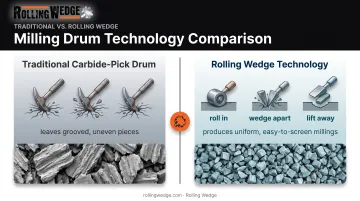
Millings quality depends on the equipment that removed the original pavement—and that quality shows up in how well the material screens, compacts, and holds up in a parking lot. Traditional carbide-pick milling drums rely on repeated impact, which can leave grooved surfaces or uneven pieces when picks wear or break.
Rolling Wedge Asphalt Milling tools use a rolling-wedging-lifting action instead. They roll into the pavement, wedge material apart at a controlled contact angle, and lift cuttings away, putting asphalt into tension (where its strength is only about 20% of its compressive strength) rather than hammering through it. That produces more uniform millings that are easier to haul, screen, and reuse.
Key Advantages of Using Asphalt Millings for Your Parking Lot
The advantages below focus on outcomes property owners and facility managers actually weigh when deciding between millings and full replacement: budget, lifespan, and environmental compliance. Each one maps to a concrete project decision.
Lower Project Costs Compared to Full Replacement
Millings skip the two most expensive parts of a parking lot project: full-depth removal and new hot-mix asphalt. Property owners repurpose milled material as a base layer or a compacted top surface instead of ordering fresh virgin mix.
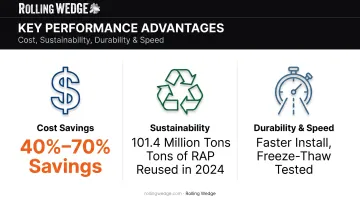
The savings can be substantial. FHWA has documented agencies reporting 40%–70% savings in Indiana and 30%–40% initial savings in New York when using in-place recycling methods instead of conventional reconstruction, according to a FHWA tech brief on asphalt pavement recycling technologies.
Actual figures vary by region, contractor, and scope, so get local bids before budgeting. This matters most for:
- Large commercial lots where material volume drives cost
- Municipal projects with fixed annual paving budgets
- Temporary or overflow parking areas that don't justify premium asphalt
Sustainability Through Material Recycling
Every ton of RAP reused is a ton that doesn't go to a landfill and doesn't require freshly quarried aggregate or virgin binder.
In 2024, U.S. asphalt producers used an estimated 101.4 million tons of RAP in new mixtures, displacing over 96 million tons of virgin aggregate and 5.1 million tons of binder worth roughly $4.7 billion, according to NAPA's 2024 recycled materials survey.
More than 96% of that reclaimed asphalt went back into pavement mixtures, and less than 0.2% was landfilled. For businesses tracking ESG commitments or municipalities under environmental mandates, those are documented results you can cite.
Durability and Fast Installation
Compacted millings bind together over time as residual asphalt binder resets the material into a stable surface. There's no demolition phase and no waiting on a full new asphalt layer to cure, which shortens the overall project timeline.
FHWA notes that full-depth reclamation construction time is significantly reduced compared to full reconstruction, though it doesn't publish a universal day-per-acre figure.
Durability holds up under seasonal stress as well. Laboratory testing in Minnesota found no clear loss of resilient modulus after freeze-thaw cycling in tested RAP samples, though shear strength did drop for RAP/aggregate blends under low confinement—so proper compaction and mix design still matter.
Cold-climate sites and high-traffic commercial lots that can't stay closed for long gain the most from that mix of surface stability and shorter install time.
What Happens When Millings Are Poorly Sourced or Installed
Millings only deliver their promised savings when the material and the installation are both handled correctly. Cut corners on either, and the "savings" disappear fast.
Common consequences of poor sourcing or rushed installation:
- Inconsistent particle size or contamination leads to poor compaction and premature rutting
- Uneven surfaces create drainage problems, standing water, and accelerated deterioration
- Higher long-term repair costs erase the original budget savings over time
- Lost sustainability value when a weak install needs redoing years early
- Safety hazards from soft spots or loose material in vehicle and foot traffic areas
Source quality drives those outcomes. WSDOT research comparing interstate-sourced RAP to parking-lot RAP found material passing the No. 200 sieve at 8% versus 0.45%, with maximum dry density ranging from 130 to 115 lb/ft³. That spread shows how much variability affects compaction and performance.
Sourcing and installation quality decide whether the cost and durability benefits actually hold.
How to Get the Most Value from Asphalt Millings
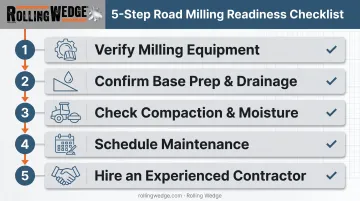
Millings only pay off on cost and long-term performance when they're sourced and installed carefully. Check these points before you commit:
- Ask what equipment produced the millings. Precision drum systems—such as Rolling Wedge's rolling-wedging-lifting design—yield more uniform material than impact-based carbide picks, which can leave grooved or uneven spoils.
- Confirm base preparation and drainage before millings go down. They perform best over a sound sub-base with enough slope to prevent pooling.
- Verify compaction depth and moisture control during installation. Crushed RAP can hold excess moisture after heavy rain, which hurts density and stability.
- Schedule ongoing maintenance, including periodic grading and sealing where appropriate, to extend usable life.
- Work with an experienced paving contractor who can weigh traffic volume, climate, and lot-specific needs before recommending millings over full replacement.
Most "recycled asphalt didn't work" stories trace back to skipping one of these steps, not to the material itself.
Conclusion
Asphalt millings offer measurable advantages for parking lots: lower project costs, faster installation, and reduced environmental impact.
Those benefits only show up on your lot if the millings were properly sourced, produced with quality milling equipment, and correctly installed with attention to compaction and drainage. Treat asphalt millings as a practical, budget-conscious option to discuss with a qualified paving contractor before your next project—not a guaranteed shortcut.
Frequently Asked Questions
How much is a truckload of asphalt millings?
Pricing varies by region, quantity, and material quality—there's no reliable national average. Get quotes from local suppliers or paving contractors for an estimate tied to your project.
Are asphalt millings as durable as new asphalt for a parking lot?
Properly compacted millings can be highly durable, but they generally aren't a permanent substitute for full-depth new asphalt in high-traffic commercial applications. They perform best in lower-traffic or budget-conscious scenarios.
Do asphalt millings need to be sealed?
Sealing isn't always required, but it can extend surface life and improve appearance, especially in high-traffic or weather-exposed lots. Ask your contractor whether your specific climate and usage justify it.
Can asphalt millings be used for a brand-new parking lot, or only repairs?
Millings are most commonly used for repairs, resurfacing, and budget-friendly new lots. Full-depth new construction with millings as the primary material should get an engineering evaluation first.
How long do asphalt millings last before needing replacement?
Lifespan varies with traffic, climate, and how the surface was built. Proper installation, drainage, and routine maintenance are what keep a milled lot performing well for years.
Is using asphalt millings actually environmentally friendly?
Yes. Reusing old pavement cuts landfill waste and reduces demand for virgin aggregate and binder. More than 96% of reclaimed asphalt is reused rather than discarded.