Introduction
Skidsteer loaders have become the Swiss Army knives of construction, landscaping, and municipal work. Swap one attachment for another, and a machine that was digging a trench an hour ago is now clearing brush, hauling pallets, or milling asphalt.
That flexibility is exactly why the market keeps growing. North America accounted for 84.7% of global skidsteer-loader revenue in 2023, according to a Grand View Research industry report published in October 2024. The right attachment mix turns one machine purchase into a dozen job capabilities, so fleet managers obsess over which tools to buy first.
This guide ranks the 10 must-have skidsteer attachments that contractors, landscapers, and municipalities should own or rent, based on versatility, durability, and real return on investment.
Key Takeaways
- One skidsteer plus the right attachments covers earthmoving, material handling, forestry, and snow removal
- North America drives roughly 85% of global skidsteer-loader revenue, so attachments sit at the center of U.S. jobsites
- Buckets, pallet forks, and augers deliver the broadest utility across industries
- Specialty tools like milling attachments and grapples support high-frequency, high-margin work
- Attachment choice should follow your most common job type, not the flashiest option on the lot
Overview of Skidsteer Attachments in the Construction & Landscaping Industry
A skidsteer attachment is any tool that mounts to the machine's front end to perform a specific task, from digging to mulching to milling. The universal quick-attach (SSQA) system uses a standardized mounting plate and two locking pins, meaning most attachments can lock onto most skidsteers within minutes.
That interchangeability is a big reason the North American market holds such a dominant 84.7% revenue share globally. Contractors don't need a fleet of specialized machines. They need one skidsteer and a smart attachment lineup.
The rankings below weigh versatility, durability, and proven ROI across construction, landscaping, agriculture, and municipal work.
Top 10 Must-Have Skidsteer Attachments
Each entry was scored on versatility across job types, build quality, how easily it attaches, and the productivity gains it delivers relative to cost.
1. Rolling Wedge Milling System (Drum and Tools)
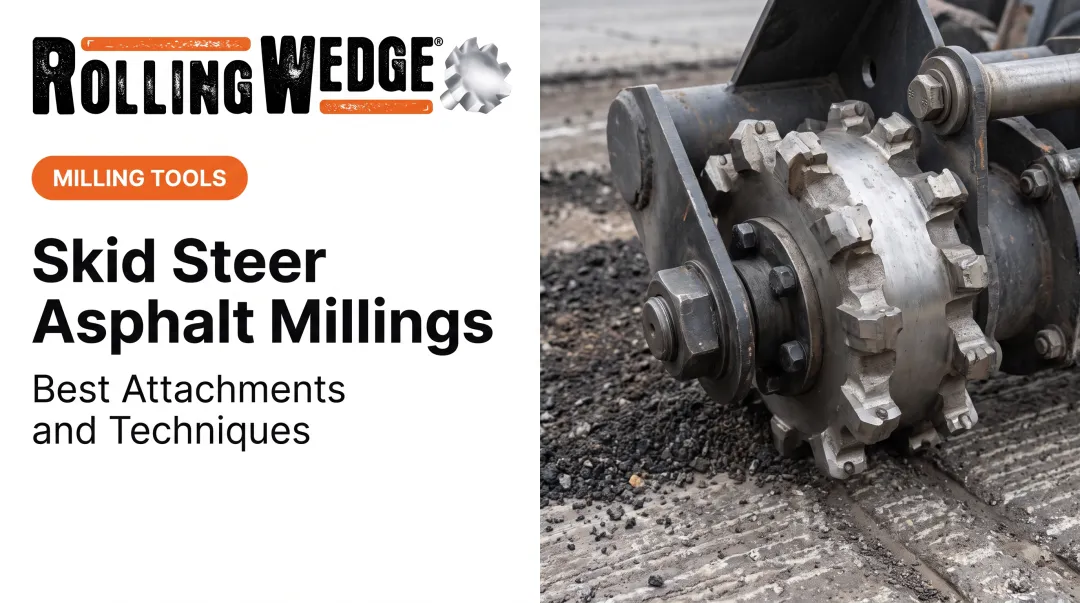
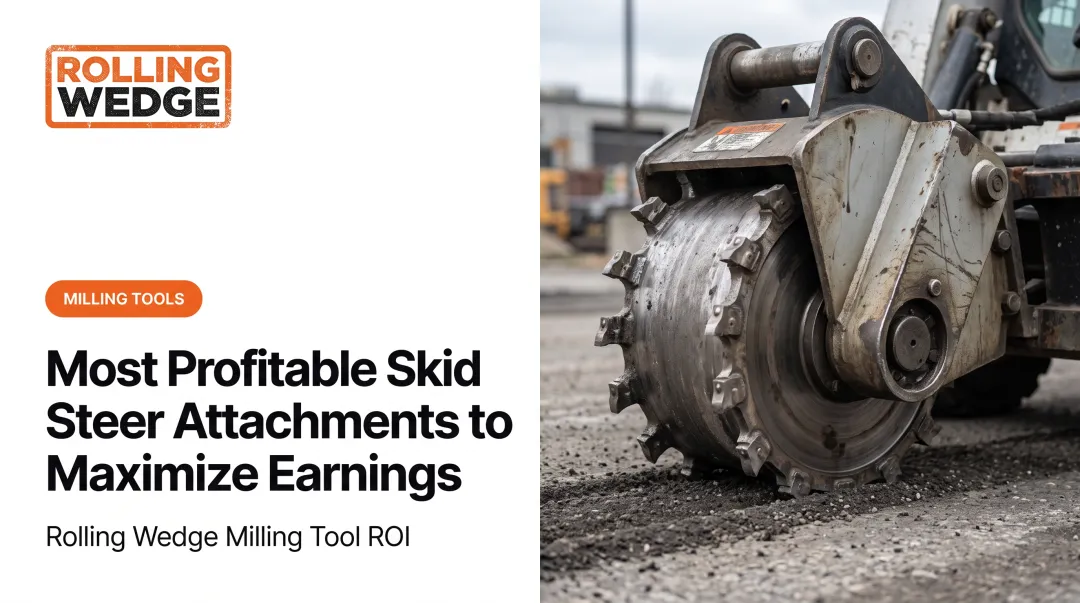
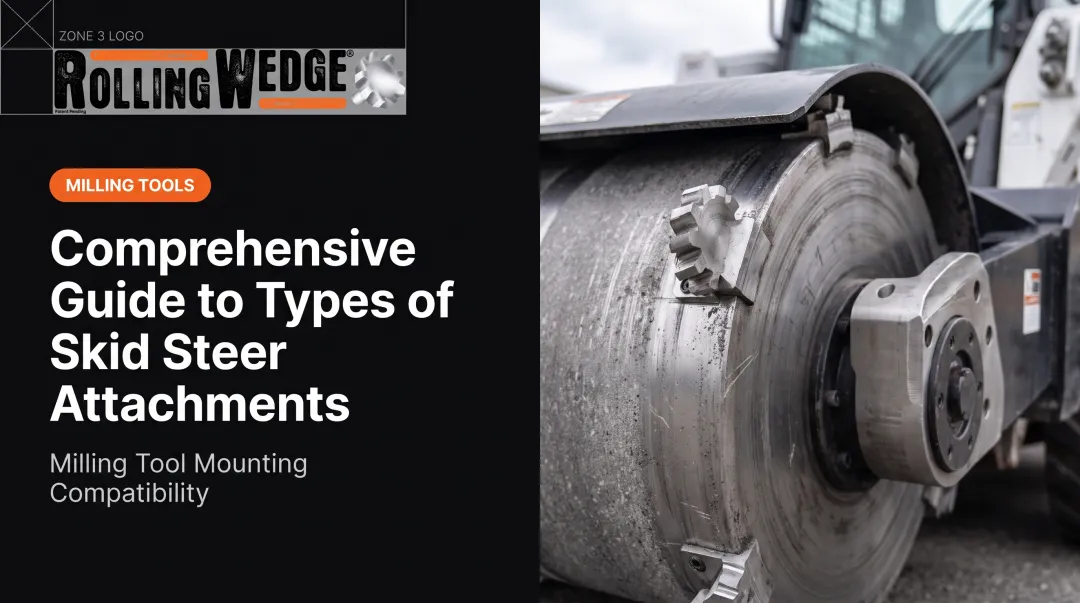
Rolling Wedge manufactures Milling Drums fitted with proprietary Rolling Wedge Milling Tools as part of the Rolling Wedge Milling System for Skidsteer. The drum assembly installs into your skidsteer planer attachment - Rolling Wedge does not manufacture the planer attachment itself. The Rolling Wedge Milling Tools use a rolling-wedging-lifting action instead of impact-style carbide picks, with nine carbide teeth that roll into the surface and lift material away, so you can mill asphalt and concrete in one pass with less vibration and operator fatigue.
| Best For | Asphalt/concrete milling, patching, and surface prep for contractors and municipalities |
| Tool Longevity | Up to 10x reported tool life vs. carbide picks; replace about every 1-3 months vs. twice weekly, with full drum changeout in ~20 minutes |
| Key Feature | 18- to 40-inch drum widths; fits skidsteer planer attachments and larger milling platforms, including Roadtec equipment |
2. Buckets
Buckets are the default attachment on nearly every skidsteer, used for scooping, grading, and hauling loose material like dirt, gravel, and mulch. Dirt, utility, grader, and combination configurations cover almost any material-handling task a jobsite throws at them.
| Best For | Digging, loading, grading, and general material handling |
| Price Range | About $750-$1,000 for standard dirt buckets, per a 2024 manufacturer pricing guide |
| Versatility | Combination bucket variants add grappling and leveling functions |
3. Pallet Forks
Pallet forks turn a skidsteer into a mobile forklift. They're fast to attach, inexpensive relative to their utility, and effective for moving pallets, lumber, hay bales, and bagged building supplies around a site.
| Best For | Loading and unloading pallets, lumber, and bagged materials |
| Price Range | Typically $500-$1,000, among the lower-cost attachments available |
| Load Capacity | Available in multiple widths and lift ratings to match jobsite needs |
4. Grapples
Grapples use claw-style jaws to grip and move irregular or loose material like brush, logs, and construction debris. Root, brush, and demolition variants each target a different cleanup or land-clearing scenario.
| Best For | Debris removal, land clearing, and demolition cleanup |
| Price Range | Generally $3,000-$6,000+, with heavy-duty root and brush models running higher |
| Key Feature | Hydraulic clamping arms prevent material spillage during transport |
5. Augers
Augers bore vertical holes for posts, poles, and plantings far faster than a hand-held auger or a crew with shovels. Standard, heavy-duty, and rock-cutting variants handle everything from soft topsoil to rocky terrain.
| Best For | Fence posts, tree planting, and utility pole installation |
| Price Range | Around $2,000-$2,500 for a complete drive-and-bit setup |
| Time Savings | Cuts hole-digging time dramatically versus manual or hand-held augers |
6. Backhoe Attachment
A backhoe attachment adds a boom and bucket to a skidsteer, giving it excavator-style digging capability without renting a separate machine. It's a practical middle ground for crews that need occasional trenching but not full-time excavation work.
| Best For | Utility trenching, septic/sewer work, and small-scale excavation |
| Price Range | Roughly $10,000-$12,000, among the pricier attachment categories |
| Add-On Options | Compatible with hydraulic hammer attachments for light demolition |
7. Dozer Blade
A dozer blade converts a skidsteer into a compact bulldozer, useful for pushing, leveling, and piling material on sites too tight for a full-size dozer. Residential and municipal crews rely on these for exactly that reason.
| Best For | Grading, backfilling, and site leveling |
| Price Range | Typically $3,000-$6,000 depending on blade width and controls |
| Key Feature | Pivoting or angling blade options improve material control |
8. Brush Cutter / Forestry Mulcher
Brush cutters and forestry mulchers clear brush, small trees, and overgrowth in a single pass. Mulchers go a step further, turning cleared vegetation into usable mulch on-site instead of leaving debris to haul away.
| Best For | Land clearing, right-of-way maintenance, and vegetation management |
| Price Range | Often $5,000-$8,000, rising sharply for high-flow forestry mulcher heads |
| Key Feature | Enclosed blade designs improve safety and control versus tow-behind cutters |
9. Snow Blower / Snow Blade
Snow attachments either push snow clear with an angled blade or throw it clear with a blower. Municipalities and commercial lot maintenance crews often run both, depending on snowfall depth and surface type.
| Best For | Municipal and commercial snow removal |
| Price Range | Blades run $3,000-$4,000; blowers can reach $7,000-$8,000 |
| Key Feature | Multi-position blades direct snow to either side of the machine |
10. Trencher
Trenchers cut narrow trenches for cable, pipe, and drainage lines without disturbing the surrounding surface the way a backhoe would. Interchangeable chains and teeth let one unit handle soft ground one day and rocky terrain the next.
| Best For | Utility line, irrigation, and drainage installation |
| Price Range | Generally $4,000-$6,000 |
| Key Feature | Boom lengths and dig widths vary to match project depth requirements |
How We Chose the Best Skidsteer Attachments
The biggest mistake operators make is buying the attachment that looks most impressive at a trade show instead of the one matching their most frequent job. A grapple sitting unused in a yard doesn't generate revenue, no matter how capable it is.
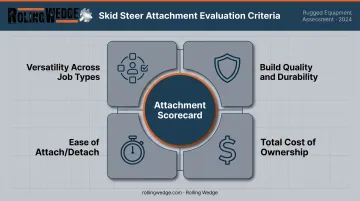
We evaluated each attachment against four factors that tie directly to business outcomes:
- Versatility across job types: Earns its keep on more than one kind of project
- Build quality and durability: Holds up under repeated, heavy use
- Ease of attach/detach: Quick-attach systems that cut downtime between jobs
- Total cost of ownership: Purchase price balanced against maintenance, replacement frequency, and productive hours gained
Attachments that score well on all four tend to pay for themselves fastest. That can mean a bucket used daily, or a milling tool that needs replacement every few months instead of every few days.
Conclusion
The best skidsteer attachment lineup is the one matched to your actual jobsite demands, week after week—not the one with the biggest marketing budget.
Before buying, weigh long-term cost-effectiveness, compatibility with your specific skidsteer model, and how well the attachment scales as your project scope grows.
If milling or resurfacing is part of that scope, use Rolling Wedge's Milling Cost Comparison Tool to see how its Milling Tools reduce tool replacement frequency and downtime versus traditional carbide picks in existing skidsteer planer attachments.
Frequently Asked Questions
What is the most profitable skidsteer attachment?
Profitability depends on local demand, but buckets, grapples, and specialty tools like milling or cold planer attachments often deliver strong ROI through high utilization and less downtime for tool changes.
What are the most useful skidsteer attachments?
Buckets, pallet forks, and augers are the most broadly useful, thanks to versatility across construction, landscaping, and agricultural tasks.
How much do skidsteer attachments typically cost?
Prices span roughly $500 for basic pallet forks up to $12,000+ for backhoe or specialty milling attachments, depending on complexity and build quality.
What is the most versatile skidsteer attachment for a new operator?
Combination buckets or pallet forks make the best starting point, since both handle multiple tasks with a low learning curve.
Can skidsteer attachments be used across different brands and models?
Most attachments use a universal quick-attach mounting system, but hydraulic flow and machine weight class still need to match for safe, effective operation.
How do I know which skidsteer attachment is right for my business?
Audit your most frequent job types first, then evaluate which attachments cover the widest range of those tasks before weighing purchase versus rental costs.