The catch: attachment wear, inconsistent millings quality, and downtime from constant tool swaps eat into margins fast. Pick the wrong attachment for your machine's hydraulics, and you're looking at underperformance and unplanned repair bills.
This guide breaks down the top skidsteer attachments for asphalt milling and the field-proven techniques that turn raw millings into usable material.
Key Takeaways
- Skidsteer cold planers mill asphalt in tight spaces without a full-size milling machine
- Match drum width, hydraulic flow, and tool replacement needs before you buy
- Rolling Wedge, Blue Diamond, Bobcat, Caterpillar, and Asphalt Zipper lead skidsteer milling options
- Depth control, dust suppression, and millings handling drive results as much as the attachment
Overview of Skidsteer Milling Attachments in the Asphalt Industry
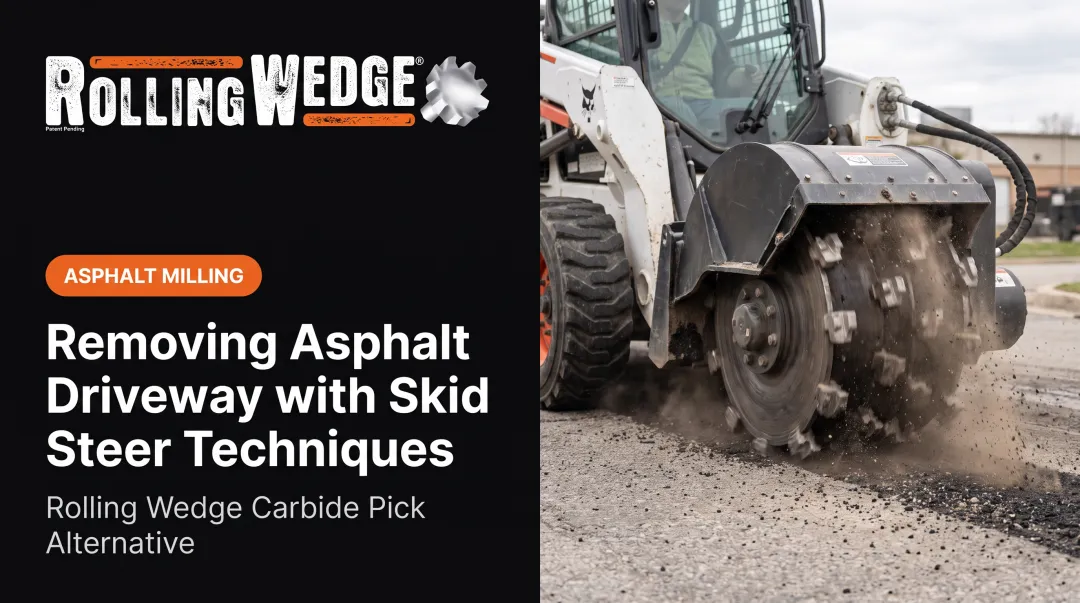
A skidsteer milling attachment (also called a cold planer) mounts to a skidsteer's universal quick-attach plate and uses a rotating drum to grind asphalt or concrete surfaces. It's the workhorse behind reclaimed asphalt pavement (RAP) recovery on smaller job sites.
NAPA's 2024 survey found 119.6 million tons of RAP accepted nationwide, with 101.4 million tons reused directly in asphalt mixtures. More than 99% of collected RAP went back into use. That survey covered 218 companies and 1,254 plants.
Compact attachments give municipal patch crews and smaller contractors a practical option when a dedicated milling machine isn't cost-justified.
Below, we rank the top skidsteer attachments for asphalt milling based on cutting technology, tool longevity, hydraulic compatibility, and total cost of ownership.
Top Skidsteer Attachments for Asphalt Milling
Selection comes down to four factors: cutting technology, tool life between changeouts, hydraulic compatibility with your carrier, and total cost of ownership over the life of the attachment.
This roundup covers Rolling Wedge Milling Tools, Blue Diamond and Bobcat planers, Caterpillar cold planers, and Asphalt Zipper units.
Rolling Wedge
Rolling Wedge, LLC, based in Peoria, Illinois, supplies the Rolling Wedge Milling System for Skidsteer: Milling Drums and proprietary rolling-wedging-lifting Milling Tools that upgrade existing skidsteer-mounted planers and large milling equipment, including Roadtec and Caterpillar platforms.
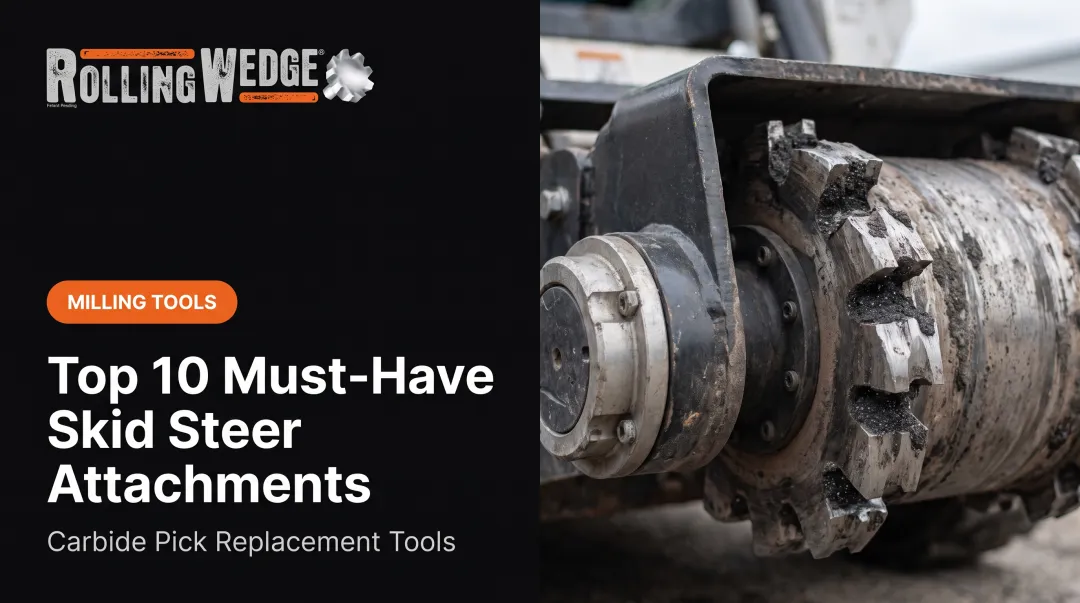
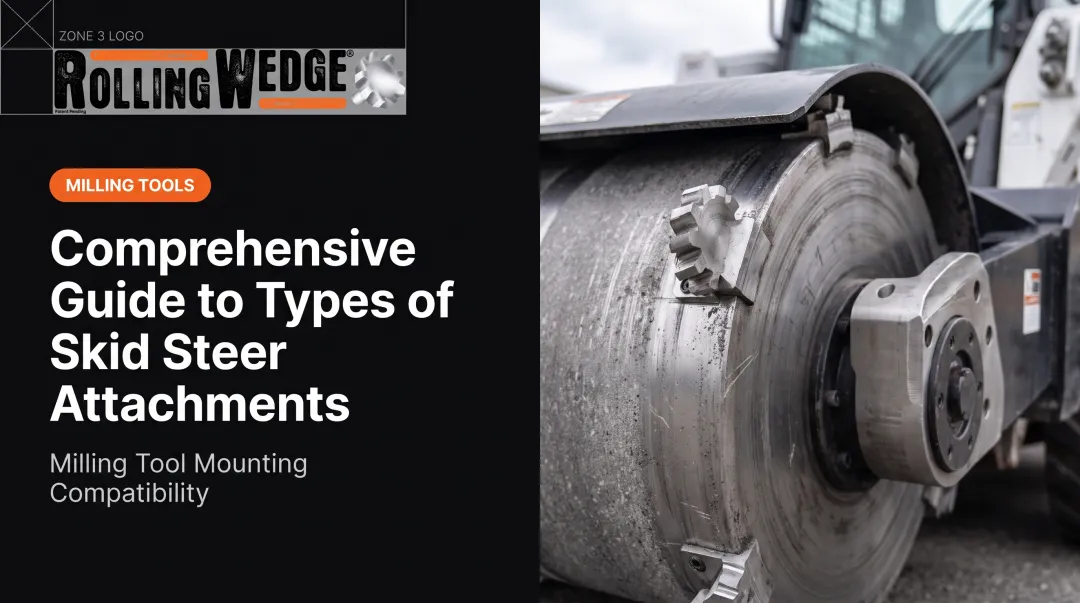
Instead of chipping material with repeated impacts like a standard carbide pick, the tool rolls into the surface at an angle and lifts material away, putting asphalt or concrete into tension, where it holds only about 20% of its compressive strength. That means less resistance to cut through, no seizing, and no excess heat buildup during operation.
In practice, Rolling Wedge tools mill asphalt and concrete—including rebar-reinforced sections—in a single pass without swapping tools. Reduced drum bounce can also ease operator fatigue and help protect hydraulic components.
Full drum changeout takes about 20 minutes, versus 1–2 hours for carbide picks. Pricing is available on request with volume discounts - contact Rolling Wedge for current pricing. A limited Try & Buy program (20-day evaluation of a Rolling Wedge Milling Drum - not a general rental program) is available for qualifying customers.
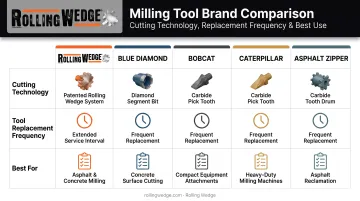
| Category | Rolling Wedge |
|---|---|
| Cutting Technology | Rolling-wedging-lifting action vs. traditional carbide pick chipping |
| Tool Replacement Frequency | Every 1-3 months vs. multiple times weekly for standard carbide picks |
| Best For | Mixed asphalt/concrete jobs, municipalities, and contractors seeking lower downtime |
Blue Diamond Attachments
Blue Diamond's Extreme Duty Series 2 Cold Planer is a mainstream skidsteer and excavator attachment built for both concrete and asphalt work.
The self-leveling design keeps cutting depth consistent even on uneven surfaces. Width and depth are adjustable across the lineup, and an optional pressurized water kit (with a 40-gallon rooftop tank) handles dust suppression.
| Category | Blue Diamond Extreme Duty Series 2 |
|---|---|
| Grinding Width | 14" to 48" range |
| Cutting Depth | Up to 6.7" |
| Key Feature | Electronic side shift and independent depth adjustment |
Bobcat
Bobcat's factory-engineered planer attachments are built for direct hydraulic and Bob-Tach coupler compatibility with its own skidsteer lineup.
They handle standard asphalt milling and surface prep on Bobcat carriers with matched hydraulic flow. The upside is simple: less guesswork on hydraulic fit, a wide dealer and parts network, and easier warranty support if something breaks mid-job.
| Category | Bobcat Planer |
|---|---|
| Compatibility | Matched to Bobcat skidsteer hydraulic flow specs |
| Support Network | Nationwide dealer service and parts availability |
| Best For | Fleets standardized on Bobcat equipment |
Caterpillar
Caterpillar offers a range of cold planer attachments (PC305, PC406, and PC412) backed by its global dealer network, each rated for High Flow or XHP/XE hydraulic systems.
Build quality leans heavy-duty, with reinforced housing and independent left/right depth control for cross-slope work. Cat's VisionLink platform monitors connected equipment for fault codes and maintenance alerts, though it's fleet-wide telematics rather than an attachment-specific feature. Financing runs through Cat dealers' commercial accounts.
| Category | Caterpillar Cold Planers |
|---|---|
| Build Quality | Reinforced housing for high-cycle commercial use |
| Technology | VisionLink fleet monitoring for connected equipment |
| Best For | Contractors already invested in CAT fleets |
Asphalt Zipper
Asphalt Zipper builds compact milling attachments specifically for skidsteers, loaders, and backhoes tackling road repair and utility trenching.
Its 300XLP and 420XLP units mount via a quick-connect Versa-Mount system and feature a remote-controlled hydraulic baffle that adjusts particle size on the fly, which helps when you want reusable RAP rather than fine dust. These are engine-powered attachments rather than conventional hydraulic-driven planers, and carrier weight starts around 10,000 lb, so fitment needs confirming beforehand.
| Category | Asphalt Zipper 300XLP/420XLP |
|---|---|
| Milling Width | 30" and 42" cutting widths |
| Particle Control | Adjustable hydraulic baffle for RAP reuse sizing |
| Best For | Utility trenching and smaller municipal patch crews |
Best Techniques for Milling and Handling Asphalt Millings with a Skidsteer
Depth and Grade Control
Rest the front skid shoes on the ground, then lower and tilt the attachment until the cutter drum sits parallel to the surface. Keep the carrier's front wheels or tracks raised while milling.
Never move the carrier sideways with the drum running. Consistent depth prevents low spots that cause poor overlay bonding later.
Milling Mixed or Reinforced Surfaces
Transitioning from asphalt into concrete or rebar sections calls for slowing your pass rate and easing off drum speed. Carbide-pick attachments are prone to stalls or broken teeth when they hit reinforcement unexpectedly. Rolling Wedge tools handle this transition without a tool change, since the cutting action works the same way on both materials.
Dust and Water Management
Water suppression isn't optional on most urban or municipal jobs. OSHA's silica standard sets an action level of 25 micrograms per cubic meter and a permissible exposure limit of 50 micrograms per cubic meter as an 8-hour average. It requires integrated water delivery or an approved dust collector for comparable grinding tasks.
Practical steps:
- Run onboard or add-on water kits continuously while milling, not just intermittently
- Inspect water nozzles every 8 hours to prevent clogging
- Sweep or vacuum haul routes to control fugitive dust on adjacent streets
Collecting and Hauling Millings Efficiently
Coordinate skidsteer bucket passes with dump trucks positioned alongside the cut, rather than stockpiling and reloading later. Double-handling millings wastes fuel and labor hours. On smaller jobs without a truck on standby, stockpile in one consolidated pile near the site exit for a single loading pass.
Compacting and Reusing Millings On-Site
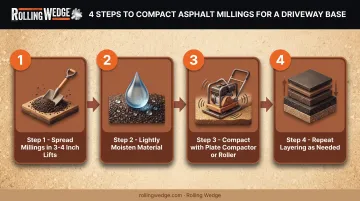
Millings make a workable driveway or access road base when compacted properly:
- Spread millings in lifts no thicker than roughly 3-4 inches
- Lightly moisten the material; granular RAP often compacts better with little or no added water
- Run multiple passes with a plate compactor or roller until the surface feels firm underfoot
- Repeat layering for additional lifts if greater depth is needed
Attachment Maintenance Between Passes
Check teeth and drum condition hourly during active milling. This catches worn or broken cutters before they damage the drum housing. Inspect hydraulic hoses and lubricate fittings roughly every 50 hours. Skipping these checks is the most common cause of mid-project downtime on multi-day jobs.
How to Choose the Right Skidsteer Milling Attachment
The most common mistake: sizing an attachment's width and depth to the project without first confirming your skidsteer's hydraulic flow (GPM) and pressure rating (PSI). A 48-inch drum bolted onto an undersized carrier simply won't cut at rated depth, no matter how good the attachment is.
Before buying or renting, check:
- Hydraulic match: confirm your carrier's GPM and PSI against the attachment's minimum and maximum requirements, plus any case-drain needs
- Tool replacement cost and frequency: compare carbide picks that need replacing multiple times a week in abrasive material with Rolling Wedge tools commonly rated for 1-3 months
- Mixed-surface capability: verify whether the attachment requires a tool swap between asphalt and concrete, or handles both in one pass
- Dust/water system availability: factor in whether a suppression kit is built-in or sold separately
- Dealer and parts support: check lead times on replacement parts before you're mid-project
These factors translate directly into lower cost per ton milled, less downtime waiting on parts, and a longer service life for your attachment.
Conclusion
There's no single "best" skidsteer milling attachment — the right choice depends on whether you mill asphalt, concrete, or both, and whether your carrier's hydraulics can support the drum you want.
Before finalizing a purchase or rental, weigh total cost of ownership: tool replacement frequency, install time, and downtime add up fast over a season of jobs.
Want to see what switching from carbide picks could save on your next season of work? Run the numbers in Rolling Wedge's Milling Cost Comparison Tool using your own project volume.
Frequently Asked Questions
How much is a truckload of asphalt millings?
Pricing varies by region, hauling distance, and volume ordered. Unscreened millings often run around $20 per ton. Always request a quote that separates material cost, loading, and mileage.
What skidsteer attachment is used for milling asphalt?
Cold planer or milling attachments with rotating carbide or rolling-wedge drums mount to a skidsteer's universal quick-attach plate. These attachments run off the carrier's auxiliary hydraulics to power the drum.
How thick can a skidsteer cold planer mill in one pass?
Most skidsteer cold planers cut between 4.3 and 6.7 inches in a single pass, depending on drum width and model. Engine-powered reclaimer attachments built for full-depth reclamation can reach up to 10 inches.
Can a skidsteer handle both asphalt and concrete milling?
Standard carbide-pick attachments typically require a tool change when switching between asphalt and concrete. Rolling-wedge technology mills both materials, including rebar-reinforced sections, in a single pass without swapping tools.
How do you compact asphalt millings for a driveway?
Spread millings in lifts of about 3-4 inches, lightly moisten the material, then compact with multiple passes of a plate compactor or roller. Repeat in layers until you reach the desired base depth.
What is the difference in tool replacement frequency between carbide pick and rolling wedge attachments?
Carbide picks in abrasive material commonly need replacing multiple times a week, as often as every 30 minutes to 150 hours depending on conditions. Rolling-wedge tools are rated for roughly 1-3 months between changeouts under normal use.