Rolling Wedge Milling Tools do not grind. They cut. The mechanism is different at a fundamental level: instead of abrasive contact, a rolling-wedge-lifting action puts concrete into tension and separates it along its weakest plane. This article explains how that works, why it matters for contractors and municipalities, and where it fits versus conventional handheld grinding.
Key Takeaways
- Rolling Wedge uses a rolling-wedging-lifting cutting action - no abrasive discs, no percussion, no angle grinders
- Concrete's tensile strength is roughly 20% of its compressive strength; Rolling Wedge exploits that weakness to cut with less resistance
- Nine carbide teeth per tool, 45.9g total carbide - designed for production milling, not surface finishing
- One tool handles asphalt, concrete, rebar-reinforced concrete, and tree stumps without tool swaps
- Tool replacement every 1-3 months versus twice a week for carbide picks - 10x and longer lifespans reported
- Compatible with skidsteer-mounted planer attachments and large milling equipment including Caterpillar and Roadtec platforms
- Try & Buy program available for contractors who want to test before committing
Grinding vs. Cutting: What the Difference Actually Means
How Grinding Works
Angle grinders, surface grinders, and floor grinders all share the same core principle: a diamond-impregnated or abrasive wheel spins at high RPM and wears away material through friction. The wheel contacts the surface, microscopic abrasive particles shear off thin layers of concrete, and the material is removed gradually.
This works well for:
- Smoothing small high spots or trip hazards on residential flatwork
- Removing old coatings, adhesives, or sealers from garage floors and patios
- Detail work in corners and tight transitions where larger equipment cannot fit
- Surface preparation for new coatings or overlays using concrete cutting tools
The constraints are equally clear. Grinding is slow by volume. Abrasive wheels wear down quickly on hard aggregate and rebar. Motors bog under load. Depth is limited to thin passes. And none of it is practical at the scale of a road lane, a bridge deck, or a commercial parking lot.
How Rolling Wedge Cuts
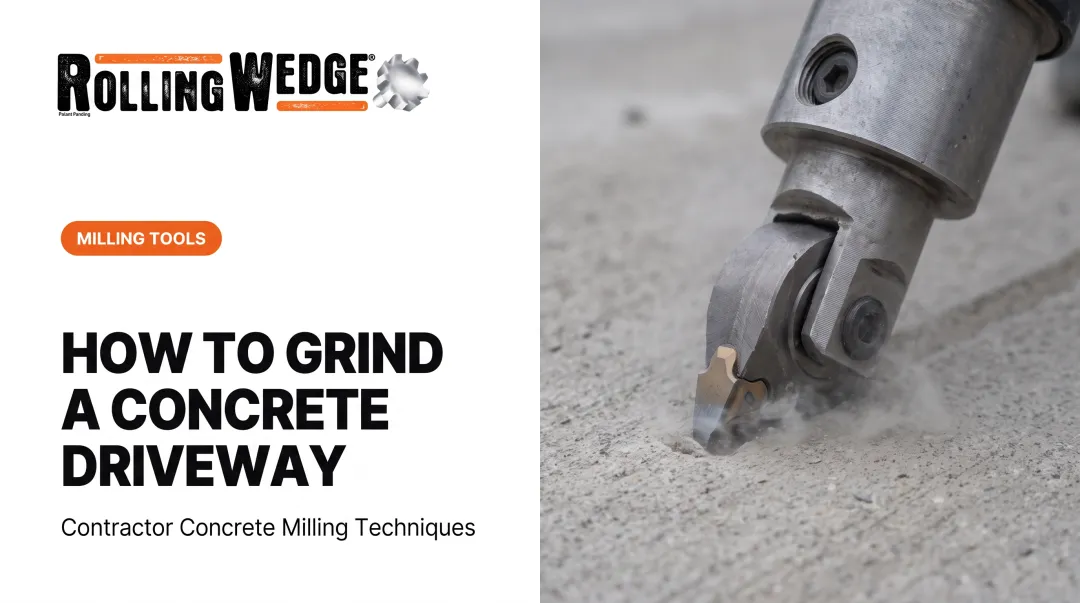
Rolling Wedge Milling Tools operate on a different physical principle entirely. The Rolling Wedge Milling Tool rolls across the surface as the drum rotates. Its geometry - a wedge shape with nine carbide teeth - contacts the concrete at a set angle, driving a wedging force into the material. That force puts the concrete in tension rather than compression.
Concrete's tensile strength is approximately 300-700 psi, roughly 10-20% of its compressive strength of 3,000-5,000 psi for typical structural mixes. A force aligned to exploit tensile weakness requires far less energy to fracture the material than trying to crush or abrade it. The Rolling Wedge tool rolls continuously forward, lifting and separating material along that low-resistance tensile plane.
Key consequences of this design:
- No heat generation - the rolling contact does not create the frictional heat that abrasive grinding or carbide pick hammering produces. The tools never overheat and never seize up.
- No bounce or chatter - the rolling action is smooth and continuous, eliminating the percussion and vibration characteristic of carbide pick systems.
- No jamming on rebar - because the tool rolls rather than impacts, it passes through many grades of rebar and wire mesh without stalling or breaking.
- No water required for cooling - water can still be used for dust suppression as site conditions require, but it is not needed to protect the tool.

Rolling Wedge Tool Specifications
The Rolling Wedge Milling Tool is the primary Rolling Wedge Milling Tool. Its design reflects the cutting action described above.
| Specification | Detail |
|---|---|
| Tool diameter | 2.5 inches |
| Carbide teeth per tool | 9 |
| Carbide weight per tooth | 5.1 grams |
| Total carbide per tool | 45.9 grams |
| Seizing risk | None - tool never seizes |
| Heat generation | None - rolling action prevents overheating |
| Replacement interval (asphalt) | Every 1-3 months |
| Replacement interval (carbide picks) | Twice per week (typical) |
| Tool life advantage | Up to 10x reported vs. conventional carbide picks |
| Drum changeout time | Approximately 20 minutes (24-inch drum) |
| Carbide pick changeout time | 1-2 hours (typical) |
A documented field assessment on a 24-inch Caterpillar PC306B drum recorded Rolling Wedge tools milling through solid steel roadway joint dowel bars and continuing into concrete: only 3 of 278 cutting edges sustained damage (1.1%), including 0.8% on the large rolling cutters versus 12.5% on the carbide picks riding the same drum.
What Rolling Wedge Cuts - and What It Does Not
One of the practical advantages of the Rolling Wedge Milling Tool is that it handles materials that force conventional setups to stop and change tools.
Rolling Wedge cuts:
- Asphalt (standard and reclaimed)
- Concrete (standard structural mixes)
- Rebar-reinforced concrete (many grades) - see concrete milling for process details
- Wire-mesh-reinforced slabs
- Mixed asphalt-and-concrete surfaces in a single pass
- Tree stumps (when mounted in a skidsteer planer attachment)
Rolling Wedge does not do:
- Residential or DIY surface finishing
- Fine polishing or coating-removal on garage floors or driveways
- Small spot repairs where a handheld tool is the practical choice
- Any application requiring an angle grinder, floor sander, or surface polisher
For small-scale residential work - smoothing a cracked driveway, removing an old epoxy coating, or flattening a trip hazard on a patio - a rented floor grinder or angle grinder is the right tool. Rolling Wedge is production equipment for contractors and municipalities working at scale.
Equipment Compatibility
Rolling Wedge Milling Tools install into:
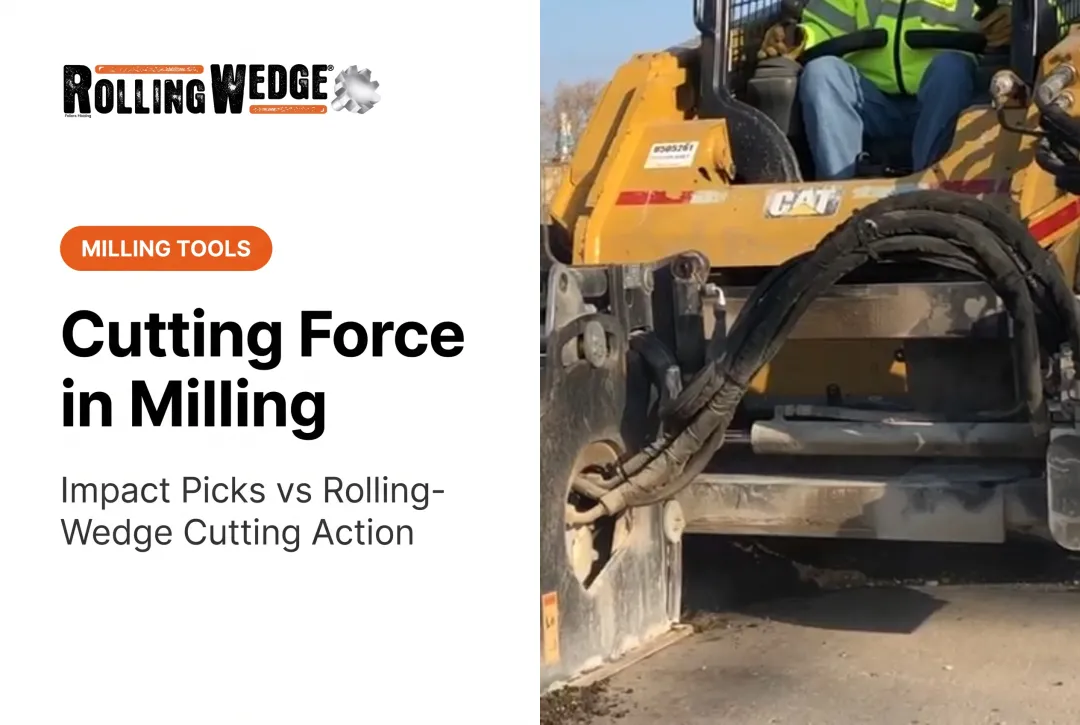
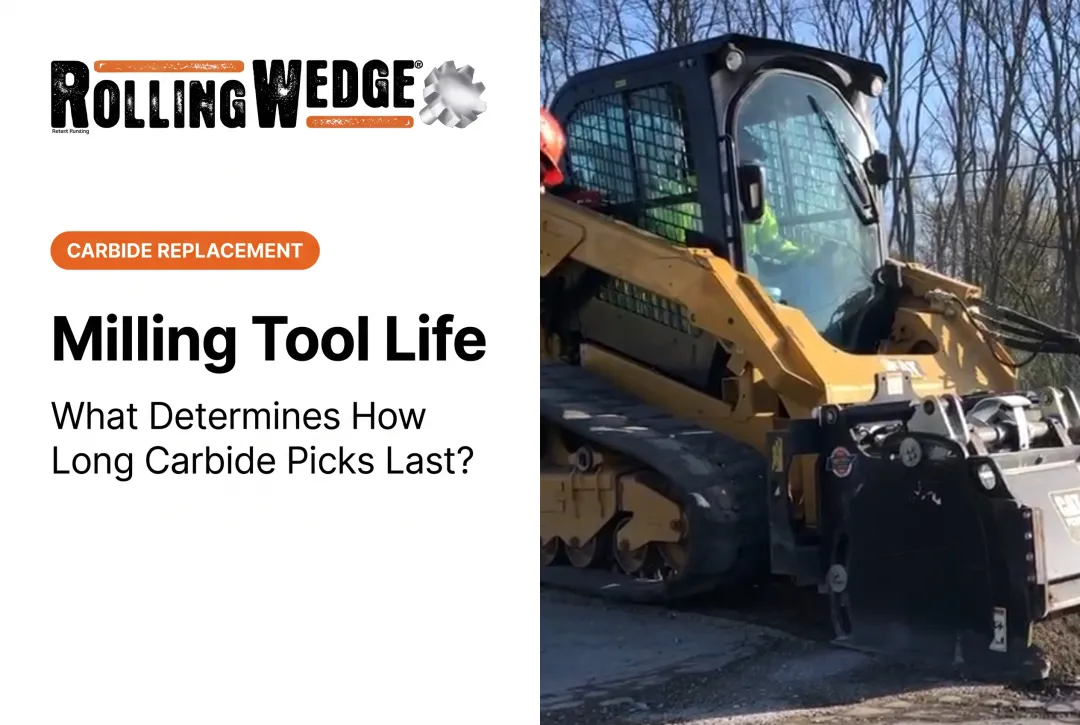
- Skidsteer-mounted planer attachments - rubber-tire and track machines, with drum widths of 18, 24, 30, and 40 inches available - see the concrete grinder attachment for skid steer category for compatible platforms
- Large milling equipment - compatible with Caterpillar cold planers, Roadtec milling machines, and other major manufacturer platforms
The tools work in conjunction with 8 carbide picks, 4 at each end of the outer cut edge, for a square edge and corners. The 20-minute changeout time for a full 24-inch drum means a crew can move to Rolling Wedge tooling between jobs without significant downtime.

Why Contractors Switch from Carbide Picks to Rolling Wedge
The cost-of-ownership difference between carbide picks and Rolling Wedge tools comes down to replacement frequency and downtime.
Conventional carbide picks require replacement roughly twice per week on active milling jobs. Each replacement takes 1-2 hours of machine downtime. Tool costs accumulate fast.
In asphalt applications, operating lives of 10x and longer than carbide picks have been reported for Rolling Wedge tools, with a typical replacement interval of every 1-3 months. The 20-minute drum changeout further reduces lost production time.
Practical impact on a fleet:
- Fewer tool purchases per year
- Significantly fewer maintenance stops per month
- Reduced operator fatigue from smooth, bounce-free operation
- Helps protect hydraulic components through lower machine vibration
- No mid-job tool swaps when a surface transitions from asphalt to concrete or encounters rebar
Try & Buy Program
Rolling Wedge offers a Try & Buy program for contractors who want to evaluate the tools on their own equipment before committing to a full purchase. The program is available for both skidsteer and large milling equipment platforms.
Contact Rolling Wedge at (309) 322-1600 or visit the Rolling Wedge Milling System for Skidsteer page to ask about availability and pricing. Rolling Wedge will also be exhibiting at PaveX 2027 (Booth 521, Savannah, GA, January 25-27) and World of Asphalt 2027 (Booth 1475, New Orleans, March 15-17).

Frequently Asked Questions
Does Rolling Wedge use an angle grinder?
No. Rolling Wedge Milling Tools are installed in skidsteer-mounted planer attachments and large cold planers - not handheld tools. The Rolling Wedge Milling Tool has no connection to angle grinders, surface grinders, or any handheld abrasive equipment.
Does Rolling Wedge grind concrete?
No. Rolling Wedge cuts concrete using a rolling-wedging-lifting action that exploits the material's low tensile strength. Grinding uses abrasive friction to wear away material; Rolling Wedge uses mechanical wedging force to separate it. The distinction matters for tool life, heat generation, rebar handling, and production scale.
Can Rolling Wedge cut rebar-reinforced concrete?
Yes. The rolling action of the Rolling Wedge Milling Tool means the tool passes over and through many grades of rebar and wire mesh without jamming. Carbide picks impact rebar directly, which causes jamming and tool breakage. Rolling Wedge tools roll past the reinforcement. A documented drum assessment recorded only 0.8% damage on Rolling Wedge cutters encountering solid steel joint dowel bars, versus 12.5% on carbide picks on the same drum.
How long do Rolling Wedge tools last?
In asphalt milling, operating lives of 10x and longer than conventional carbide picks have been reported. Typical replacement interval is every 1-3 months versus twice per week for carbide picks. In harder materials like reinforced concrete, intervals vary with job conditions.
What equipment is compatible with Rolling Wedge tools?
Rolling Wedge tools are compatible with rubber-tire and track skidsteer-mounted planer attachments (18-, 24-, 30-, and 40-inch drum widths) and large milling equipment from Caterpillar, Roadtec, and other major manufacturers.
Is there a way to try Rolling Wedge tools before buying?
Yes. Rolling Wedge offers a Try & Buy (20-day evaluation) that lets contractors test the tools on their own equipment. Call (309) 322-1600 for program details.
What is the difference between grinding and milling?
Grinding removes material by abrasion - a spinning abrasive wheel wears the surface down particle by particle. Milling removes material by cutting - a rotating drum with cutting tools shears material away to a controlled depth. Rolling Wedge is a milling tool that uses tensile-strength cutting rather than abrasion or percussion.