Introduction
Concrete road joints fail for a simple reason: crews pick the wrong tool for the job. Saw cutting and milling both touch the same joint, but they solve opposite problems.
Saw cutting creates a narrow, controlled kerf in sound concrete. Milling removes or reshapes material that's already deteriorated. Confuse the two, and you either damage a good slab or waste time trying to "cut" your way through a spall that needs to be removed entirely.
The FHWA notes that improperly designed, built, or maintained joints contribute directly to spalling, faulting, pumping, and mid-panel cracking. That's not a minor detail.
Joint work affects repair scope, equipment time, debris cleanup, traffic control, and how long the fix actually lasts.
This article breaks down what each method does well, where it falls short, and how to decide between them on your next project.
Key Takeaways
- Saw cutting delivers precise, narrow joints with controlled depth in sound concrete
- Milling removes deteriorated material, widens joints, or preps surfaces for repair
- Select the method based on joint purpose, concrete condition, reinforcement, and cleanup needs
- Verify dimensions, sealant specs, and repair details against project standards before work starts
- Rolling Wedge Milling Tools handle concrete, asphalt, and some rebar grades in one pass
Saw Cutting vs Milling Concrete Road Joints: Quick Comparison
Here's how the two methods stack up across the factors that actually matter on a jobsite:
| Factor | Saw Cutting | Milling |
|---|---|---|
| Purpose | Creates a narrow, controlled weakened plane or defined joint in sound concrete | Removes deteriorated material, widens a joint profile, or preps a surface for repair |
| Equipment | Diamond blade on walk-behind, ride-on, or early-entry saw; wet or dry cutting | Milling drum or cutter attachment removes material rather than a narrow kerf |
| Precision | Best for straight lines, specified depths, and repeatable layouts | Better for widening, recessing, or correcting irregular geometry |
| Typical condition | New pours, sound slabs, planned construction joints | Spalled edges, failed sealant, overlays, mixed-material transitions |
| Site impact | Blade wear, water/dust control, slurry management, cure timing | Machine access, debris volume, tool wear, vibration |
The one-sentence decision rule: choose saw cutting when the priority is a precise joint line, and choose milling when the priority is controlled material removal or joint rehabilitation.
Saw Cutting: Definition, Process, and Use Cases
Saw cutting uses a diamond blade to create a planned joint or repair boundary in concrete. Here’s how it relates to common joint and cut types:
- Contraction/control joints — induce cracking along a planned weakened plane as the slab shrinks
- Construction joints — separate sequential pours (though not all are formed by sawing)
- Isolation joints — separate pavement from adjacent structures using compressible material, not a shallow cut
- Repair cuts — define the boundary of a partial-depth repair area
Timing and Depth Matter More Than the Clock
Cutting too early causes raveling. Cutting too late invites random cracking instead of a controlled one. Per the FHWA technical advisory, conventional sawing typically starts 4–12 hours after paving; early-entry saws can begin at 1–4 hours, depending on weather and mix design.
Depth follows a similar logic:
- Conventional saw cuts: about T/4 over a granular subbase or T/3 over a stabilized subbase (T = slab thickness)
- Early-entry cuts: typically T/6 to T/5, with a 1.25-inch minimum
Panel spacing generally runs 1.5-2 feet per inch of slab thickness, though many state DOTs cap panel length around 15 feet. None of this replaces the project's actual joint design — treat these as starting references, not a substitute for the spec sheet.

Where Saw Cutting Fits Best
Saw cutting works best when:
- The surrounding concrete is sound
- A specific joint line and tight dimensional tolerance are required
- Material removal needs to stay minimal
- There's clear access for a saw and water supply (or a dry-cut early-entry unit)
Typical applications include:
- New contraction joints in fresh roadway slabs
- Extending a joint line through a repair zone
- Straight boundary cuts before a partial-depth patch
Milling: Definition, Process, and Use Cases
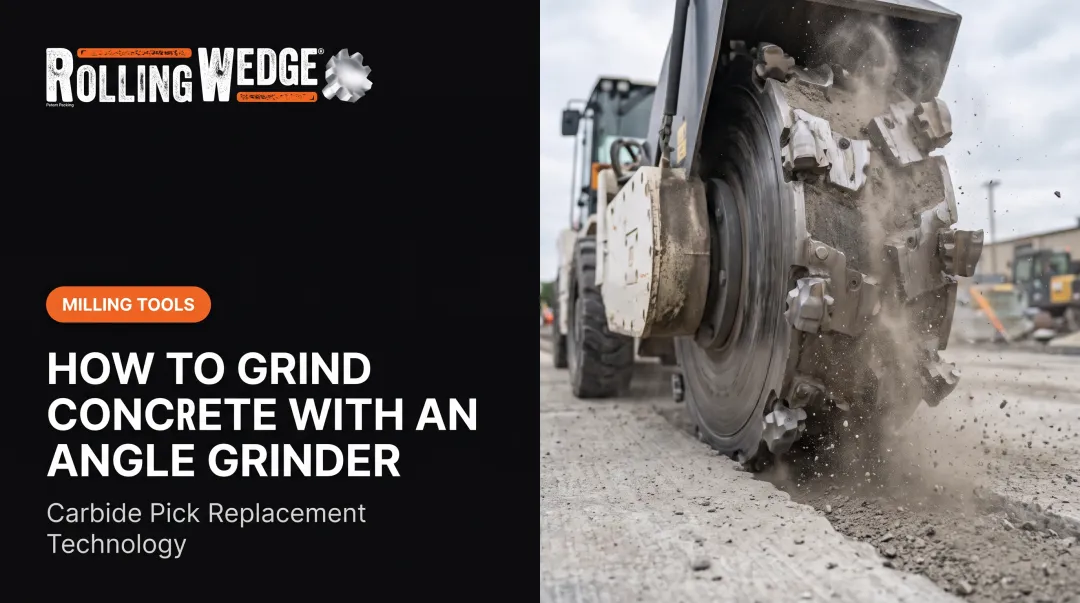
Milling is controlled removal or profiling of hardened concrete using a rotating drum or comparable cutting attachment. Unlike a saw blade, which produces a narrow kerf, a milling drum takes out volume: reshaping, widening, or clearing an area rather than slicing a line.
Why Milling Handles What Saw Cutting Can't
Deteriorated joints usually need more than a clean cut. FHWA's partial-depth repair guidance describes controlled-depth milling as effective for removing spalled or weakened concrete along a joint, particularly when deterioration runs the length of the joint rather than staying isolated to one spot.
Milling heads in the 12-18-inch range have proven efficient for larger repair areas. Depth control still matters: excessive penetration risks hitting dowels or reinforcing steel.
Milling also handles conditions saw cutting struggles with:
- Irregular joint geometry that a straight blade can't correct
- Mixed asphalt-over-concrete sections needing surface prep before resurfacing
- Reinforced concrete where a blade would bind or wear excessively
- Wide areas of failed sealant or contaminated joint material
Equipment Considerations
Drum width, cutting depth, and attachment compatibility all affect how efficiently a crew can work. Debris handling matters too. Milling generates more material volume than a saw kerf, and that debris needs a plan before the truck shows up.
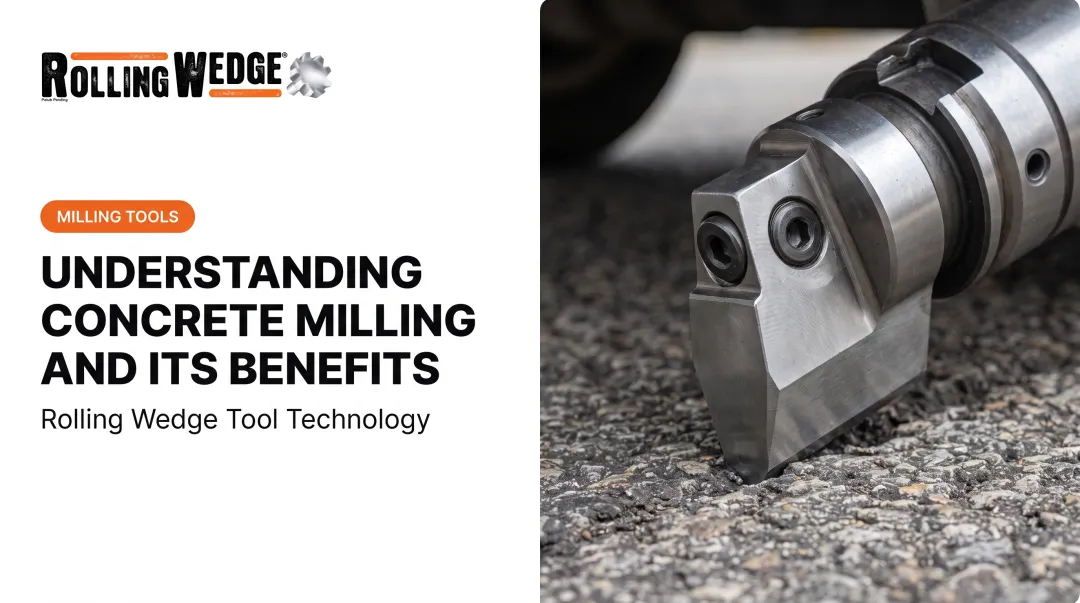
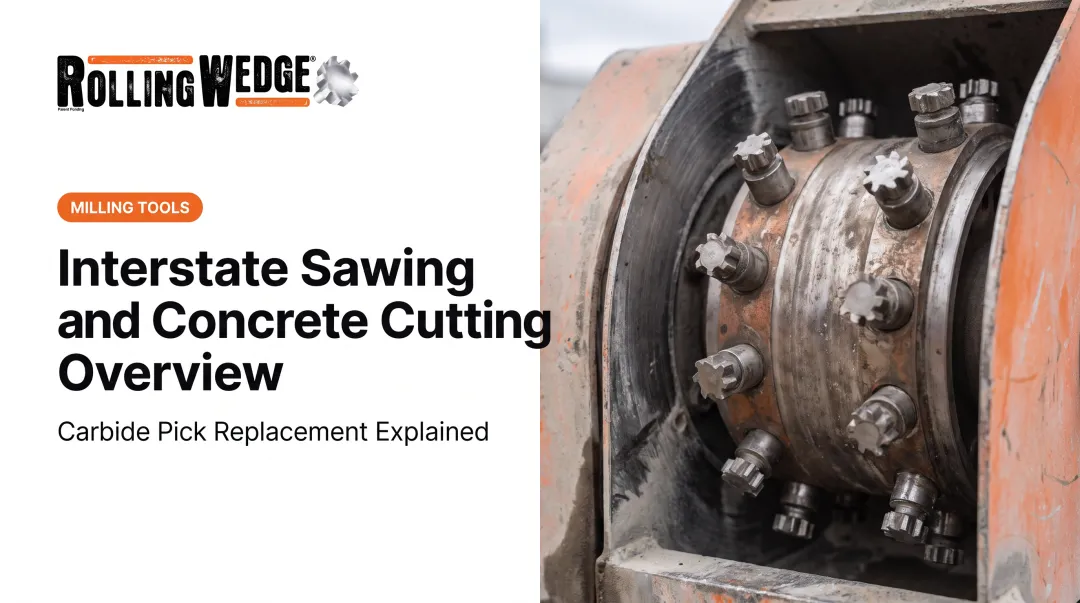
Those same job variables—mixed materials, reinforcement, and continuous production—also drive tool selection inside the milling system. Rolling Wedge manufactures Milling Drums and Milling Tools built around a rolling-wedging-lifting action, suited to mixed-condition joint work. Instead of the hammer-and-chisel action of a traditional carbide pick, the Milling Tool rolls over and away from the material, putting it into tension.
Concrete and asphalt carry roughly 20% of their compressive strength in tension, so the material pulls apart more readily. The tool geometry exploits that weakness rather than fighting it.

For contractors and municipalities working joints that mix sound concrete, spalled edges, and embedded steel, that matters because Rolling Wedge Milling Tools:
- Mill concrete, asphalt, many grades of rebar, and some concrete joint dowel bars without swapping tools mid-job
- Require no water for operation, only for optional dust suppression
- Allow a full 24-inch drum changeout in about 20 minutes, versus 1–2 hours for carbide picks
- Run 1-3 months between replacements, compared to twice-weekly swaps for carbide
None of this replaces a project's own testing or manufacturer documentation — verify tool suitability against the specific concrete strength, aggregate, and reinforcement on your job before committing.
Where Milling Fits Best
Milling is the stronger choice when:
- Joint material is damaged, contaminated, or irregular in shape
- Removal needs to go deeper or wider than a saw cut allows
- The section includes reinforcement or mixed hard materials
- Repeated saw passes would take longer than one milling pass
Saw Cutting vs Milling: What Is Better?
Neither method wins outright. The real question is whether you're creating a joint in sound concrete or rehabilitating one that's already failed.
Choose saw cutting when the job needs a straight, narrow, accurately placed joint with minimal material removal, typically in newly placed concrete or during a planned repair boundary cut.
Choose milling when the job needs deteriorated concrete removed, a joint widened or reprofiled, or work spanning concrete and asphalt in the same pass.
Compare the Whole Work Package, Not Just Tool Cost
Real job cost includes more than the tool:
- Mobilization and setup time
- Tool consumption and labor
- Slurry or debris disposal
- Traffic control and expected downtime
A cheaper blade doesn't help if water saturates the repair area and delays the next step. A fast milling pass doesn't help if cleanup takes twice as long.
A Practical Decision Checklist
Before choosing, run through these questions:
- What is the joint's actual purpose: new construction or existing repair?
- Is the surrounding concrete sound, or does it show spalling and deterioration?
- How much material has to come out?
- What dimensions does the spec call for?
- Is reinforcement or dowel steel present?
- How will debris or slurry get managed on site?
- What equipment is already available or compatible?
Site conditions push the decision further: access constraints, nearby traffic, noise limits, dust control, and whether the repair has to finish in a single pass.
If your team already runs Skidsteer or large milling equipment and keeps hitting mixed asphalt-concrete-rebar sections, talk with Rolling Wedge about compatible Milling Drums and Milling Tools before assuming another carbide swap is the only option. Rolling Wedge supplies the Milling Drum and Milling Tools installed on your equipment, not the Skidsteer, attachment, or milling machine.
Real-World Applications and Case Study Guidance
One clear data point on repair method comparisons comes from an FHWA field experiment on a Pennsylvania roadway northeast of Pittsburgh. Researchers compared saw-and-patch against mill-and-patch repairs at existing spalled joints using the same repair material.
| Repair Method | Mean Repair Life | Annual Adjusted Cost (per m³) |
|---|---|---|
| Saw-and-patch | 71.2 months | $3,032 |
| Mill-and-patch | 77.6 months | $1,026 |
The FHWA's Long-Term Pavement Performance study reported these figures as annualized, volume-normalized costs under stated assumptions — not a bid price per joint or per linear foot. Project scale, traffic control needs, and pavement condition all shift the numbers on any given job.
In this field test, mill-and-patch delivered both a longer average repair life and a lower adjusted cost. That aligns with FHWA guidance: saw-and-patch stays cost-effective for small, isolated repairs, while cold milling is more efficient for larger-scale deteriorated concrete removal.

The situational takeaway: saw cutting remains the clearer fit for precise joint creation. Milling remains the stronger fit when the job involves removal, rehabilitation, or profiling work that a blade alone can't handle efficiently.
Conclusion
Saw cutting and milling each solve different joint problems. Match the method to the job, not a blanket preference. Saw cutting suits precise, narrow, planned joints in sound concrete. Milling fits removal, rehabilitation, profiling, and mixed-material conditions common on older pavement.
Base the final call on:
- Joint purpose
- Concrete condition
- Required geometry
- Equipment capability
- Cleanup demands
Then verify the design with your project's responsible engineer and the applicable U.S. roadway specification before cutting or milling anything. If milling is the right call, contact Rolling Wedge for a Milling Drum or Milling Tools quote.
Frequently Asked Questions
Why are concrete joints sawed?
Saw cuts create a planned weakened plane so shrinkage- and temperature-related cracking happens along a controlled line instead of randomly across the slab. Timing and depth must follow the project's mix design and specifications.
What tool is used to cut joints in concrete?
Diamond-blade concrete saws, including walk-behind, ride-on, wet-cut, dry-cut, and early-entry models. The choice depends on concrete maturity, weather conditions, and whether raveling control is a concern.
What is a good joint filler for saw cut concrete?
There's no universal filler — the right choice depends on expected joint movement, exposure, traffic loads, and width. Check with the project engineer and the sealant manufacturer for a spec-approved material.
Is milling concrete the same as saw cutting?
No. Saw cutting produces a narrow blade kerf, while milling removes or profiles a much broader volume of concrete using a rotating drum or cutter.
When should a contractor mill a concrete road joint instead of saw cutting it?
Mill when the joint material is deteriorated, edges have failed, geometry is irregular, or the section mixes concrete with asphalt or reinforcement. A simple saw cut can't fix material that's already gone bad.
Can concrete milling remove reinforced or mixed-material sections?
Yes, with the right drum setup and tooling. Reinforcement type, spacing, and mill configuration all affect results, so confirm equipment capability and project limits before you select a tool for the job.