Pick the wrong machine and the fallout shows up fast — slower production, blown tooling budgets, a finish that doesn't match spec, or a crew standing around while dust settles. This guide breaks down how milling drums and abrasive tooling actually work, where each machine fits, and how to decide without guessing.
Key Takeaways
- Planers remove bulk material fast with a rotating drum; grinders refine surfaces with diamond tooling.
- Milling drums use replaceable picks or cutters; grinders use diamond segments or wheels.
- Match equipment to depth, finish, substrate, reinforcement, and dust rules — not just budget.
- On mixed asphalt-concrete or reinforced surfaces, a single-tool milling drum cuts tool-change downtime.
Concrete Planer vs Grinder: Quick Comparison
| Factor | Concrete Planer | Concrete Grinder |
|---|---|---|
| Removal method | Rotating drum with cutting tools chips, mills, and profiles the surface | Rotating abrasive discs or diamond segments grind, smooth, or polish |
| Typical application | Bulk removal, uneven-surface correction, roadway/slab profiling, joint prep | Coating and adhesive removal, smoothing, polishing prep |
| Best for | Fast, aggressive removal across large areas | Controlled refinement and finish quality |
Removal Depth and Finish
Depth numbers alone don't tell the whole story. The International Concrete Repair Institute ties removal method to concrete surface profile (CSP), not just millimeters removed:
- Grinding: typically CSP 1–3
- Scarifying: around CSP 5–8
- Rotomilling: CSP 7–9
Those bands track progressively rougher textures as the method gets more aggressive. A planer leaves a coarser, more textured surface by design. A grinder produces a smoother finish, though the exact result still depends on tooling and pass count.
Equipment and Tooling
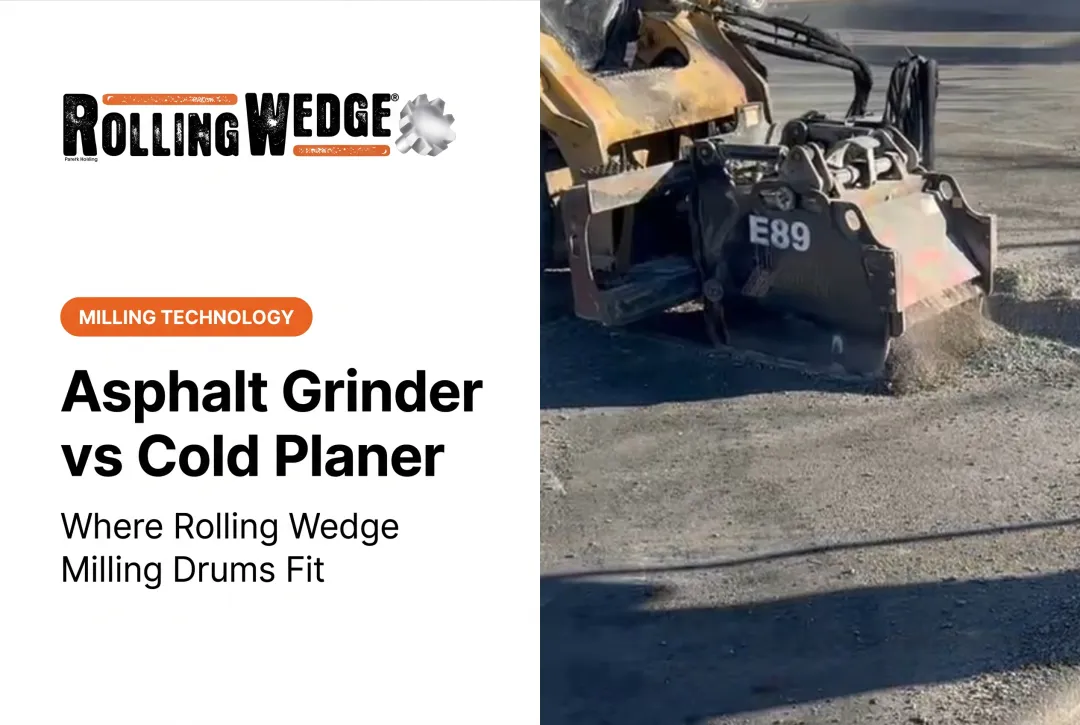
Planers range from walk-behind scarifiers to Skidsteer attachments to large road-milling machines. Rolling Wedge Milling Drums for Skidsteer planer attachments, for example, come in 18-, 24-, 30-, and 40-inch widths that fit existing rubber-tire and tracked machines. Rolling Wedge supplies the Milling Drum and Milling Tools, not the Skidsteer or the attachment.
Grinders scale differently:
- Handheld — edges, corners, small repairs
- Single-disc/rotary — aggressive correction, coating strip
- Planetary/walk-behind — even coverage on larger floors, polishing prep
Diamond bond and grit selection changes everything on the grinder side — softer bonds for harder concrete, harder bonds for softer or more abrasive slabs.
Decision shortcut: Choose a planer for fast, substantial removal or aggressive profiling. Choose a grinder for controlled refinement, coating removal, or a smoother final surface.
What Is a Concrete Planer?
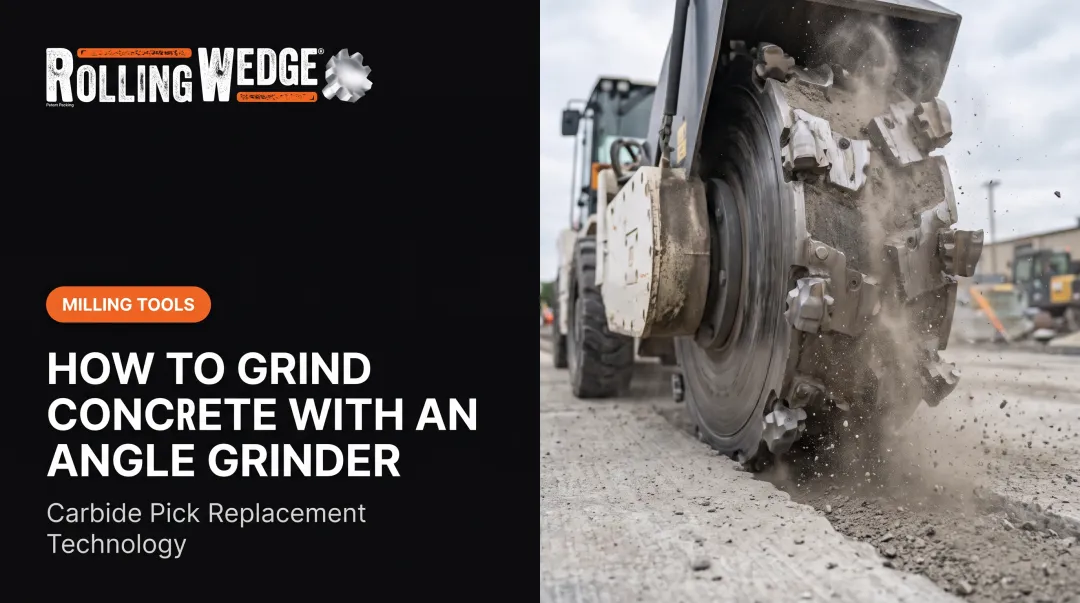
A concrete planer (also called a scarifier or milling machine) removes a controlled layer of concrete or asphalt using a powered rotating drum fitted with cutters. The sequence is straightforward: cutters strike or wedge into the surface, fracture the material, lift the debris, and leave behind a profiled finish ready for resurfacing or the next construction stage.
The drum and the individual cutting tools do different jobs. The drum is the rotating carrier that sets cutting width, tool layout, and the pattern left behind. The cutters (picks, teeth, or wedges mounted on the drum) determine how the machine actually engages the material, whether that's asphalt, concrete, or reinforced sections.
Several variables control how well a planer performs:
- Drum width and cutting depth
- Forward speed plus machine weight and power
- Cutter spacing and configuration
- Concrete hardness, aggregate type, and moisture
- Reinforcement such as wire mesh or rebar
The tradeoff is real. Faster bulk removal and precise profiling cut secondary work, but aggressive cutting brings more noise, vibration, and dust. Depth control and dust management can't be an afterthought.
Where Planers Earn Their Keep
Planers show up on jobs where you need to:
- Remove damaged or uneven concrete before resurfacing
- Lower slab elevations to match new grade
- Prepare bridge decks or roadway surfaces for overlay
- Texture concrete to improve bonding with new material
- Strip thick coatings or built-up deposits
Skidsteer-mounted planer attachments work well for accessible outdoor jobs and tighter sites with lean crews, with no need to mobilize a full-size milling machine. Larger walk-behind or road-scale milling equipment makes more sense once the project scale and production targets outgrow what a Skidsteer can deliver.
Mixed-material work (transitioning between asphalt and concrete on the same pass) is where tooling choice matters most. Always confirm reinforced-concrete or rebar compatibility with the tool manufacturer and project engineer before mobilizing; not every cutter is built for it.
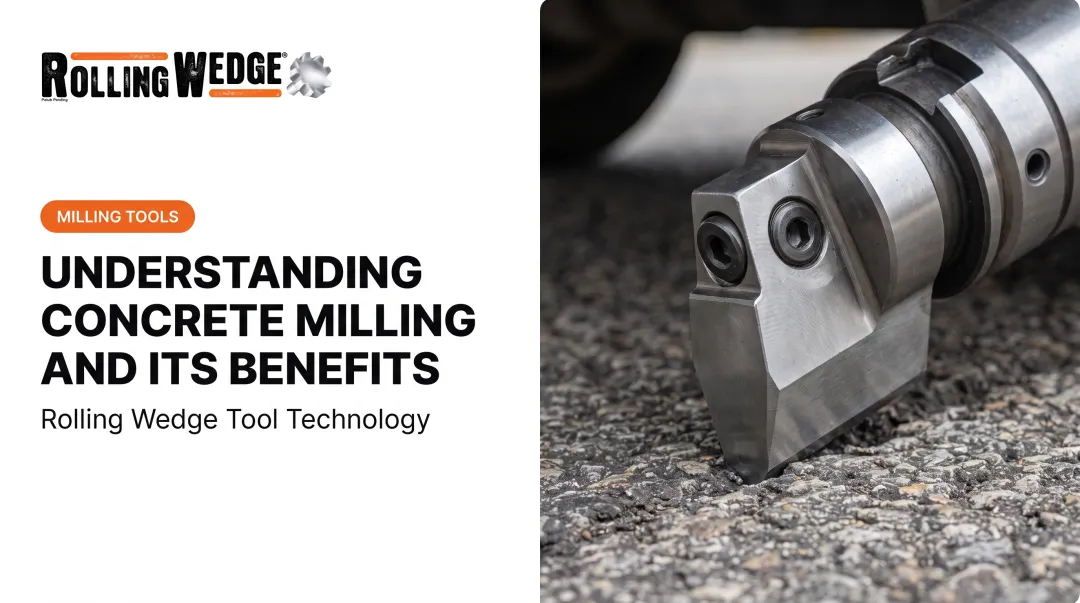
That tooling gap is where the Rolling Wedge Milling Drum system sits, with Milling Tools doing the main cutting and a few carbide picks kept at the cut edges. Instead of a fixed tooth taking the full impact, the tools roll over and away from the material, wedging and lifting it in tension rather than hammering.
The company reports tool replacement every 1 to 3 months versus twice weekly for carbide picks, and a full 24-inch drum changeout in about 20 minutes compared to 1–2 hours. Rolling Wedge also documents milling asphalt, concrete, and wire-mesh reinforced concrete in a single pass without swapping tools. Results depend on reinforcement grade and drum configuration, so confirm your application with Rolling Wedge before specifying on a reinforced job.

What Is a Concrete Grinder?
A concrete grinder uses abrasive tooling (commonly diamond segments or wheels) to strip surface contaminants, smooth irregularities, expose aggregate, or prep concrete for coatings and polishing. Unlike a planer's impact-driven cutting, a grinder cuts and abrades.
Grinders break down into a few main categories:
- Handheld grinders: edges, corners, small areas, detail work
- Single-disc/rotary grinders: aggressive surface correction, coating removal
- Planetary and walk-behind grinders: even coverage on larger floors, polishing prep
Match the category to project size, access, desired finish, and how much operator control the job demands.
Tooling and Dust Control
Diamond tooling selection drives the result. Segment bond, grit, shape, and segment count all change how a grinder performs on hard concrete, soft concrete, coatings, adhesive residue, or polishing prep. Harder concrete generally needs a softer bond; softer or more abrasive concrete needs a harder bond.
Dust management isn't optional. OSHA's construction silica standard sets different Table 1 controls depending on the machine: handheld grinders, walk-behind floor grinders, and drivable milling equipment each have their own requirements. The permissible exposure limit sits at 50 micrograms per cubic meter as an eight-hour average where exposure assessment applies.

Wet grinding, dust-collection shrouds, and indoor-specific HEPA cleanup between passes are not interchangeable. Pick the control that matches the actual operation.
Grinders excel at controlled refinement and finish quality. They're not the right tool when a substantial layer needs to come off fast — that's still a planer's job.
Where Grinders Earn Their Keep
Common grinder tasks include:
- Stripping paint, epoxy, glue, or laitance
- Smoothing high spots and minor imperfections
- Prepping a surface for coatings or overlays
- Transitioning from coarse grinding to polishing
Grinders are the better call indoors, in occupied spaces, on edges and detail work, or anywhere a refined finish matters more than raw removal speed. They are not a substitute for deep leveling or major profile correction; that calls for a planer, saw, or scarifier.
Grinder diamond consumables and planer cutters wear differently, too. The right choice always comes back to substrate hardness, contamination level, required finish, and expected production.
Concrete Planer vs Grinder: What Is Better?
Neither machine wins universally. The right call depends on how much material has to go, how fast, and what finish the next step requires.
Reach for a planer when the project involves:
- Significant removal, leveling, grooving, or profiling across a broad area
- A roadway, slab, bridge, or industrial surface where production and depth control outweigh a polished look
- Mixed asphalt-concrete conditions, subject to tooling compatibility
Reach for a grinder when the project involves:
- Thin coatings, adhesive, paint, or minor surface irregularities
- Prepping a floor for coating, overlay, or polishing
- Edges, confined areas, indoor work, or a smoother, more uniform finish
Compare total project cost, not just the purchase price:
- Machine cost — rental or ownership
- Labor — crew time on the actual task
- Consumables — cutter or diamond wear rate
- Dust control and disposal — collection, containment, and haul-off
- Rework and downtime — including tool-change frequency
Pre-job checklist:
- Concrete strength and aggregate type
- Reinforcement or embedded services
- Required depth and target profile
- Area size, access, and power
- Dust rules and operator experience
- Tooling compatibility
A two-stage workflow often makes the most sense: mill with a planer for bulk removal or profiling, then grind for smoothing or coating prep.

Whatever the sequence, follow the manufacturer's operating instructions, inspect cutters and guards, and locate utilities and reinforcement before you start. Control silica exposure with proper PPE and site dust controls.
Real-World Examples and Case Studies
A Minnesota-based contractor profiled by AsphaltPro reported significant efficiency and productivity gains after switching from carbide-pick drums to Rolling Wedge Milling Tools on asphalt work. Ask Rolling Wedge for current replacement-interval and cost data before you build them into a bid.
On the pavement side, a Missouri Department of Transportation technical brief documented by the American Concrete Pavement Association found that diamond grinding a section of U.S. 69 in Texas cut the International Roughness Index by 52%. That figure is a grinding outcome, not a planer-versus-grinder productivity test.
Combined workflows show up in the field regularly. A decorative concrete project in Duluth, Georgia used scarifying attachments to prep a broad river-shaped floor area for epoxy, then finished the edges by hand grinding where the scarifier couldn't hold the design detail.
That two-stage pattern is common on mixed-scope jobs:
- Planer for high-volume removal and profiling
- Grinder for controlled refinement and edge work
- Both when bulk removal must be followed by a smoother finish
If you're comparing Milling Drum options or tooling costs for a Skidsteer planer attachment or large milling platform, review Rolling Wedge's milling tool documentation, Rolling Wedge Milling Drums, and Milling Tools, or contact Rolling Wedge for a quote before you spec a system.
Conclusion
Planers and milling drums fit aggressive removal and profiling. Grinders and abrasive tooling fit surface refinement and finish preparation. Neither is universal. The job dictates the machine.
Before mobilizing equipment, confirm:
- Removal depth and target finish
- Substrate condition and reinforcement
- Area size and access constraints
- Dust-control requirements
- Tooling life and total project cost
Then verify compatibility and safety requirements with the manufacturer. Nail those inputs first, and the right machine choice follows. If a planer is the right fit, contact Rolling Wedge about Milling Drums and Milling Tools for the attachment or milling machine you already run.
Frequently Asked Questions
What is the best tool for cutting concrete?
It depends on cut type, depth, area, and finish required. Use a planer or milling drum for surface removal across a wide area, and a concrete saw when you need a clean, defined cut line.
Can you use a planer on concrete?
Yes. Concrete planers are designed for surface milling and scarifying. Confirm the machine, drum, cutter type, and depth setting match your concrete condition and dust-control requirements.
How much concrete will a concrete grinder remove?
Removal varies widely by grinder type, diamond tooling, concrete hardness, and number of passes. There's no universal depth figure. For deeper removal, a planer is generally the faster option.
What is the difference between a concrete planer and a grinder?
A planer uses a rotating cutting drum for aggressive material removal and profiling. A grinder uses abrasive diamond tooling for surface refinement, coating removal, and smoother preparation.
When should you use a concrete grinder instead of a planer?
Choose a grinder for thin coatings, adhesives, minor imperfections, edges, and polishing prep: anywhere deep bulk removal isn't necessary and finish quality matters more than speed.