Introduction
Ripping out an old driveway or a cracked parking lot sounds simple until the quotes start rolling in. Professional asphalt removal for a residential driveway now runs $3 to $7 per square foot, with a full project typically landing between $4,375 and $5,125, according to 2026 Angi pricing data.
That's a wide range, and it stretches even further once commercial lots and municipal road work enter the picture.
Removal costs vary this much because no two jobs share the same conditions. A thin, easy-to-reach driveway costs far less to tear out than a thick, reinforced parking lot tucked behind a narrow gate. The equipment a contractor brings, whether it's hand tools or a cold-planing machine, shifts the math even further.
This guide breaks down 2026 pricing by project size, the factors driving costs up or down, how removal methods compare, and where you can realistically trim your budget without cutting corners.
TL;DR
- Residential driveway removal costs $3-$7/sq ft, or $1,800-$4,200 for an average 600 sq ft driveway
- Commercial and municipal milling runs $1.83-$15/sq yd depending on depth and project scope
- Size, thickness, access, disposal fees, and removal method drive most of the cost swing
- Small, accessible, thin-asphalt jobs cost the least; large, reinforced surfaces cost the most
- Hand tools suit tiny areas; excavators and milling machines pay off on anything bigger
How Much Does Asphalt Removal Cost? (Pricing Overview)
Asphalt removal doesn't have one fixed price. Contractors calculate it per square foot or square yard, then adjust for thickness, base depth, and how many labor hours the job demands. A thin residential slab lands near the bottom of the range. A thick, reinforced commercial lot climbs toward the top, sometimes well past it once disposal and hauling are added.
Because that price swings so widely, homeowners and facility managers often fall into the same budgeting traps:
- Underestimating disposal and hauling fees, which are often billed separately from the removal quote itself
- Assuming DIY is cheaper, without factoring in tool rental, dump fees, and the actual hours involved
- Forgetting base repair or grading, which is almost always needed once the old surface is gone
- Skipping competing quotes, which often reveals a wide price gap between contractors for the same job
Typical Cost Ranges by Project Scale
| Project Scale | Typical Cost Range | Notes |
|---|---|---|
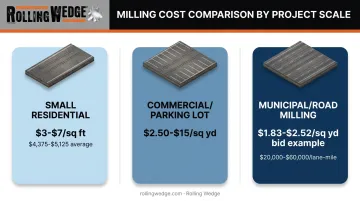
| Small residential (driveway/walkway) | $3-$7/sq ft ($4,375-$5,125 average) | 2026 Angi data |
| Mid-size commercial (parking lot/private road) | $2.50-$15/sq yd | Basic milling to full-depth removal |
| Large-scale/municipal (road milling) | $1.83-$2.52/sq yd (bid example); $20,000-$60,000/lane-mile | Varies by depth, quantity, mobilization |
These ranges typically cover breakup and haul-away. They rarely include disposal fees, base repair, or new surface installation, so ask contractors to itemize those separately.
Small Residential Projects
Small jobs cover driveways, walkways, and small patios. A typical quote includes:
- Basic breakup and haul-away of the existing asphalt
- Minimal site prep, since most driveways offer easy equipment access
- Little to no base repair unless the gravel underneath has shifted
These projects fit hand tools, jackhammers, or a rented mini excavator, especially under 1,000 square feet.
Commercial & Parking Lot Projects
Parking lots and private roads bring heavier equipment and more material to haul:
- Mobilization costs for excavators or milling machines, which take longer to set up than hand tools
- Larger disposal volume, since even a small lot generates several truckloads of debris
- Traffic control or phased removal if the lot stays partially operational during work
- Permit or inspection requirements, since many municipalities require sign-off before work begins on commercial lots
This scale suits HOAs, retail centers, and private road associations more than a DIY crew.
Large-Scale & Municipal Milling Projects
Municipal and DOT-scale projects typically use cold-planing or milling equipment instead of full excavation:
- Controlled-depth milling that leaves a surface ready for a new overlay
- Recycled millings, which can reduce disposal costs or get reused as base material
- Possible base prep if milling reveals cracking or drainage issues underneath
Municipalities, DOT contractors, and infrastructure rehab firms are the primary buyers at this scale.
Key Factors That Affect Asphalt Removal Cost
Pricing depends on more than square footage. The surface's technical specs, the site's logistics, and the equipment a contractor chooses can shift the final number by thousands of dollars on a single job.
Project Size and Square Footage
Most contractors price by square foot or square yard, but the rate itself isn't fixed. Larger footprints often lower the per-unit cost because mobilization and setup spread across more area. A 10,000-square-foot commercial lot rarely costs 25 times what a 400-square-foot driveway costs, since economies of scale kick in once a crew is already on-site.
Asphalt Thickness and Base Depth
Thicker asphalt takes longer to break and haul. A standard driveway runs 2-3 inches deep, while a commercial lot or road base can run 6 inches or more, often over a compacted gravel layer that also needs removal. Every added inch means more machine time, more tool wear, and more material to load and dispose of.
Removal Method & Equipment Used
The tool doing the cutting matters as much as the crew doing the work. Hand tools and jackhammers handle small areas fine but crawl on anything larger. Excavators speed up work on residential and mid-size commercial jobs. Cold-planing and milling machines dominate large-scale and municipal work because they remove asphalt to a controlled depth in a single pass.
Equipment efficiency also affects the bid. Contractors running rolling-drum milling systems, such as Rolling Wedge Asphalt Milling tools, process surfaces with fewer tool changes than traditional carbide-pick setups. Less downtime for tool swaps means a crew covers more square yardage per day, which can translate into more competitive bids on larger jobs.
Accessibility and Site Conditions
Narrow gates, steep driveways, and tight urban lots all add time before a single chunk of asphalt gets broken. Equipment has to be smaller, maneuvered more carefully, or hauled in over multiple trips.
Angi's 2026 data confirms accessibility as a recognized cost driver, though no published source sets a standard percentage premium for difficult access. Expect contractors to build an access allowance into the bid rather than quote a flat markup.
Disposal and Recycling Fees
Where the broken asphalt ends up changes the total bill. Landfill tipping fees vary by region and by season. Orange County's public disposal rate for qualifying loads sits at $67.76 per ton through June 2026, rising to $92.70 per ton starting that July.
Clean, qualifying asphalt accepted at recycling facilities can cost far less, or nothing at all, compared to mixed construction debris headed to a landfill.
Geographic Location and Labor Rates
Urban removal projects tend to cost more than rural ones, largely due to labor rates and logistics. Rural homeowner totals average $4,000-$4,300, while urban jobs can run up to $5,100 for a comparable driveway. Removal labor typically runs $16-$38 per hour and can account for up to 40% of total project cost.
Cost Breakdown: Removal Methods Compared
Total project cost is never one line item. It's mobilization, labor, disposal, and equipment expenses added together, and the mix shifts depending on which removal method a contractor uses.
| Method | Cost Structure | Best For |
|---|---|---|
| DIY hand tools/rental | One-time tool rental | Small areas under 500 sq ft |
| Jackhammer demolition | One-time (rental or contractor fee) | Mid-size residential jobs |
| Excavator demolition | One-time contractor fee | Larger residential and commercial jobs |
| Cold planing/milling | One-time, per lane-mile or sq yd | Municipal and large commercial projects |
| Disposal & recycling | Recurring, based on volume | Every project |
Cold planing and milling dominate large-scale work because the equipment removes a controlled depth in one pass and generates reusable millings instead of waste. A 2025 municipal bid in Huron, South Dakota priced 1.5-inch milling at $1.83 to $2.52 per square yard, depending on quantity.
The cutting tool on the drum determines how much of that per-yard price is overhead versus profit. Traditional carbide picks wear down fast and need frequent swaps, adding hidden labor costs to every job.
Rolling Wedge's rolling-wedging-lifting cutting action changes that equation:
- Lasts 1-3 months between tool swaps, compared to twice-weekly carbide pick changes
- Keeps the drum milling instead of idling for tool replacement
- Frees up labor hours contractors can redirect into tighter, more competitive bids
Contractors can check what that means on their own jobs with Rolling Wedge's Milling Cost Comparison Tool.

How to Save Money and Avoid Costly Budgeting Mistakes
Matching the removal method to project scale matters more than chasing the cheapest quote. A bargain excavator bid means nothing if the crew shows up with equipment too small for the job.
Ways to reduce cost:
- Reuse the existing base or pad instead of full excavation when it's structurally sound
- Choose contractors running efficient equipment (excavators or milling machines) over manual labor for mid-to-large jobs
- Bundle removal with new installation or resurfacing for package pricing
- Opt for recycling instead of landfill disposal wherever a facility accepts clean asphalt
Common mistakes to avoid:
- Focusing only on the upfront quote while ignoring disposal and hauling fees
- Underestimating how much poor site access adds to labor time
- Choosing the cheapest bid without confirming the contractor's equipment matches the job's scale, since undersized crews often cost more in delays than they save upfront
Conclusion
Asphalt removal cost swings on four things: project size, asphalt thickness, site access, and the removal method a contractor brings to the job. A small driveway with easy access might land near $3 per square foot. A thick commercial lot with tight access and heavy disposal fees can push well past that.
Chasing the lowest number on a quote rarely produces the best outcome. Understanding what's actually included, such as breakup, haul-away, disposal, and base repair, gives you a budget that holds up once work starts.
That said, pricing won't stay static. Milling technology continues to improve contractor efficiency, as tools that cut faster and last longer become standard equipment on job sites. As this technology spreads, homeowners and municipalities alike can expect more competitive pricing on large-scale removal projects throughout 2026.
Frequently Asked Questions
How much does asphalt removal cost?
Residential removal typically runs $3-$7 per square foot, or about $1,800-$4,200 for an average 600-square-foot driveway. Commercial and municipal projects price by the square yard instead, ranging from roughly $2 to $15 depending on depth and scope.
What is it called when you remove asphalt?
Full removal is often called asphalt demolition or excavation removal, while controlled-depth removal is known as cold planing or milling. Milling removes only a set depth rather than tearing out the entire surface.
What is the best method for removing asphalt?
Hand tools work for driveways and walkways under a few hundred square feet. Excavators handle mid-size residential and commercial jobs efficiently, while cold-planing or milling machines are standard for large-scale and municipal projects.
Is it cheaper to remove asphalt yourself than hiring a pro?
DIY can save on labor, but tool rental, dump fees, and the time investment often close the gap fast. Improper disposal or accidental utility damage can also turn a cheap DIY job into an expensive one.
Can removed asphalt be recycled, and does that lower costs?
Yes, recycled millings often sell for $10-$20 per ton and can be reused as base material. This can lower disposal costs compared to landfill tipping fees that now exceed $90 per ton in some regions.
How long does an asphalt removal project typically take?
A small driveway usually takes a day or two with hand tools or an excavator. Municipal milling crews move much faster, covering 14,000 to 17,000 square yards per day with dedicated machines.