Choosing the wrong type, though, comes with real consequences. Machine shops face poor surface finishes and premature tool failure. Contractors face slower jobs, more vibration, and higher fuel and labor costs from constant tooling changes.
This guide breaks down the main carbide tooling formats, what sets each apart, and how to match the right one to your material, machine, and production goals.
Key Takeaways
- Carbide tooling bonds tungsten carbide with a metal binder for hardness and heat resistance steel can't match.
- Inserts, solid tools, brazed tools, and picks cover different jobs—from precision CNC cuts to bulk surface removal.
- Choose tools by material, volume, and tolerance needs—not sticker price alone.
- In road milling, engineered carbide-pick alternatives cut tool wear and downtime.
What Is Carbide Tooling?
Carbide tooling refers to cutting tools made from cemented tungsten carbide: tungsten carbide (WC) particles fused with a cobalt or nickel binder through powder metallurgy and sintering. The result is a dense, extremely hard composite material that holds an edge far longer than conventional tool steel.
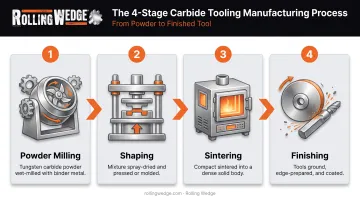
Manufacturing follows a defined sequence:
- Tungsten carbide powder is wet-milled with the binder metal
- The mixture is spray-dried and pressed or molded into shape
- The compact is sintered into a solid, dense body
- Finished tools are ground, edge-prepared, and often coated
You'll find carbide tooling on CNC lathes, mills, and drills in metal shops, but also on the rotating drums of skidsteer attachments and large-scale road milling machines. Machine shops and road contractors alike rely on it as a practical, everyday production tool.
Why Is Carbide Tooling Important?
Carbide's hardness and heat resistance directly translate into performance. Tools stay sharp longer at higher cutting speeds, which means fewer changeovers and lower cost per unit of material removed.
Without the right carbide tooling, shops and job sites run into predictable problems:
- Frequent, unplanned tool changes that eat into production time
- Poor surface finish quality that leads to rework
- Unplanned downtime from tool failure mid-job
- Rising operating costs as replacement frequency climbs
The stakes go beyond cutting performance in heavy equipment applications. On a road milling machine, the wrong tooth or pick choice can increase machine vibration and hydraulic strain, not just wear out faster.
That added stress on hydraulic components and drum bearings shortens equipment life and stacks up repair bills well beyond the tooling cost. Project delays follow close behind, since a machine running rough or losing teeth mid-shift has to stop.
Types of Carbide Tooling and Their Uses
Carbide tooling isn't one-size-fits-all. The type that makes sense for you depends on how the carbide is shaped, mounted, and applied to the material you're cutting.
These types split into two general worlds:
- Precision tooling for metal, wood, and composite machining
- Heavy-duty tooling for construction-grade surface milling
Carbide Inserts (Indexable Tooling)
Indexable inserts are replaceable carbide tips clamped into a reusable tool holder, instead of a fixed cutting edge. They're standard in turning, facing, threading, grooving, and face milling operations.
What sets inserts apart is the swap: instead of sharpening or replacing an entire tool, you exchange the worn tip. According to Kennametal's guide on selecting carbide inserts, a worn insert can be exchanged in seconds without losing tool position or needing to touch off again.
Best suited for:
- High-volume production shops running multiple part geometries
- Machining centers that need fast changeovers between jobs
Key strengths:
- Cost-efficient tip replacement instead of full tool replacement
- Wide range of grades and coatings for different work materials
- Minimal downtime between production runs
Limitations: Inserts aren't ideal for very small or intricate features, and matching insert geometry to the holder and application takes some know-how.
Solid Carbide Tools (End Mills, Drills, Reamers)
Solid carbide tools are machined from one piece of carbide, no holder or braze joint involved. They're common for milling, drilling, and reaming metals, plastics, and composites.
The single-piece construction is what separates these from inserted or brazed designs. That solid body gives higher rigidity and precision. Modern Machine Shop notes that this rigidity is what lets solid-carbide drills hold tight tolerances over long production runs, particularly on small-diameter holes where indexable tools aren't practical.
Best suited for:
- Tight-tolerance precision work
- Small-diameter tooling applications
- High-speed CNC operations
Key strengths:
- Excellent dimensional accuracy
- Can be reground and resharpened multiple times before retirement
Limitations: Higher upfront cost than inserts, and a chipped edge often means sending the whole tool out for regrinding rather than swapping a tip.
Brazed Carbide Tools
Brazed carbide tools have a carbide tip bonded onto a steel shank or body using a braze joint. This construction shows up in saw blades, router bits, and some general-purpose lathe tools.
Rather than being all-carbide, brazed tools combine carbide's hardness at the cutting edge with a tougher, more affordable steel body behind it.
Best suited for: Woodworking and general-purpose cutting jobs where the cost of full solid-carbide construction isn't justified.
Key strengths:
- Lower cost than solid carbide
- Steel shank resists breakage under impact better than a carbide-only tool would
Limitations: The braze joint itself is the weak point. Carbide and steel expand at very different rates when heated, and residual stress can build in the joint as it cools, particularly under repeated heat cycles. That makes brazed tools a poor fit for the highest-precision applications.
Carbide Picks and Teeth (Heavy Equipment & Road Milling)
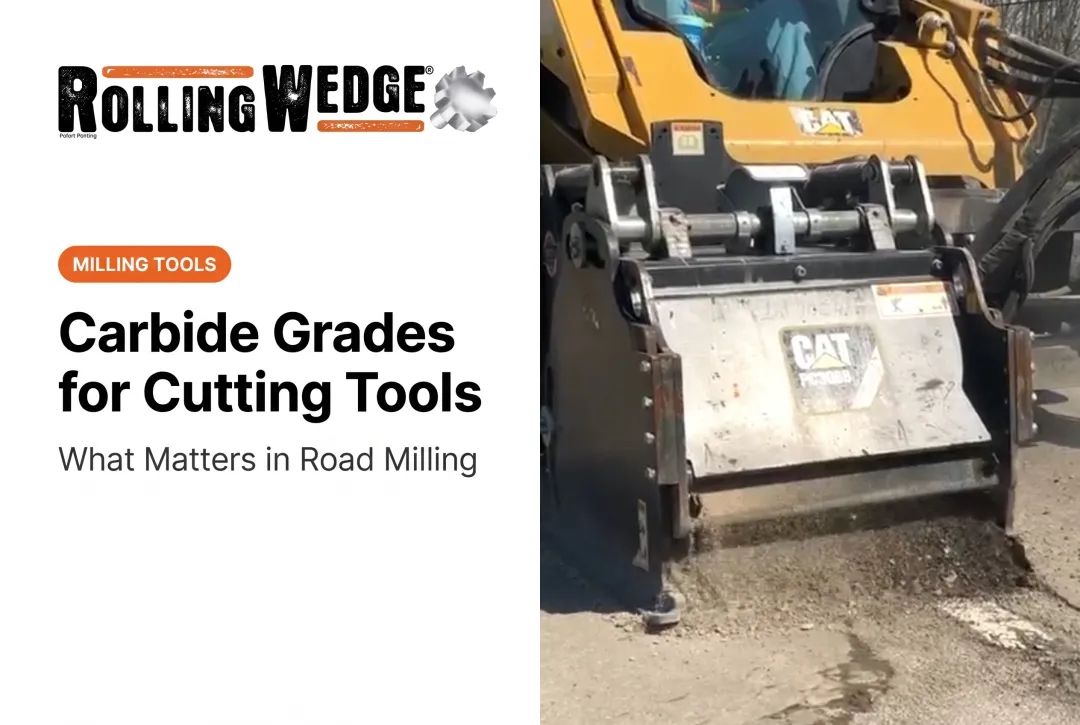
Carbide picks are individual carbide-tipped teeth mounted on rotating drums that mill asphalt, concrete, and rock surfaces. You'll see them on skidsteer attachments, cold planers, and large-scale milling machines.
These aren't shaping tools—they're bulk-removal tools engineered for high-impact, abrasive material removal rather than fine precision work.
Best suited for: Contractors, municipalities, and road rehabilitation crews milling asphalt, concrete, or mixed hard surfaces.
Key strengths: Capable of removing large volumes of hard surface material quickly across big job sites.
The trade-off: Traditional carbide picks take a beating. They're forced directly into abrasive material, generating significant heat, and often need water just to stay cool. As they wear, they develop bounce that shakes the entire machine and operator.
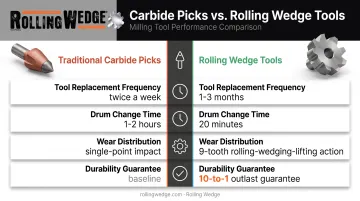
Rolling Wedge, based in Peoria, Illinois, addresses those heat and bounce problems with a different cutting method. Its patented Rolling Wedge Milling Tools use a rolling-wedging-lifting action: nine carbide teeth per tool roll and rotate across the surface at an angle, placing the material into tension rather than hammering it. Carbide picks still have a place here: eight picks, four at each end of the drum, cut a square edge and corners.
The result is a steadier cut with less bounce than impact-style picks. Results reported in the same milling environments include:
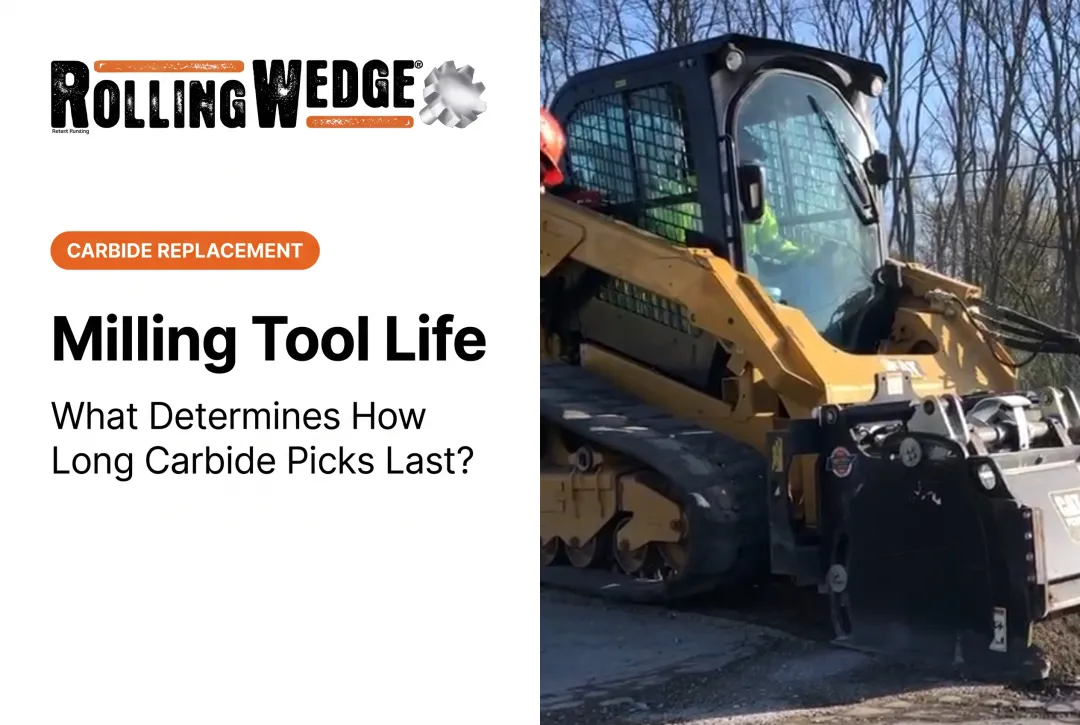
- Tool replacement every 1 to 3 months, versus roughly twice a week for traditional carbide picks
- Full 24-inch drum change in about 20 minutes, versus 1 to 2 hours for a comparable pick changeout
- Reported operating lives for Rolling Wedge tools of 10x and longer than traditional picks in asphalt milling
How to Choose the Right Type of Carbide Tooling
The right type depends on your material, your machine, and your production goals, not on what's familiar or what a competitor happens to run.
Weigh these factors before you commit to a tool:
- Material being cut or milled — metal, wood, composite, asphalt, or concrete each call for a different carbide format
- Production scale — one-off jobs tolerate higher per-unit cost better than continuous, high-volume operations
- Tolerance and finish requirements — precision machining needs a different tool than bulk surface removal
- Equipment compatibility — check tool holder type, spindle specs, or milling drum design before buying
- Total cost of ownership — weigh the purchase price against replacement frequency and downtime, not just the invoice total
That last point matters more than most buyers realize. A tool that lasts three months costs less over a year than a cheaper pick replaced twice a week, once you factor in labor and machine downtime for each swap.
Rolling Wedge pricing is available on request, with quantity-tiered volume discounts - contact Rolling Wedge for current options. A Try & Buy (20-day evaluation) lets contractors run that comparison on their own equipment before switching fleets.
Mistakes to Avoid When Finalizing Your Choice
- Overbuying capability. Choosing the most advanced, expensive carbide grade or coating when a standard type performs the job just as well wastes budget.
- Ignoring known weak points. Braze joints are heat-sensitive. Solid carbide is brittle under vibration. Learn these limits before a failure on the job teaches you the hard way.
- Skipping a real-world trial. Spec sheets and price lists will not show how a tool behaves in your mix of materials and machine setup. Test before you commit a full drum.
Conclusion
Carbide tooling serves two distinct settings: precision metal and wood machining, and heavy-duty surface milling on job sites. Inserts, solid tools, brazed tools, and picks each exist to serve a different material, production scale, and performance need.
Knowing these distinctions—and where newer engineered alternatives fit—helps operators and contractors choose tooling that cuts downtime and long-term cost, not just the option that looks cheapest on day one.
Frequently Asked Questions
What is carbide tooling?
Carbide tooling refers to cutting tools made from tungsten carbide particles bonded with a metal binder, usually cobalt. These tools offer extreme hardness and wear resistance compared to standard tool steel.
Why is carbide tooling so expensive?
Raw tungsten and cobalt carry real market costs. USGS reported 2024 prices of about $12 per pound for cobalt and $250 per dry metric ton unit for tungsten trioxide concentrate. Factor in powder metallurgy and sintering costs, and longer tool life still justifies the price for most jobs.
Is HSS better than carbide tooling?
HSS is cheaper and tougher, making it a solid choice for low-speed or budget-conscious jobs. Carbide wins on cutting speed, heat resistance, and tool life for most modern machining and milling applications.
Can you grind carbide tools?
Yes. Solid carbide and inserted tools can be reground and resharpened using diamond wheels. Brazed and pick-style tools have more limited regrinding options because of braze joint and remaining-material constraints.
How often does carbide tooling need to be replaced?
Replacement intervals depend on tool type and job severity. Heavy-duty picks in road milling can need changing twice a week, while precision inserts and solid tools last much longer. Newer tooth designs, like Rolling Wedge's, often stretch that interval to one to three months.
What's the difference between carbide inserts and solid carbide tools?
Inserts use replaceable tips in a tool holder, allowing fast changeovers without touching the whole tool. Solid carbide tools are one piece, offering higher rigidity but requiring full regrinding or replacement once the edge is worn or chipped.