Introduction
If you're pricing out a new driveway, someone at the aggregate yard has probably already asked which recycled material you want: crushed concrete or asphalt millings. Both cost a fraction of poured concrete or fresh asphalt, and both keep demolition debris out of landfills.
But they're not interchangeable. Crushed concrete drains like a French drain. Asphalt millings pack down like a mini asphalt road. Pick wrong, and you'll deal with pooling water, rutting, or a surface that needs regrading every spring.
That decision is only getting more common. Recycled paving materials aren't a niche choice anymore—the National Asphalt Pavement Association reported that 101.4 million tons of reclaimed asphalt pavement went into new asphalt mixtures in 2024, a 6% jump from 2023 and up more than 81% since 2009.
This guide breaks down what each material actually is, where it performs best, and how to match it to your soil, climate, and traffic.
Key Takeaways
- Crushed concrete wins on drainage and load-bearing strength from recycled demolition aggregate
- Asphalt millings self-bind under compaction for a firmer, water-shedding surface
- Main trade-off: drainage and heat reflection versus a tighter bonded surface
- Light traffic and drainage-sensitive lots favor crushed concrete; heavier traffic favors millings
- Both cost far less than virgin aggregate, but soil and climate matter more than price alone
Crushed Concrete vs Asphalt Millings: Quick Comparison
Here's how the two materials stack up on the factors that actually affect driveway performance:
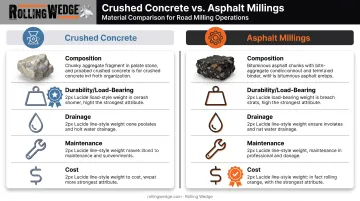
| Factor | Crushed Concrete | Asphalt Millings |
|---|---|---|
| Composition | Recycled demolition concrete; rebar removed; graded gray/white aggregate | Reclaimed pavement with bitumen that keeps binding properties |
| Durability & load-bearing | Angular particles interlock into a stable, high-strength base | Compacts and re-bonds over time; may soften in extreme heat |
| Drainage & permeability | Porous surface reduces pooling (varies with gradation) | Compacts tight and sheds water off the surface |
| Maintenance | Periodic releveling in high-traffic zones | Minimal once compacted; resurface after many years |
| Cost | Roughly $13–$20 per ton (grade and region vary) | About $13 per ton when supply is available |
| Availability | Steady from demolition sites and aggregate yards | Seasonal; depends on nearby road work |
Millings pricing holds near the low end when local resurfacing projects feed yards, but supply can tighten fast in markets without active milling work.
What Is Crushed Concrete?
Crushed concrete is demolished concrete from sidewalks, foundations, and old driveways, run through a crusher after the rebar is pulled out. What comes out the other end is a graded, gray-and-white aggregate that looks like gravel but performs differently underfoot.
It's popular for driveways because it does something asphalt millings can't: it lets water pass through instead of pooling on top.
Core benefits include:
- Porous structure that cuts standing water and erosion (permeability still depends on gradation and fines)
- Angular, jagged particles that interlock tightly under compaction
- Light gray color that stays cooler than dark millings in summer sun
The Federal Highway Administration reports CBR values between 90 and over 140 for processed reclaimed concrete used as granular base. That strength is a big reason it holds up under driveway loads.
Grades and Particle Size
Crushed concrete typically ships in a few standard gradations, labeled by top size (such as 3/4-inch minus or 1.5-inch minus). Finer grades compact into a smoother surface but drain slightly less. Coarser grades drain faster but leave a rougher top layer that takes longer to settle underfoot.
Use Cases of Crushed Concrete
Crushed concrete works best where drainage matters more than a polished finish:
- Driveway sub-base under gravel, pavers, or asphalt
- French drain fill around perimeter drains
- Low-traffic surfaces such as rural driveways, equipment yards, and pool walkways
- Landscaping backfill and pathway base for low-load jobs
One caveat: bearing strength and drainage aren't automatically linked. A dense, fine gradation can carry heavy loads while still draining poorly, so ask your supplier about fines content, not just the CBR number.
What Are Asphalt Millings?
Asphalt millings are what's left when a milling machine grinds up an old road surface during resurfacing. Contractors screen the material and sell it as a driveway aggregate instead of hauling it to a landfill. Because the bitumen binder is still active, millings have a trick crushed concrete doesn't: they self-bind under pressure.
Compact millings with a plate compactor or roller, and the residual binder softens just enough to fuse the particles into a surface that behaves like real asphalt, without the cost of a fresh pour.
Core benefits include:
- Self-bind under pressure to reduce rutting and form a firmer top layer than loose gravel
- Need far less upkeep once compacted than gravel that constantly requires regrading
- Ride closer to real asphalt than crushed concrete, especially after a season of settling
Why Milling Quality Varies
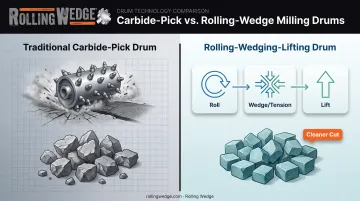
Milling quality depends heavily on the equipment that produced the material. Traditional carbide-pick drums cut through pounding and pressure, which can leave a grooved surface and inconsistent particle sizes.
Drums built around a rolling-wedging-lifting action, the approach behind Rolling Wedge Asphalt Milling tooling, roll into the pavement, place it in tension, and lift the cuttings away instead of striking them. That yields more uniform, cleanly cut spoils that are easier to haul, screen, and reuse. When you source millings, upstream drum technology can mean the difference between a consistent product and a mixed bag of oversized chunks and fines.
Particle size matters too. Coarser millings drain and compact faster but leave a rougher texture. Finer millings pack tighter and finish smoother, but need more passes with a compactor to bond well.
Where Asphalt Millings Work Best
Asphalt millings work best where firmness and low maintenance matter more than drainage:
- Primary driveway surfaces, especially where heavier vehicles are common
- Temporary access roads on construction sites and rural properties
- Parking lot overlays when a firm finish is needed without a full repave
According to Minnesota DOT testing on aggregate roads, a 70% RAP surface blend produced the least dust after one year of traffic and most closely matched all-aggregate durability. Compacted millings at higher RAP content can outperform plain gravel on erosion and surface stability.
Crushed Concrete vs Asphalt Millings: Which Is Better for Your Driveway?
There's no universal winner here. The best material depends on your site, not a spec sheet. Weigh four factors before deciding:
- Rainfall and drainage: heavy clay soil or a low spot that collects water favors a porous material
- Traffic volume: daily truck or trailer traffic wears differently than a car pulling in twice a day
- Climate extremes: hot summers and freeze-thaw winters change how each material behaves
- Desired finish: a rougher, gravel-like look versus a smoother, asphalt-like surface
Choose crushed concrete if drainage is your top priority, traffic stays light, or you're in a hot climate and want a lighter surface that reflects heat instead of absorbing it.
Choose asphalt millings if you need a firmer, smoother, more asphalt-like surface for heavier vehicles or trailers, and you want minimal upkeep after the initial compaction.
Why Asphalt Millings Quality Varies
Material choice is only half the decision. Two loads of millings can behave very differently once they hit your driveway.
Quality starts upstream of the aggregate yard—with the milling machine and tooling that produced the spoils. Worn carbide picks tend to leave grooved, uneven output. Keeping tool wear even across the drum helps give a cleaner cut, and cleaner, more uniform cuts yield millings that grade easier and compact with fewer soft spots.
That link shows up in the field. Rolling Wedge's "Making the Cut" case study follows a Minnesota contractor who moved off traditional carbide-pick tooling to a rolling-wedging-lifting drum setup. With fewer mid-job tool changes, the crew produced more consistent spoils per shift - the kind of uniform millings that finish smoother after compaction.
If you go with millings, ask your supplier where the material came from and how it was produced. Consistent, cleanly cut millings are what give you the firmer, lower-upkeep surface you're paying for.

Conclusion
Neither material wins outright. Match the material to what your site needs most:
- Crushed concrete: drainage and heat reflection for light traffic, flat or clay-heavy lots, and hot climates
- Asphalt millings: durability and a firmer, low-maintenance surface for daily vehicle traffic, heavier loads, and minimal upkeep
Both cost a fraction of poured concrete or fresh asphalt, and both keep usable material out of landfills. The right choice comes down to your site's drainage, expected traffic, and climate, not just the price per ton.
Whichever you pick, source it from a supplier who can speak to the material's gradation and origin. And if you're producing millings rather than buying them, the milling drum behind the material matters just as much as the material itself.
Frequently Asked Questions
Can I use asphalt millings as a base for concrete?
Not typically. Millings can shift, and residual binder can interfere with a clean bond, so compacted crushed stone or crushed concrete makes a more reliable sub-base for poured concrete.
Is crushed concrete cheaper than asphalt millings?
The two are usually priced similarly per ton. Regional availability and delivery distance tend to affect your final cost more than the material choice itself.
Which lasts longer for a driveway, crushed concrete or asphalt millings?
Asphalt millings generally hold up longer thanks to their self-binding surface, while crushed concrete may need more frequent releveling in high-traffic spots.
Can crushed concrete and asphalt millings be mixed together?
It's uncommon, but blending them for a base layer is possible. For the surface layer, keeping the material uniform gives you more predictable compaction and a more even finish.
Do asphalt millings need to be sealed after installation?
No sealing is required unlike with fresh asphalt. Proper compaction, using a plate compactor or roller in layers, matters far more than any sealant for the surface to bond correctly.
How do you properly compact crushed concrete or asphalt millings for a driveway?
Prepare a stable base, spread material in 2 to 4 inch lifts, and compact each lift with a plate compactor or roller before adding the next. Moisture content and even spreading matter as much as the equipment.