That question trips up a lot of equipment owners. The short answer: mostly, but not automatically.
Most skidsteers share a standardized mounting system, so the attachment will probably bolt right up. But "it fits" and "it works correctly" are two different things. Hydraulic flow, lift capacity, and electrical controls all have to line up too.
This guide breaks down the quick-attach system, where compatibility gets tricky, the attachment types worth knowing, and exactly how to verify fitment before you spend a dime.
Key Takeaways
- Most modern skidsteers share a standard quick-attach plate—physical fitment across brands is rarely the issue
- A matching mount still doesn't mean matching hydraulics, weight capacity, or electrical controls
- Specialized tools like cold planers and high-flow mulchers need extra scrutiny beyond the plate
- Always verify specs before buying cross-brand, especially online
What Is the Universal Skidsteer Quick Attach (SSQA) System?
The Skidsteer Quick Attach system, sometimes called Universal Quick Attach or Bobcat-style attach, is a standardized mounting plate with locking levers or pins. It's the reason you can swap a bucket for a set of forks in under a minute without tools.
Bobcat introduced this mounting system, known as Bob-Tach, back in 1970. It caught on. Decades later, most major manufacturers building full-size skidsteers, including Caterpillar, Case, Gehl, Kubota, and John Deere, use plates built to the same general geometry.
That shared format is exactly why an attachment built for one brand can physically mount to a machine from another.
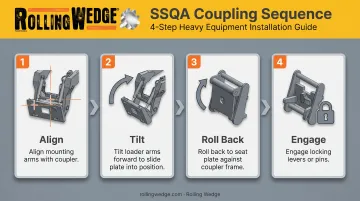
Here's how the coupling process typically works:
- Align the attachment's mounting arms with the skidsteer's coupler
- Tilt the loader arms forward to slide the plate into position
- Roll back slightly to seat the plate against the coupler frame
- Engage the locking levers or pins to secure the connection
Simple enough. But SSQA only solves the mounting problem. It says nothing about whether the attachment will run correctly once it's locked on, which is a separate question from whether it fits.
Why "Universal" Doesn't Always Mean Fully Interchangeable
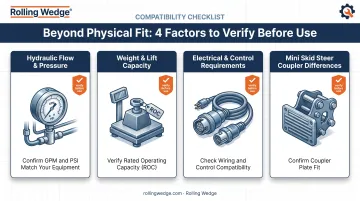
A plate that fits isn't the same as a machine that's ready to run the tool. Four factors separate "it mounted" from "it works the way it's supposed to."
Hydraulic Flow and Pressure Requirements
Powered attachments such as augers, trenchers, brush cutters, mulchers, and cold planers all draw hydraulic fluid from your skidsteer's auxiliary circuit. If the flow or pressure doesn't match what the attachment needs, you'll get sluggish performance at best and burned-out components at worst.
Flow requirements vary by manufacturer, but general industry ranges look like this:
| Flow Type | Typical GPM | Typical Pressure |
|---|---|---|
| Standard flow | 17-24 GPM | ~3,000-3,500 PSI |
| High flow | 30-38 GPM | ~3,000-3,500 PSI |
These figures come from CASE's own hydraulics guidance, and other OEMs list similar but not identical ranges. There's no single universal number, so check your specific machine's spec sheet rather than assuming.
Milling attachments are a good example of why this matters. A Skidsteer planer fitted with a Rolling Wedge Milling Drum still mounts through the same SSQA plate as any other skidsteer tool.
The smoother, bounce-free cutting action and reduced tool wear still depend on adequate hydraulic flow to the drum. Mount it on an underpowered circuit, and you lose the performance the tool was built to deliver.
Machine Size, Weight, and Lift Capacity
Every skidsteer has a rated operating capacity (ROC), the manufacturer's stated safe lifting limit. Bobcat defines this as typically 50% of tipping load, meaning the point where the rear wheels would theoretically lift off the ground.
Bolt a heavy attachment onto a machine that's too small, and you eat into that stability margin fast. A smaller skidsteer running an oversized grapple or mulcher can tip forward or lose steering control, especially with the load extended.
Before you mount a heavy tool:
- Compare attachment weight (plus payload) against your machine's ROC, not just tipping load
- Remember that load distance from the machine's center matters as much as raw weight
- Add counterweights when heavier combinations push safe operating limits
Electrical and Advanced Control Requirements
Attachments with rotating heads, variable-speed drums, or solenoid-controlled functions typically need matching wiring or a control kit. Bobcat, for instance, sells a dedicated 7-pin attachment control kit for tools like angle brooms, planers, and stump grinders, with fitment tied to specific models and serial numbers.
Here's the catch: connector pin-outs aren't standardized across brands. One industry trade analysis notes there's no ISO standard governing these electrical connections, which means the plate can seat perfectly while the advanced features simply don't respond.
Mini Skidsteers and Non-Standard Couplers
Mini skidsteers, older full-size models, and some compact loaders often use proprietary or undersized couplers instead of the full SSQA plate. If you're trying to run a standard attachment on a mini machine, you'll likely need an adapter plate designed to bridge the two mounting formats. Skip this step, and the attachment simply won't seat.
What Attachments Can You Put on a Skidsteer?
Skidsteers handle a wide range of jobs, but not every attachment carries the same compatibility risk.
Safe to swap with minimal fuss (mechanical fit is usually the only concern):
- Buckets
- Pallet forks
- Landscape rakes
- Non-hydraulic grapples
Hydraulic-powered attachments that need spec-checking:
- Augers
- Trenchers
- Snow blowers
- Rotary brooms
- Hydraulic grapples
Specialty and heavy-duty categories requiring brand-specific configuration:
- Stump grinders
- High-flow mulchers
- Cold planers and milling drums
Cold planers and milling drums sit in that last group - and the cutting tools on those drums matter as much as the attachment itself. Rolling Wedge Milling Tools use a nine-tooth carbide design and rolling-wedging-lifting action to cut asphalt, concrete, and rebar-reinforced surfaces in a single pass. Mixed-material work like that is why hydraulic and control specs matter far more with milling equipment than with a bucket.
A few growing categories round out the list: concrete mixing and pouring attachments, log splitters, and vacuum lifting systems for handling pipe or heavy materials without a crane.
How to Confirm Compatibility Before You Buy
Skip the guesswork. Follow this checklist before any cross-brand purchase:
- Pull your owner's manual or spec sheet. Look for quick-attach type, hydraulic flow/pressure range, and rated operating capacity.
- Measure the coupler yourself if documentation isn't available. Check plate width, height, and pin placement against the attachment's listed dimensions.
- Call the dealer or manufacturer directly, especially when buying cross-brand or from an online listing. Reference your exact model and serial number.
- Use manufacturer fitment tools. Bobcat and Caterpillar both offer model-based attachment search tools that flag sizing and hydraulic compatibility before you commit.
For specialty tools like milling drums, Rolling Wedge's technical team can walk through installation drawings, parts lists, and mounting specifics on request. That help is especially useful when you're pairing equipment across brands like Bobcat, Caterpillar, or Kubota.
Common Mistakes to Avoid
Three errors show up again and again with cross-brand attachment purchases:
- Assuming "universal" means fully compatible. A plate that fits does not confirm hydraulics or controls will work correctly.
- Overloading a smaller machine. Exceeding rated operating capacity erodes your stability margin fast, especially with extended or heavy attachments.
- Ignoring mini skidsteer differences. Standard SSQA fitment often fails on a mini or older machine; an adapter plate is usually required.
Frequently Asked Questions
Are skidsteer attachments universal?
Most attachments physically mount via the standardized SSQA plate found on major-brand machines. True compatibility also depends on matching hydraulic flow, weight capacity, and control specs to your specific carrier.
What attachments can go on a skidsteer?
Everything from buckets, forks, and rakes to augers, mulchers, and specialized tools like cold planers. The exact list your machine can run depends on its hydraulic flow capacity and lift rating.
Can I use a Bobcat attachment on a Caterpillar skidsteer?
Generally yes, since both use SSQA-style plates. Still verify hydraulic flow, pressure, and weight specs against your Caterpillar model before buying.
What's the difference between standard-flow and high-flow hydraulics?
Standard flow typically runs 17-24 GPM, while high flow spans roughly 30-38 GPM depending on the manufacturer. Running a high-flow attachment on a standard-flow machine usually means weak performance and slower cycle times.
Do all skidsteers use the same quick-attach plate?
Most modern full-size skidsteers share the same SSQA-style plate. Mini skidsteers and older models often use proprietary couplers that need an adapter plate.
How do I know if a specific attachment will work with my skidsteer?
Check your owner's manual for hydraulic and weight specs, compare them against the attachment's requirements, and confirm fitment with the dealer or manufacturer before purchasing.