Skip it, and the risks stack up fast: unplanned downtime, higher replacement costs, rough surface finish, and safety hazards from worn tools that jam or kick back.
This guide covers why maintenance matters, the four types of maintenance, warning signs to watch for, a sample schedule, and how tool technology itself affects how often you need to service anything at all.
TL;DR
- Preventive maintenance cuts downtime and unplanned failures on milling equipment
- Match the job to one of four maintenance types: routine, corrective, predictive, or overhaul
- Watch for uneven wear, vibration, rotation problems, and pattern defects in the milled surface
- A structured daily-to-annual schedule extends tool life and keeps machinery online
- Durable tool design, like Rolling Wedge's rolling-wedging-lifting system, reduces how often preventive maintenance is needed
Why Preventive Maintenance for Cutting Tools Is Important
Maintenance discipline protects the return on a machine that costs hundreds of thousands of dollars and the crew hours running it.
Performance takes the first hit. A dull or damaged tool doesn't just cut worse. It forces the machine to work harder for the same result, straining the drum, holders, and drivetrain.
Tool life itself is unpredictable without good data. There's no universal replacement interval for carbide picks. Life depends on material, cut depth, and travel speed.
In especially abrasive, heavy-cut conditions, some crews report changing tools every 30 minutes just to keep pace (For Construction Pros, 2008). That's an extreme case, not a planning benchmark, but it shows how fast neglect compounds.
Safety is on the line too. A worn tooth left in service can:
- Wear into the holder and drive up secondary repair costs
- Cause uneven rotation and vibration that fatigues the operator
- Increase the risk of jamming or kickback during the cut
Industry-wide cost comparisons between preventive and reactive maintenance are hard to pin down; no dated source publishes a road-milling-specific downtime dollar figure. Field experience is still clear: planned inspection and replacement cost less than emergency tool swaps, lost production hours, and secondary drum damage.
Build your own cost model from crew rates, traffic control costs, and actual tool spend rather than a generic number.
Types of Maintenance for Cutting Tools
Your maintenance approach should match the tool, the application, and how hard you're running it. Asphalt, concrete, and rebar-reinforced surfaces all wear tools differently.
Four approaches cover most milling operations—from daily upkeep to full overhauls.

Routine / Preventive Maintenance
This is your baseline—scheduled cleaning, inspection, and lubrication before problems start.
Typical tasks include:
- Removing debris and cutting residue from the drum
- Checking cutting edges for even wear
- Verifying tool rotation and alignment
- Inspecting holders for buildup or damage
Routine maintenance alone works fine for light-to-moderate use, especially on less abrasive materials where tool wear is gradual and predictable.
Corrective / Reactive Maintenance
This kicks in after something's already gone wrong: a broken tooth, a jammed drum, a sudden drop in cut quality.
Relying on this approach lets costs stack up fast:
- Emergency labor rates
- Unplanned downtime
- Secondary damage to holders or the drum when a broken tool keeps spinning unnoticed
Predictive / Condition-Based Maintenance
Instead of waiting for a failure or following a rigid calendar, predictive maintenance tracks wear patterns, vibration, and cutting speed as leading indicators.
Manufacturers like Wirtgen recommend measuring pick length before installation, checking again at the end of each working day, and using that trend to project remaining useful life (Wirtgen Group, 2016). This turns tool replacement into a data-driven decision instead of a guess.
Major / Overhaul Maintenance
Overhaul maintenance means a full teardown: replacing drum components, reconditioning holders, restoring cutting geometry across the whole system.
This is required when:
- The tool set has reached the end of its useful life cycle
- Holder or bracket wear has accumulated enough to affect pick rotation
- The equipment is due for a major manufacturer-recommended service interval
How to Check If Cutting Tools Need Maintenance
Catching wear early beats discovering it mid-shift. Here's what to watch.
Performance or Output Changes
- Slower milling speed for the same workload
- Rough, inconsistent, or lower-quality milled surface
- Solid streaks, white lines, or high ridges in the cut pattern from a worn or broken tool, as noted by For Construction Pros
Unusual Behavior or Operation
- Abnormal vibration, bounce, or noise during the cut
- Increased operator fatigue that signals tool imbalance or rotation problems
Visible Wear, Damage, or Irregularities
A round carbide tip is your reference point for even wear. A tip that's flat on one side means uneven wear, often caused by a tool that's stopped rotating properly. Check for:
- Chipped, cracked, or excessively worn cutting edges
- Discoloration from overheating, which can also mean a plugged spray-bar tip is starving the tool of cooling

Increased Resource Consumption or Downtime
- Higher fuel or energy use for the same output
- More frequent stops for tool swaps or drum adjustments
Preventive Maintenance Schedule for Cutting Tools
How often you service cutting tools depends on the material you cut, how hard the machine runs, and the tool technology itself. Use this schedule as a baseline.
| Interval | Recommended Tasks |
|---|---|
| Daily/per-use | Visual inspection, debris removal, cutting-edge check, pattern review during the shift |
| Weekly | Lubrication, alignment check, wear measurement, holder inspection |
| Monthly/quarterly | Deeper inspection, sharpening or reconditioning, mount checks |
| Annual | Full overhaul, part replacement, calibration |
Daily inspection is the strongest documented practice. A 2006 milling-maintenance guide from For Construction Pros recommends washing the machine and inspecting the cutter drum and tools every day, with special attention at end of shift.

Continuous heavy-duty milling on abrasive material demands tighter intervals across the board. Intermittent light use on less abrasive surfaces can often stretch inspection cycles, but never skip the daily visual check. It costs a few minutes and catches problems before they become drum damage.
Reducing Maintenance Burden with the Right Tool Technology
Maintenance frequency isn't only about upkeep habits. It's also a function of what the tool is made of and how it cuts the material.
Traditional carbide picks rely on compressive, impact-style cutting. That repeated hammering wears teeth unevenly, generates heat, and eventually produces the "bounce" that shakes the machine and the operator. In practice, this often means replacement roughly twice a week on active jobs.
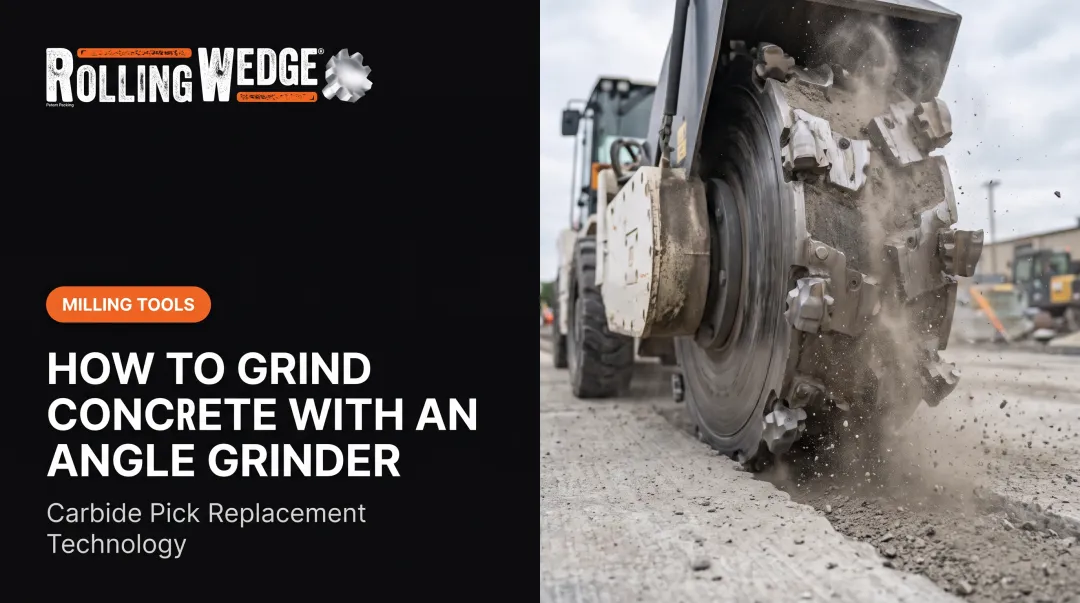
That impact load is what drives most of the emergency maintenance on a milling drum. Rolling Wedge Milling Tools use a rolling-wedging-lifting action instead: each of the nine carbide teeth on the Rolling Wedge Milling Tool rotates continuously rather than striking the surface. The tool rolls into the material at a set contact angle, then wedges and lifts the cuttings rather than hammering them loose:
- Each tool carries nine carbide teeth and stays usable with one or two missing
- Continuous rotation helps prevent seizure and localized overheating
- Documented replacement interval is every 1–3 months, versus roughly twice a week for carbide picks
- A full drum changeout takes about 20 minutes, versus 1–2 hours for traditional picks
- Operating lives of 10x and longer than carbide picks have been reported in the same asphalt-milling environment

Inspections and scheduled replacement still matter—Rolling Wedge tools wear out like any cutter, and keeping wear even across the drum gives the best cut and tool life. With less vibration and impact stress built into the design, though, preventive maintenance has less to catch: fewer emergency swaps, less holder damage, and less time lost chasing a bouncing pick mid-shift.
Conclusion
Preventive maintenance for cutting tools is non-negotiable if you want uptime and cost control. Skip inspections, and you trade a few minutes of daily checks for hours of unplanned downtime later.
The right approach balances two things: disciplined routine care and smart tool selection that cuts how much maintenance you need in the first place. Build a simple schedule, stick to it, and choose tooling built for longer service intervals—so your crew stays on the cut instead of waiting on parts.
Frequently Asked Questions
What are some preventive maintenance practices for cutting tools?
Daily cleaning and inspection, checking tool rotation and edge condition, lubricating moving parts, and scheduling sharpening or replacement before tools fail are the core practices. Reading the milled surface pattern also helps catch problems early.
What is preventive maintenance for tools and equipment?
Preventive maintenance is scheduled, proactive upkeep done to catch wear and stop failures before they happen, rather than repairing equipment only after it breaks. It includes routine inspection, cleaning, and planned part replacement.
What are the main types and elements of preventive maintenance?
The main types are routine or time-based (scheduled inspection and cleaning), usage-based (service after set hours or distance), condition-based (action triggered by inspection findings), and predictive (using wear data to time replacements).
How often should cutting tools be inspected?
At minimum, inspect visually every day the equipment runs, with deeper wear checks weekly and full inspections monthly or quarterly. Frequency should increase for abrasive materials or heavy-duty continuous use.
What are the warning signs that a cutting tool needs maintenance?
Watch for abnormal vibration or noise, slower production rates, rough or inconsistent surface finish, and visible chipping, cracking, or discoloration on the tool edges. Uneven wear patterns often signal a rotation problem.
Why is preventive maintenance more cost-effective than reactive repairs?
Reactive repairs come with unplanned downtime, emergency labor costs, and sometimes secondary damage to holders or drums. Preventive maintenance catches wear early, extending tool life and keeping production on schedule.