This isn't a rare story. Many operators discover the hard way that an attachment's horsepower on the shelf means nothing if the machine feeding it hydraulic fluid can't keep up. The result is lost job-site hours, a frustrated crew, and sometimes a damaged pump or motor that costs far more than the rental fee.
This guide breaks down what GPM and PSI actually mean for attachment performance, which tools genuinely demand high flow, and how to match your machine correctly before you buy or rent anything.
Key Takeaways
- High-flow skidsteers typically run 27–45+ GPM vs. 16–26 GPM for standard-flow machines
- Hydraulic horsepower (GPM × PSI ÷ 1,714)—not GPM alone—decides if an attachment can handle tough materials
- Cold planers, drum mulchers, stump grinders, and rocky-ground trenchers need high flow to avoid stalling
- Mismatched flow risks equipment damage, safety hazards, and voided warranties
- Faster cycle times and fewer failures often offset the higher upfront cost of high-flow systems
What Is High-Flow on a Skidsteer?
Hydraulic flow is simply the volume of fluid moving through your skidsteer's auxiliary system, measured in gallons per minute (GPM). More flow means more fluid available to spin motors, extend cylinders, and drive an attachment's cutting components.
Manufacturers don't agree on one exact line between "standard" and "high" flow, but the pattern is consistent:
- Standard flow: roughly 16-26 GPM on most current skidsteers
- High flow: roughly 27-45+ GPM, depending on the model
- Super flow (select models): 40+ GPM on select machines — Bobcat's S86 hits 42 GPM at 4,061 PSI vs. 23.6 GPM standard
Why Horsepower Matters More Than GPM Alone
GPM tells you volume. It doesn't tell you force. That's where hydraulic horsepower comes in:
Hydraulic HP = (GPM x PSI) ÷ 1,714
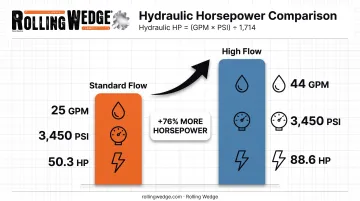
Here's what that looks like in practice. John Deere's 334 P-Tier specification shows the gap clearly at equal pressure:
| Configuration | GPM | PSI | Calculated Hydraulic HP |
|---|---|---|---|
| Standard flow | 25 | 3,450 | 50.3 hp |
| High flow | 44 | 3,450 | 88.6 hp |
That's 38.3 additional horsepower, roughly 76% more, from higher flow at the same pressure. That extra power feeds attachments the torque they need to cut, grind, or mill through resistant material without bogging down.
Run a high-flow attachment on a standard-flow machine, or vice versa, and you get inefficiency at best. At worst, you're looking at pump wear, motor damage, or overheated hydraulic fluid.
Which Skidsteer Attachments Require High Flow?
Not every attachment cares about flow rate. Pallet forks don't need hydraulic horsepower to lift a pallet. But attachments that cut, grind, or mill through dense material compete constantly against resistance, and that's where flow becomes non-negotiable.
Cold Planers / Milling Attachments
Cold planers need continuous high torque to grind through dense asphalt and concrete, so they demand the highest hydraulic horsepower of any common skidsteer attachment category. Paladin's 36-inch high-flow asphalt mill requires 31-45 GPM to run properly, and that's typical for the category.
Rolling Wedge supplies the Rolling Wedge Milling System for Skidsteer to upgrade these existing high-flow planer setups. Instead of relying on traditional carbide picks that hammer and chip at the surface, the Rolling Wedge Milling Tool uses a rolling-wedging-lifting cutting action that takes advantage of asphalt and concrete's low tensile strength.
On a high-flow machine, that design shows up in the field:
- Mills asphalt and concrete simultaneously in a single pass, no tool swaps needed
- Cuts through wire-mesh-reinforced concrete and many grades of rebar without jamming or stalling
- Reported tool lives of 10x and longer than conventional carbide picks
That last point matters on high-flow machines especially, where the attachment is working harder and faster. A tool that needs replacing twice a week under that workload eats into any productivity gain the high flow was supposed to deliver. The smoother, lower-impact cut can also reduce stress through the machine and help protect its hydraulic components.
Drum & Disc Mulchers
Mulcher heads need their hydraulic motor spinning at high speed continuously, fighting tree limbs, brush, and debris the entire time. Fecon's Bull Hog high-flow head calls for 30-50 GPM to maintain that spinning speed under load.
Drop below the required flow and the drum slows every time it hits something dense, which stretches job time and stresses the motor.
Swing Arm Stump Grinders
Swing-arm stump grinders create a unique flow demand: the flywheel and the hydraulic cylinders moving the swing arm are both drawing from the same system at once. Paladin's high-flow SG30 model runs 29-44 GPM specifically to keep both functions supplied without robbing power from either one.
Trenchers in Rocky or Hard Ground
Trenching through compacted soil or rock requires torque that standard flow often can't sustain. High flow gives the chain enough continuous force to keep cutting instead of stalling every time it hits a dense pocket.
Heavy-Duty Augers and Brush Cutters
Augers boring into rocky ground and heavy-duty brush cutters clearing thick undergrowth both benefit from the added torque high flow provides. Blue Diamond's severe-duty brush cutter, for instance, needs 27-35 GPM on its 200cc motor and 35-45 GPM on its 250cc version.
The extra flow isn't just about speed here. It's a safety margin that keeps the blade or auger from binding mid-cut.
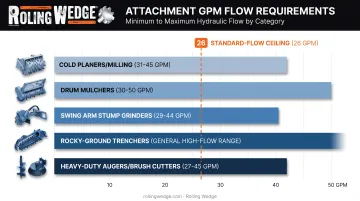
What Is High Flow Good For on a Skidsteer?
High flow's real value is usable horsepower for high-resistance work, not "more power" as a general upgrade. If the material fights back, whether it's asphalt, root wood, or compacted rock, flow determines how much force the attachment can bring to bear without bogging down.
High-flow systems earn their keep on attachments that chew through resistant material:
- Forestry mulchers and brush cutters
- Stump grinders
- Cold planers and asphalt/concrete mills
- Rock saws and heavy trenchers
- High-demand augers in dense soils
Baumalight's published data for its S40 stump grinder shows how flow and pressure interact on grind time:
| Pressure | Time at 30 GPM | Time at 40 GPM |
|---|---|---|
| 2,500 PSI | 9 min | 8 min |
| 3,000 PSI | 6.5 min | 6 min |
| 3,500 PSI | 4.5 min | 4 min |
Pressure moves the needle just as much as flow. At 30 GPM, raising pressure from 2,500 to 3,500 PSI cuts grind time roughly in half. Flow alone doesn't tell the whole story.
Where high flow doesn't help:
- Pallet forks
- Standard buckets
- Basic sweepers and brooms
These attachments don't fight material resistance the way a mulcher or planer does. Paying a premium for flow capacity they'll never use is money left on the table.
Matching Your Machine to the Right Attachment
Before you shop for any attachment, know your machine's numbers. This is a five-minute check that saves hours of frustration later.
- Check your skidsteer's spec sheet or auxiliary hydraulics data plate for its rated GPM and PSI output
- Pull the attachment's manufacturer spec sheet or manual and note the minimum and maximum flow/pressure it's rated for
- Compare the two ranges and aim to land in the middle of the attachment's published window, not just barely above its minimum
A few things to watch for:
- Product lines can span standard and high flow (Blue Diamond's auger series runs 8–36 GPM across models)— "heavy duty" branding alone doesn't confirm flow needs
- Adjustable-flow attachments still have a hard PSI ceiling; exceeding it can damage seals and hoses
- Published GPM is often measured at a set engine RPM—under load, actual flow may fall short of the number on the sheet
Pairing a high-flow-only attachment with a standard-flow machine, or the reverse, risks poor performance, overheating, and hydraulic damage warranty won't cover.
The Cost of High-Flow Hydraulics: Is It Worth It?
High-flow skidsteers and attachments cost more upfront. There's no getting around that. Larger pumps, bigger radiators, oversized fans, and reinforced hoses all add to the sticker price.
The question that actually matters is whether that premium pays for itself. In most demanding applications, it does:
- Faster cycle times mean more completed jobs per week
- Fewer attachment failures reduce unplanned downtime and repair bills
- Extended tool life on the right attachment lowers long-term operating costs
Those savings compound when high-flow power is paired with durable tooling. Rolling Wedge offers pricing available on request, with quantity-tiered volume discounts on the Rolling Wedge Milling Tool for contractors outfitting a milling drum.
The larger lever is replacement frequency and labor:
- Tool replacement every 1-3 months, versus twice a week for carbide picks
- Full drum changeout in about 20 minutes, versus 1-2 hours for carbide tooling
- Fewer parts orders and less idle time, which cuts long-term operating spend
Contractors can run the numbers with Rolling Wedge's Milling Cost Comparison Tool, which estimates ROI against traditional carbide-pick tooling.
Qualifying customers can also use the Try & Buy 20-day evaluation on a live job before buying.
Frequently Asked Questions
Which skidsteer attachments require a high-flow hydraulic system?
Cold planers, drum mulchers, swing-arm stump grinders, and trenchers working rocky or compacted ground are the most common examples. Heavy-duty augers and brush cutters often need it too, depending on the model.
What is high-flow good for on a skidsteer?
It delivers extra hydraulic horsepower for high-resistance tasks like milling, mulching, grinding, and trenching through hard material. Light-duty attachments like forks or buckets don't need it.
What GPM is considered high flow for a skidsteer?
Generally 27-45+ GPM, though this varies by manufacturer. Always check your specific machine's spec sheet rather than relying on a general range.
Can I run a high-flow attachment on a standard-flow skidsteer?
The attachment will likely underperform, stall under load, or fail to operate at all. Running it anyway risks overheating and damage to hydraulic components.
How do I know if my skidsteer has high flow?
Check the machine's spec plate, operator's manual, or ask your dealer for the auxiliary hydraulic flow rating. This tells you both your GPM and PSI output.
Is a high-flow skidsteer worth the extra cost?
For contractors running demanding attachments regularly, yes. Faster cycle times and fewer attachment failures typically offset the higher upfront investment within normal job volume.