Introduction
Roads and bridges are aging faster than most agencies can afford to rebuild them. Tight municipal budgets, grant funding caps, and growing traffic loads have pushed concrete milling from a niche prep step to a go-to rehabilitation method.
Most milling talk starts with drum horsepower and machine specs. But contractors and municipalities don't measure success by specs. They measure it by cost per job, downtime, and how the surface performs once traffic returns.
This article covers what concrete milling is and why it delivers real operational benefits. It also covers what determines whether those benefits show up on your job site or get eaten by rework and downtime.
Key Takeaways
- Milling removes only the damaged top layer, cutting rehabilitation costs versus full-depth reconstruction
- Textured, level surfaces improve traction and reduce skid-related risk on high-traffic roads
- Reclaimed material can be reprocessed into new paving mixes instead of landfilled
- Cutting tool technology, not just the base machine, determines whether milling saves money or creates rework
What Is Concrete Milling
What Is Concrete Milling?
Concrete milling uses a rotating drum fitted with cutting teeth to grind away and remove a controlled depth of an existing concrete surface. Instead of tearing out an entire slab, crews shave off the top layer that's cracked, rutted, or worn smooth.
You'll see it applied on:
- Highways and interstates
- Bridge decks
- Parking structures and garages
- Sidewalks and pedestrian paths
- Industrial floors
In nearly all these cases, milling is prep work. It precedes resurfacing or an overlay rather than standing as a finished surface on its own. The milling pass is one stage in a longer pavement lifecycle—the step that sets up a safer, more durable ride.

Key Advantages of Concrete Milling
The advantages below focus on measurable, operational impact, not theoretical upside. Each one ties directly to outcomes contractors and municipalities already track: cost per job, safety and surface quality, and sustainability metrics tied to grant requirements or ESG reporting.
Cost-Effective Surface Rehabilitation
Milling removes only the damaged top layer instead of requiring full-depth removal and reconstruction. That difference cascades through every line item on a project budget: less material to haul away, fewer labor hours on demolition, lower disposal fees.
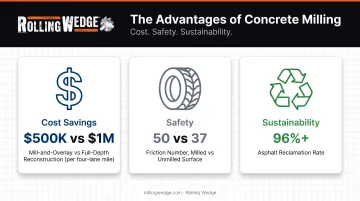
An NCHRP rehabilitation example illustrates the gap. A mill-and-overlay treatment with 0.5 inch of cold milling runs roughly $500,000 per four-lane mile (including shoulders) with a 12-year service life. Full-depth reconstruction runs about $1 million per four-lane mile for a 20-year life, since it includes demolition, subgrade prep, and full slab replacement.
That's roughly half the cost for a treatment that still delivers well over a decade of service. For agencies working under annual budget caps or grant funding limits, that math often decides whether a road gets fixed this year or gets deferred again.
KPIs impacted:
- Cost per square yard
- Material and disposal costs
- Labor hours
- Project turnaround time
On large-scale road and parking lot rehabs, every dollar saved on one job frees up budget for the next one on the list.
Improved Safety and Surface Quality
A milling drum grinds away cracks, ruts, and potholes in a single controlled pass, leaving behind a textured, level surface. That texture isn't cosmetic. It's what restores grip in wet weather and cuts down on tire noise.
A TxDOT-sponsored field study measured this directly. Milled concrete pavement averaged a friction number of 50, compared to 37 on adjacent unmilled sections, using locked-wheel friction testing under ASTM E274. Milled asphalt sections showed a similar bump, from 38 to 44.
That kind of friction gain translates into fewer skidding incidents and tripping hazards, plus a stronger position on liability and ADA compliance for public roadways.
KPIs impacted:
- Surface friction/skid number
- Incident rates
- Ride quality index
High-traffic roads, airport runways, and ADA-regulated sites leave no margin for a rough or slick surface.
Sustainability Through Material Reclamation
Milling doesn't just remove the old surface. It generates material that can go right back into the construction supply chain. Crushed and reprocessed, milled concrete and asphalt become aggregate for new paving mixes, subbase layers, and fill.
That matters more every year. NAPA's 2024 survey found that more than 96% of asphalt reclaimed from old pavement gets put back into new asphalt mixtures, with the remaining share used in other civil applications like unbound aggregate base. Concrete follows a similar pattern, with recycled concrete aggregate now common in at least 41 states.
For contractors, that means lower procurement costs on raw aggregate. For municipalities, it's a documented line item for ESG reporting and sustainability mandates that increasingly show up in bid requirements.
KPIs impacted:
- Material procurement costs
- Waste disposal costs
- Sustainability/ESG metrics
Environmental regulations and sustainability requirements in procurement make reclamation especially valuable for agencies and the contractors who bid their work.
Choosing the Right Milling Technology
Cost savings, safety gains, and sustainability wins depend less on the base machine and more on the cutting tool fitted to the drum.
Traditional carbide picks work by impact. Point-attack picks chip away material through repeated striking. On heavy jobs, that wear often means replacement multiple times per week—every swap is downtime, and every strike adds vibration through the machine.
Rolling Wedge Concrete Milling uses a rolling-wedging-lifting cutting action instead. The Rolling Wedge Milling Tool works with a material's low tensile strength (about 20% of its compressive strength), rolling over and away from it rather than striking it over and over.
Here's how the two compare in the field:
| Factor | Traditional Carbide Picks | Rolling Wedge Tooling |
|---|---|---|
| Replacement interval | Multiple times per week | Every 1-3 months |
| Installation time | 1-2 hours | About 20 minutes |
| Mixed-material handling | Prone to jamming | Single pass, no tool swaps |
| Rebar-reinforced sections | Risk of stalling | Designed to cut without jamming |
That replacement gap alone is significant. Fewer tool changes mean fewer interruptions to the schedule and fewer hours spent with the machine parked instead of milling.
Rebar and mixed surfaces are where the design gap shows up most. The Rolling Wedge Milling Tool uses nine carbide teeth on a rolling wheel-and-shaft layout that wedges and lifts material in tension instead of hammering into rebar or wire mesh.
That same rolling action supports single-pass work on mixed asphalt-and-concrete sections without mid-pass jams or stalls. In the field, contractors typically see:
- Longer intervals between tool changes (weeks and months, not days)
- Less bounce, which eases stress on hydraulics and operator fatigue over a full shift
- Fewer stalls on rebar-reinforced or mixed-material cuts
- Drop-in use on existing skidsteers and large mills, including CAT and Roadtec platforms
Contractors can upgrade the tooling without buying a new machine to get the difference on the job.
Avoiding Pitfalls and Maximizing Milling ROI
Even the best cutting tool technology won't deliver its full value if it's mismatched to the job or run incorrectly.
What Happens When the Wrong Equipment or Technique Is Used
Worn or mismatched cutting teeth are the most common source of rework on a milling job. When teeth wear unevenly, cut depth becomes inconsistent, leaving a rough surface that needs to be re-milled before overlay work can start.
A few common failure patterns:
- Standard carbide picks used on reinforced concrete or mixed-material surfaces frequently jam or stall, forcing unplanned downtime and tool changes mid-shift
- Worn teeth develop bounce, which shakes the entire machine and accelerates wear on hydraulic components over time
- Inconsistent tooth wear across the drum produces uneven texture that fails skid resistance checks and needs a second pass
None of these are one-time costs. They compound across a season of jobs, eating into margins that looked fine on the original bid.
How to Get the Most Value from Every Milling Pass
These habits separate a smooth, profitable milling job from one that runs over budget:
- Match the tool to the surface. Don't default to standard carbide picks for every job. Asphalt-only, concrete-only, mixed-material, and rebar-reinforced surfaces each put different demands on cutting tools.
- Maintain consistent pass overlap. Aim for roughly 20-30% overlap to prevent ridges and uneven texture between passes.
- Track tool wear and replacement cycles. Monitor wear over time rather than reacting to failures as they happen.
- Run the numbers before upgrading equipment. Rolling Wedge's Milling Cost Comparison Tool lets contractors compare carbide-pick expenses against rolling-wedge tooling costs to evaluate total cost of ownership before committing.
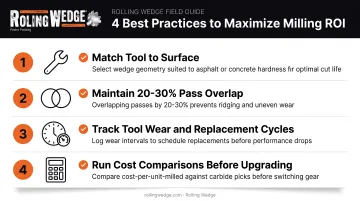
Treating tool selection as a routine check is what keeps a milling operation profitable job after job.
Conclusion
The real value of concrete milling shows up in three places: cost control, surface quality, and material efficiency. But none of that happens automatically. It depends on pairing the milling pass with cutting technology suited to the job.
These benefits compound. Reduced tool wear and less downtime on one job might save a few hours. Across dozens of projects and multiple seasons, that adds up to a measurable difference on the bottom line.
Milling equipment and tool selection deserve a seasonal review, not a one-time purchase decision. What worked on last year's mix of jobs may not fit this year's workload, so reassess tools before the next season starts.
Frequently Asked Questions
What is milling in concrete?
Concrete milling grinds away a controlled depth of the top layer of a concrete surface using a rotating drum fitted with cutting teeth. It's typically done before resurfacing or to restore a level, safe driving surface.
How deep does concrete milling typically cut per pass?
Light texturing passes on concrete typically remove about 0.25 to 0.5 inches. Depth depends on surface damage and project requirements.
What's the difference between concrete milling and concrete scarifying?
Milling generally uses carbide-tipped or rolling-wedge teeth for deeper, heavier-duty material removal. Scarifying is a shallower surface prep method, often specified to roughly a quarter inch before an overlay.
Can concrete milling equipment cut through rebar-reinforced concrete?
Standard carbide tooling often jams or stalls when it hits rebar or wire mesh. Rolling-wedge tooling rolls and lifts through the material with nine carbide teeth per tool, letting it cut through reinforced sections without stopping.
How often do milling teeth or picks need to be replaced?
Traditional carbide picks often need replacement about twice a week on heavy jobs. Rolling Wedge tooling is built to last 1 to 3 months under comparable conditions.
Is the material removed during concrete milling recyclable?
Yes. Milled concrete and asphalt are commonly crushed and reprocessed into aggregate for new paving mixes, subbase layers, or fill, cutting both material costs and landfill waste.