Many contractors and municipal fleet managers struggle with the opposite problem now: too many attachment options, not enough clarity on which one actually fits their work. Pick the wrong tool and you're either underpowered for the job or paying for capability you'll never use.
This guide breaks down the major attachment categories, what separates one from another, and how to match an attachment to your terrain, task frequency, and machine specs, rather than to whatever looks impressive on a trade show floor.
Key Takeaways
- Attachments span five functions: earthmoving, material handling, demolition, land management, and surface work.
- A shared quick-attach plate doesn't guarantee fit; hydraulic flow and weight capacity matter equally.
- Buckets and pallet forks cover the most jobs; specialty tools pay off only with frequent use.
- Total cost of ownership, not sticker price, should drive your purchase decision.
What Are Skidsteer Attachments?
Skidsteer attachments are task-specific tools, often hydraulically powered, that mount to a skidsteer's quick-attach plate in place of the standard bucket. Instead of buying separate machines, one skidsteer handles multiple jobs by swapping tools:
- Trenching without a dedicated trencher
- Material handling with forks instead of a forklift
- Jobsite cleanup with a broom or sweeper
The industry standardized this swapping process decades ago. Bobcat introduced the first lever-actuated mounting system back in 1970, replacing pin-on implements that required tools and time to change. That innovation evolved into today's Universal Skidsteer Quick Attach (SSQA) system, which most manufacturers now build to.
SSQA only standardizes the coupler plate itself. It says nothing about whether an attachment's hydraulic demand, weight, or mounting dimensions actually match your carrier. Plate compatibility is step one, not the whole checklist.
Why does this matter for your bottom line? Equipment World has reported that expanding the range of applications a skidsteer performs is one of the clearest ways to boost its utilization on a jobsite. In other words, the attachment ecosystem is what turns an idle machine into billable hours.
Types of Skidsteer Attachments
Skidsteer attachments cover earthmoving, material handling, demolition, land management, and surface work. The right pick depends on three variables that come up throughout this guide:
- Job frequency (daily use vs. occasional need)
- Material hardness (loose soil vs. reinforced concrete)
- Hydraulic requirements (standard-flow vs. high-flow)
Here's how the major attachment types compare.
General Purpose, Grapple & Skeleton Buckets
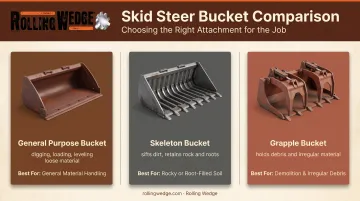
The bucket is still the workhorse. A solid general-purpose bucket digs, loads, carries, levels, and dumps loose material on nearly every jobsite [R4].
Skeleton and grapple variants handle debris work more cleanly. Their rail or tine design lets dirt and rock sift through while the bucket retains larger debris, roots, or trash [R5]. That's a real advantage over a solid bucket on demolition cleanup.
- Best for: dirt and gravel moving, debris cleanup, general site work
- Limitation: poor choice for precision placement or hauling heavy, stable loads over distance — forks handle that better
Pallet Forks
Forks turn a skidsteer into a forklift substitute for palletized loads, lumber, block, and other bulky materials. Supply yards and landscaping crews lean on them constantly instead of renting a dedicated forklift.
One caution worth flagging: a fork's rated frame strength isn't the same as your loader's lifting capacity. Cat's 48-inch Class II pallet fork, for example, has an operating weight of 429.9 lbs on its own [R6], but actual safe lift depends on your machine's counterweight, load center, and rated operating capacity, not the fork's construction.
OSHA also notes that skidsteers with fork attachments aren't governed by the same forklift-specific standard as traditional forklifts [R7]. The manufacturer's load chart is your real reference point.
- Best for: supply yards, landscaping crews, palletized lumber and block
- Limitation: lift capacity follows the loader's ROC and load center, not fork frame strength alone
Augers
An auger is a rotating drill bit powered by the skidsteer's hydraulics, built to bore consistent holes for posts, footings, or plantings. Bit styles range from standard earth to heavy-duty and rock-cutting, matched to how tough your ground is [R8].
Hydraulic flow matters here more than most attachments. John Deere's PA40 auger, for instance, needs between 28 and 42 gpm to run properly [R9]. Those figures are model-specific, not a universal auger benchmark. An underpowered machine will bog down fast in rocky or frozen soil.
- Best for: fencing contractors, utility installers, landscapers needing repeatable holes
- Limitation: rock or compacted ground demands higher flow than many standard skidsteers provide
Grapples (Root, Brush & Industrial)
Grapples grip what buckets can't scoop cleanly: logs, brush piles, storm debris, scrap. The claw or clamshell design closes around irregular material and holds it during transport.
Cat markets its industrial grapple rakes specifically for demolition, construction cleanup, recycling yards, and storm response [R10] — heavier-duty environments than a typical root or brush rake handles. Match tine spacing and clamp geometry to your material before buying.
- Best for: land clearing, demolition cleanup, forestry work
- Limitation: built to hold material, not to dig or grade
Trenchers
Trenchers use a chain-driven cutting bar to dig narrow trenches for utility lines, irrigation, or drainage runs. Bobcat's current lineup spans roughly 2 to 5 feet of digging depth and 4 to 12 inches of width, with some models reaching deeper [R11].
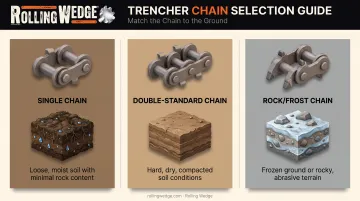
Chain selection depends on soil condition: single chains for loose or damp ground, double-standard chains for harder, drier soil, and rock/frost chains for frozen or mixed-rock conditions. Smaller 3- to 4-foot trenchers typically run on standard hydraulics, while 5-foot-plus units generally need high flow [R12].
- Best for: utility installs and drainage work that don't justify full excavation
- Limitation: boom length caps trench size, so large excavation projects need heavier equipment
Breakers & Hydraulic Hammers
Breakers deliver repeated hydraulic-powered blows to fracture concrete, rock, or asphalt into removable chunks. Cat's H55s hammer, as one example, runs on 8 to 22 gpm at roughly 1,450 psi [R13] — specs that vary meaningfully across models and manufacturers.
Maintenance is non-negotiable with breakers. Industry guidance calls for daily inspection of the tool and grease points [R14], since tip wear and hydraulic strain both climb fast under heavy use. There's no fixed hour-based replacement schedule published across manufacturers, so budget for condition-based inspection rather than a set interval.
- Best for: demolition, quarry work, slab removal before hauling
- Limitation: heavy use drives up tip wear and hydraulic demand, raising operating costs over time
Brush Cutters & Mulchers
These rotary attachments clear vegetation on-site and mulch it into debris rather than requiring separate haul-off. Bobcat's heavy-duty brush cutters, for instance, come in 62-, 74-, and 86-inch versions across standard-flow and high-flow builds, cutting material up to 10 inches in diameter with the right forestry door installed on the loader [R15].
Deere's SM60 mulcher, by contrast, is a standard-flow unit built for material up to 5 inches on mid-frame machines under 75 hp [R16]. Don't assume every mulcher needs high-flow hydraulics; check the specific model.
- Best for: forestry, right-of-way clearing, land management
- Limitation: larger cutting capacities generally require high-flow hydraulics, narrowing compatibility
Cold Planers & Surface Milling Attachments
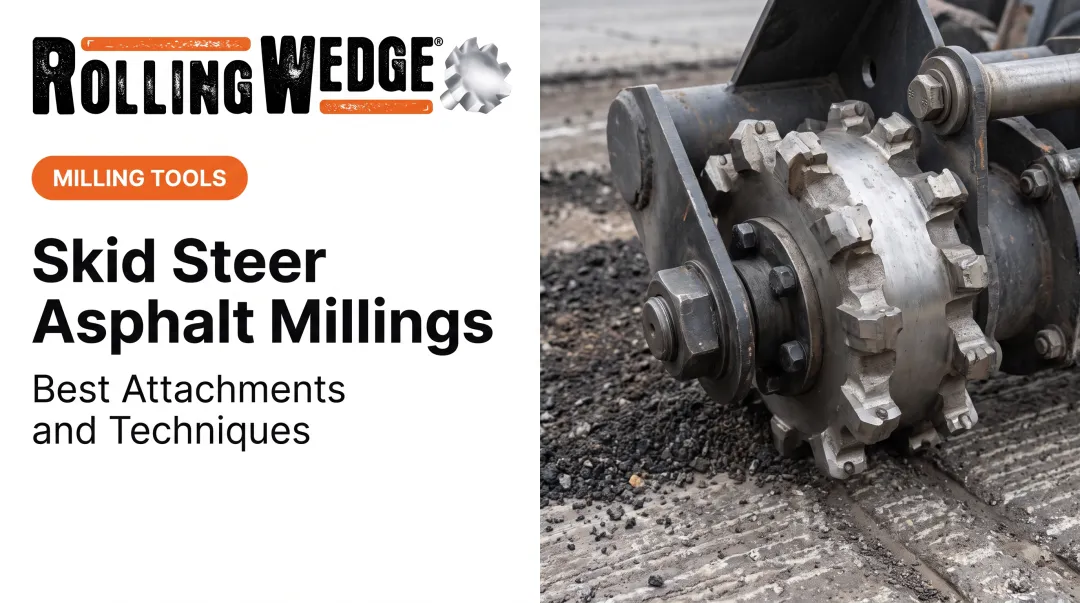
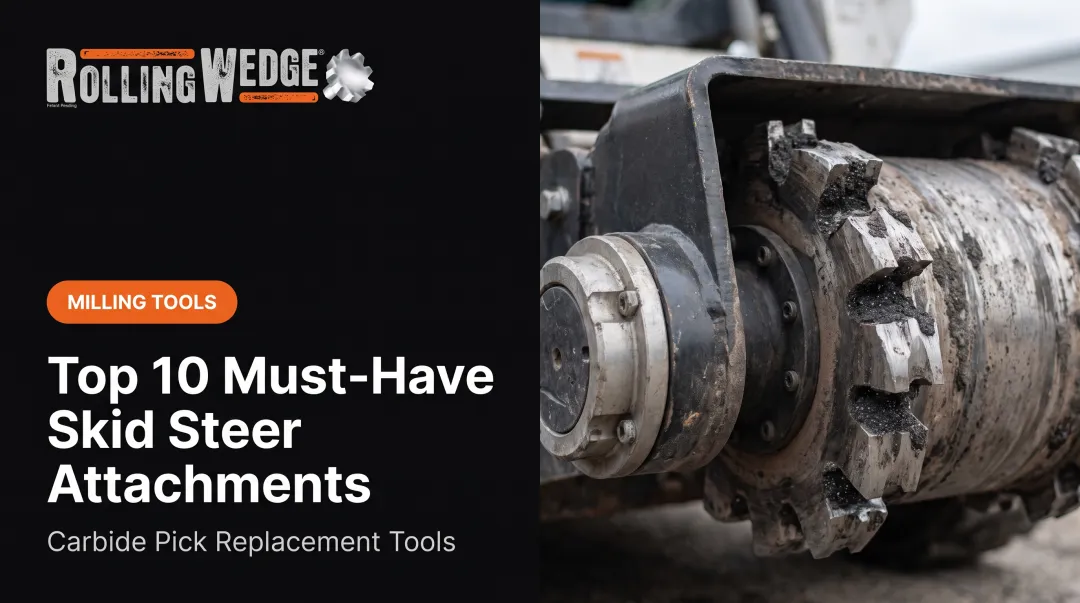
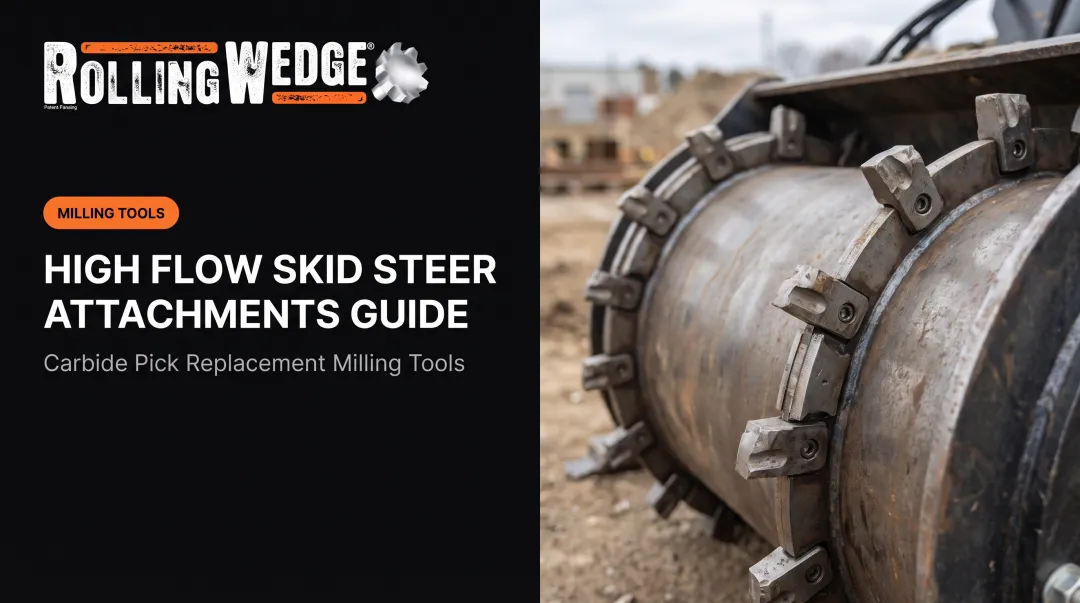
Cold planers mill away layers of asphalt or concrete using a rotating drum fitted with cutting teeth. Municipalities and paving crews rely on them for pothole patching, utility cuts, and resurfacing prep where you need to remove a controlled depth of surface, not the whole slab.
Traditional carbide-pick drums cut through repeated impact. That impact generates heat and wears tips fast. Published data from For Construction Pros puts typical carbide pick life at 50 to 150 hours in asphalt and just 10 to 30 hours in concrete, with abrasive, heavy-cut work sometimes wearing a pick out in as little as 30 minutes.
Rolling-wedging-lifting drums (the design behind the Rolling Wedge Milling System for Skidsteer) work differently. Instead of hammering the surface, the Rolling Wedge Milling Tool rolls, wedges, and lifts material by exploiting asphalt's and concrete's low tensile strength. That action produces a smoother cut with far less tip wear:
- Tool replacement every 1 to 3 months, versus roughly twice a week for carbide picks
- Reported operating lives of 10x and longer than carbide picks in the same asphalt-milling environment
- A 20-minute full changeout on a 24-inch drum, versus 1 to 2 hours for carbide pick swaps
The same design mills asphalt and concrete in a single pass, including surfaces with rebar or wire mesh, without stalling or tool damage.
Compatible skidsteer platforms include Bobcat, Caterpillar, Kubota, Roadhog, Simex, and Virnig, with drum widths from 18 to 40 inches. Large-scale milling machines like Roadtec use the same tool technology.
Rolling Wedge tools are available with pricing available on request, with quantity-tiered volume discounts, plus a Try & Buy (20-day evaluation): companies receive a Rolling Wedge Milling Drum for hands-on evaluation, then purchase or return it. Not a single drum has ever been returned.
- Best for: municipalities, paving contractors, and utility crews doing frequent milling or mixed-surface removal
- Limitation: higher upfront cost; best justified when milling is a regular part of the workload
Snow Removal Attachments (Blades, Pushers & Blowers)
Snow attachments range from angled blades to powered blower drums. Angle brooms suit dry, shallow snow on sidewalks and small lots, but heavier or wet snow overwhelms them quickly. Snow pushers move large volumes without leaving windrows, and V-blades handle first-pass plowing, back-dragging, and widening [R19].
High-flow blowers are built for heavy, wet snowfall, while standard-flow blowers manage lighter conditions in most regions.
- Best for: municipalities, property managers, and contractors with seasonal snow contracts
- Limitation: seasonal use only. ROI hinges on regional snowfall and how the machine gets used the rest of the year
Brooms (Angle & Pickup)
Rotating bristle attachments sweep loose debris, millings, or dirt off paved surfaces. Angle brooms push material to one side, useful when you're windrowing debris or snow rather than collecting it [R20]. In-cab angling controls let the operator adjust sweep direction on the fly [R21].
Pickup brooms, by contrast, collect debris rather than relocating it — the better choice for post-construction cleanup where material actually needs to leave the site.
- Best for: post-construction cleanup, routine street and site maintenance
- Limitation: not built for heavy, wet, or compacted debris; often paired with a loader bucket for full cleanup
How to Choose the Right Skidsteer Attachment
The right attachment depends on job type, frequency, and your machine's actual specs, not sticker price or brand loyalty.
Factors to Consider
- Purpose and job frequency: Rent for one-off projects; buy for recurring work. Rolling Wedge's 20-day Try & Buy program lets you evaluate the milling system on your own equipment before committing capital.
- Machine capacity: Match your skidsteer's operating weight limit and hydraulic flow (standard vs. high-flow) to the attachment's requirements.
- Material and terrain: Let surface hardness—from soft soil to reinforced concrete—drive tooth or tip design.
- Versatility vs. specialization: Combination buckets spread ROI across many tasks; specialty tools like milling drums pay off on frequent, specific work. Rolling Wedge users moving from twice-weekly carbide-pick changes to a 1-to-3-month cycle shows how the right specialty tool cuts downtime and long-run cost.
- Total cost of ownership: Factor in tool wear, installation downtime, and maintenance—not just purchase price.
- Compatibility: Verify the quick-attach system, mounting plate, and hydraulic connections against your specific skidsteer model.
What to Check Before Finalizing Your Attachment Purchase
A few common mistakes account for most attachment regret:
- Going oversized or overly specialized when a general-purpose tool would cover most of your actual jobs.
- Ignoring hydraulic flow and weight limits, which risks instability or premature attachment damage.
- Focusing only on sticker price while overlooking tool wear, downtime, and parts availability over the attachment's life.
- Buying on brand familiarity alone instead of verifying fit and safety documentation.
On that last point, safety covers more than a single purchase check. OSHA's skidsteer guidance requires:
- Approved lift-arm supports before any work under raised arms
- Replacement of worn protective guards instead of running without them
AEM also publishes a supplemental skidsteer safety manual on setup, operation, and maintenance. Treat both the carrier's and the attachment's manuals as required reading, not optional paperwork.
Conclusion
A skidsteer with the right attachment lineup works like a small fleet: digger, forklift, breaker, mower, and milling rig, all sharing the same base unit. Each attachment type carries its own strengths and real limitations, and mismatching one to the wrong job costs more than the tool itself.
Match the attachment to your terrain, task frequency, and total cost of ownership. Get those three right, and the investment pays for itself in uptime and fewer wrong-tool jobs.
Frequently Asked Questions
What are the different types of skidsteer attachments?
The major categories include buckets, pallet forks, augers, grapples, trenchers, breakers, brush cutters/mulchers, cold planers, snow tools, and brooms. They fall into earthmoving, material handling, demolition, land management, and specialty surface work.
What is the most useful skidsteer attachment?
General-purpose buckets and pallet forks see the most use across job types thanks to their versatility. The truly "most useful" attachment still depends on your specific line of work.
Are skidsteer attachments universal across brands and models?
Most modern skidsteers share the standardized SSQA quick-attach system, but that only confirms plate fit. Weight capacity, hydraulic flow, and mounting dimensions still need to match before you assume universal compatibility.
What's the difference between standard-flow and high-flow hydraulic attachments?
Standard-flow systems handle buckets, forks, and lighter-duty tools. High-flow is required for power-hungry attachments like mulchers, cold planers, and larger brush cutters.
Can skidsteer attachments be used on mini skidsteers?
Many attachment types have mini-skidsteer-specific versions scaled to lower weight and hydraulic capacities. Full-size attachments generally won't fit or operate safely on a mini machine.
How do I know if an attachment fits my skidsteer's specs?
Check the manufacturer's spec sheet for weight, hydraulic flow and pressure, and quick-attach dimensions. Compare those figures directly against your skidsteer's operator manual before buying.