Picking the wrong one is not a minor mistake. It affects how much weight a base can hold, how water moves through it, and whether you're back on site regrading in six months. This matters most for contractors and municipalities juggling multiple project types, where a material that works perfectly on one job fails on the next.
This article breaks down what each material is made of, how it's produced, where it performs best, what it costs, and how to decide between them — including what happens when a single job site has both.
Key Takeaways
- Concrete millings offer high compressive strength and strong drainage for structural base and fill work.
- Asphalt millings retain bitumen binder, compacting and re-bonding under heat and traffic for driveways and budget paving.
- Material choice should follow load requirements and climate, not just sticker price.
- On mixed-surface jobs, the milling equipment you use matters as much as the material you produce.
Concrete Millings vs Asphalt Millings: Quick Comparison
| Factor | Concrete Millings | Asphalt Millings |
|---|---|---|
| Composition | Crushed aggregate and cement paste residue, no residual binder | Aggregate coated in retained bitumen — 93%-97% mineral aggregate and 3%-7% asphalt cement by weight |
| Load capacity (CBR) | 94%-148% | 20%-25% for straight RAP |
| Drainage | 0-1.2 ft/day loose; blends reach 60-70 ft/day | Drops sharply as compaction effort increases |
| Production | Jaw-crushed, rebar separated, then re-crushed and screened | Ground by carbide-tipped milling drums |
| Best uses | Structural base, fill, equipment yards | Driveways, temporary roads, parking overlays |
Concrete millings develop less permanent strain under repeated heavy loads than even natural aggregate. Asphalt millings soften with heat and deform more under the same pressure, because the bitumen coating loses stiffness in warm conditions.
Those performance gaps still get weighed against local price. Cost is highly regional—there's no single national per-ton figure for either material. Haul distance, local aggregate supply, and how much demolition or resurfacing work is happening nearby all drive what you pay.
Virginia's DOT modeled RAP at roughly $12.50/ton against $30/ton for virgin aggregate, about 30% material savings in a 50/50 blend. That's a project-specific figure, not a national price tag, but it shows the savings potential when RAP is locally available.
What Are Concrete Millings?
Concrete millings are the reclaimed material left over when a concrete surface (a road, bridge deck, or parking structure) gets milled down. For municipalities and heavy civil contractors, this material isn't scrap. It's structural-grade aggregate that happens to be free.
The benefits translate directly into fewer headaches later:
- Compressive strength reduces base-layer maintenance under heavy loads
- Angular particle shape improves load distribution across a footprint
- Better drainage cuts down on water pooling and frost-heave issues
None of that comes easily, though. Milling concrete is mechanically demanding, and when rebar is present, it gets worse fast. Traditional carbide-pick tools rely on hammer-and-chisel impact.
Against high-strength concrete, those picks overheat, freeze in their holders, or snap outright. Hit a section of rebar or wire mesh, and a standard pick will often stall completely.
Cutting technology matters as much as the concrete itself. Rolling Wedge Concrete Milling uses a rolling-wedging-lifting action that takes a different path: the Rolling Wedge Milling Tool rotates continuously, wedging and lifting material so concrete goes into tension (about one-fifth of its compressive strength) and fractures more easily. Each 2.5-inch tool carries nine carbide teeth, and its rolling action helps it pass through wire mesh and many rebar grades without jamming.
That durability is what makes steady production of clean, reusable concrete millings practical on reinforced jobs—not just on plain slab.
Use Cases of Concrete Millings
Concrete millings show up wherever structural load and drainage take priority over cost alone:
- Road base layers for highway and municipal reconstruction
- Parking lot foundations under new asphalt or concrete surfacing
- Equipment yards where heavy machinery sits or maneuvers daily
- Construction pads supporting cranes and staging areas
New Jersey's DOT has leaned on this material since the mid-1980s, running a 50:50 blend of recycled concrete aggregate with virgin dense-graded aggregate in its base course specification. Testing classified that blend as low-permeability with high stability and bearing strength, exactly the profile municipalities want under high-traffic pavement.
What Are Asphalt Millings?
Asphalt millings, more formally called reclaimed asphalt pavement (RAP), come from grinding up existing asphalt during a resurfacing job. Unlike concrete millings, they keep their bitumen coating, which is the whole reason contractors and homeowners reach for them.
What makes them attractive in the field:
- Lower material cost than virgin asphalt or aggregate, especially near a resurfacing project
- Self-binding under heat and traffic, letting compacted RAP harden into a driveway-like surface over time
- Retained bitumen that cuts the need for fresh petroleum binder
Not all RAP is the same. Fine-graded millings compact into a smoother surface and suit driveways; coarse grades hold up better under vehicle traffic on temporary roads. Some suppliers also blend RAP with virgin aggregate or other reclaimed material, which changes performance slightly and is worth asking about before ordering by the ton.
Use Cases of Asphalt Millings
Asphalt millings dominate cost-sensitive, lower-traffic applications:
- Residential driveways, where the self-binding property saves the cost of fresh asphalt
- Private and rural roads, especially where county budgets can't stretch to full paving
- Temporary access surfaces on active construction sites
- Gravel road resurfacing, where dust control matters
A Minnesota gravel-road study found that a 50% RAP surface course cut fugitive dust and produced the highest elastic modulus among the RAP sections tested. Initial cost ran about 1.5% higher than 100% virgin aggregate, but the dust reduction and stiffness gains offset that over the road's life. Upfront price and total cost of ownership are different conversations.
Concrete Millings vs Asphalt Millings: Which Should You Choose?
The decision usually comes down to four questions:
- What load will this surface carry? Heavy equipment or truck traffic favors concrete millings' compressive strength.
- How much water needs to move through it? Drainage-sensitive sites lean toward concrete; tighter, semi-sealed surfaces favor asphalt millings.
- What's the climate? Asphalt millings soften in extreme heat; concrete millings hold their shape regardless of temperature.
- Is the budget the deciding factor? If so, and traffic is light, asphalt millings usually win on upfront cost.
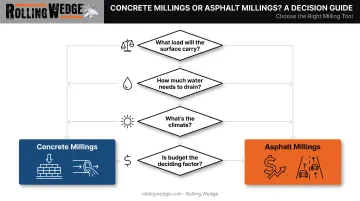
Rule of thumb: choose concrete millings when structural strength and drainage matter most. Choose asphalt millings when the project is lower-traffic and cost-sensitive.
That choice gets messier when both materials show up on the same job. Plenty of resurfacing stretches put concrete curbs or bridge decks inside an asphalt roadway. Crews then stop the drum and swap cutting tools every time the surface changes, which burns production time and adds wear from repeated startup and shutdown cycles.
A Minnesota-based contractor hit that exact problem on a mixed-surface job. After switching to Rolling Wedge milling drum technology, the crew milled through asphalt and concrete in a single pass without tool changes between sections.
Less downtime, fewer stop-start cycles, and a cleaner production run followed. Traditional carbide-tipped drums built for one material at a time rarely deliver that continuity.
If mixed surfaces show up often in your work, changeover time may cost more than the tooling itself. Rolling Wedge offers a Try & Buy (20-day evaluation) on its Milling System for Skidsteer so crews can test single-pass performance across asphalt, concrete, and rebar-reinforced sections on their own equipment.
Conclusion
Neither material wins outright. Concrete millings earn their place in structural base, fill, and high-drainage applications where load-bearing capacity can't be compromised. Asphalt millings fit driveways, temporary roads, and lower-traffic surfacing where cost and quick installation matter more than compressive strength.
The right call depends on what the project actually needs, not which material happens to be cheaper that week.
For the contractors and municipalities producing these materials, milling equipment shapes cost, tool wear, and timelines just as much as the material choice. Picking the right cutting technology is part of the same decision, not an afterthought.
Frequently Asked Questions
Can asphalt millings be used as a base for concrete?
No — not directly under new concrete. Binder interaction and settling issues make compacted aggregate or crushed concrete a more reliable base.
What is poor man's concrete?
Poor man's concrete is a colloquial name for compacted asphalt millings that harden into a driveway-like surface without the cost of new asphalt or concrete. It is not an official engineering term.
What's the difference between the equipment used to mill concrete versus asphalt?
Concrete milling needs tougher cutting tools able to handle higher compressive strength and embedded rebar without jamming. Standard asphalt milling uses carbide-tipped drums built for softer bituminous material.
Are concrete millings as eco-friendly as asphalt millings?
Both are recycled materials that cut landfill waste and reduce demand for virgin aggregate. In 2024, producers reused 105.1 million of the 119.6 million tons of RAP they accepted, with less than 0.2% landfilled — and concrete millings conserve quarried stone the same way.
How much do concrete millings cost compared to asphalt millings?
There's no fixed national price for either. Local haul distance, aggregate availability, and nearby demolition or resurfacing activity drive pricing more than the material itself does.
Can concrete millings be used for driveways?
Yes, when properly compacted, though they lack asphalt millings' self-binding property. Expect to add a binder or regrade more often to keep the surface stable.