Introduction
Milling teeth take more abuse than almost any other component on a cold planer. They hit rebar, chew through reinforced concrete, and grind against asphalt aggregate hour after hour — and when they wear out, the whole job stops.
Many contractors underestimate this line item until a mid-project tool swap eats into their schedule. Others buy tools that aren't rated for the surface they're actually milling, leading to jams or broken picks halfway through a job.
Those failures show why milling tool cost isn't one number. It swings based on tool design, carbide grade, machine compatibility, and whether you're running traditional carbide picks or newer cutting systems. This guide breaks down real pricing ranges, what drives cost up or down, and how to budget for milling tool spend without getting blindsided.
Key Takeaways
- Standard carbide picks cost less per unit but wear out fast on hard or reinforced surfaces.
- Replacement frequency and installation labor often matter more than the sticker price.
- Rolling-wedge tooling cuts replacement cycles from twice weekly to once every 1–3 months.
- Machine wear from vibration and heat adds hidden costs that rarely show up on a quote.
- Total cost of ownership, not per-tool price, should drive your buying decision.
How Much Do Milling Tools Cost? (Pricing Overview)
Milling tool pricing depends on the tool's design, its carbide grade, whether it fits a skidsteer or a full-size milling machine, and how many units you're buying at once.
There's no single fixed price across the industry. Manufacturers like Caterpillar leave actual transaction pricing to authorized dealers, and quotes vary by volume and region.
A few common mistakes drive up real-world milling costs:
- Underbudgeting for replacement frequency: treating tools as a one-time cost instead of a recurring one
- Buying tools that don't fit the machine: skidsteer planer tools and large drum systems aren't interchangeable
- Ignoring hidden downtime and labor costs tied to every tool swap
Wirtgen notes that carbide remains the most cost-effective cutting material for non-homogeneous surfaces. That's why it's still the default choice for a lot of contractors, even though it isn't always the cheapest option once you factor in replacement rates.
Standard Carbide Picks
Basic tungsten carbide tips on a standard shank, with no specialized geometry. These are built for light-duty, occasional milling on straightforward asphalt. You get a low entry price and simple availability, but not much durability on tougher surfaces. Expect to replace these every few days under heavy use, which adds up fast in labor and reordering time.
Premium / Reinforced Carbide Tooling
Hardened steel bodies, improved carbide bonding, and better heat resistance. This tier suits mid-volume contractors doing regular asphalt milling who need more life out of each pick without jumping to a completely different cutting system. Expect a moderate price premium over standard carbide, offset by fewer swaps across a full season of milling.
Advanced Rolling-Wedge Cutting Systems
Rolling Wedge's Rolling Wedge Milling Tool is available with pricing available on request, with quantity-tiered volume discounts. The RW127-B Milling Tool Mount is also available; pricing is provided on request.
This tier is built for large-scale contractors and municipalities that need fewer swaps, less downtime, and the ability to mill mixed surfaces without changing tools mid-job.
Whichever tier fits your operation, the sticker price is only part of the story. What's typically included in any of these price points is the tool itself. What's typically excluded: installation labor, downtime during the swap, and drum-compatibility hardware, all of which factor into your real cost per job.
Key Factors That Affect the Cost of Milling Tools
Pricing depends on the tool's engineering, the surface it's cutting, and how your crew uses it day to day.
Type or cutting technology. Traditional carbide picks force a single tip past the material's compressive strength, a brute-force approach that wears fast. Rolling-wedge designs instead exploit tensile strength, which runs at roughly 20% of compressive strength, meaning less resistance and less wear per pass.
Surface material. Asphalt-only jobs are gentler on tooling than concrete, and rebar-reinforced concrete is harder still. A 2012 Paladin Construction Group estimate found carbide pick life ranging from 50–150 hours in asphalt but just 10–30 hours in concrete, a stark illustration of how material hardness drives replacement cost.
Replacement frequency. This is where total cost really diverges:
| Tool Type | Typical Replacement Frequency |
|---|---|
| Standard carbide picks | Multiple times per week on demanding jobs |
| Rolling Wedge tools | Every 1–3 months, per company-reported asphalt-milling performance |
Installation and setup time. A full carbide pick change on a drum can take 1–2 hours. Rolling Wedge advertises roughly 20 minutes for a complete 24-inch drum changeout. Multiply either figure by your crew's hourly rate and you start seeing why swap time matters as much as unit price.
Equipment compatibility. Tooling built for specific machine brands, like Caterpillar or Roadtec, or for skidsteer-mounted planers, isn't universal. Caterpillar's own catalog includes both 20mm and 22mm shank products, so compatibility has to be verified at the holder level, not assumed.
Operating and maintenance impact. Bounce, vibration, and heat from cheaper tooling stress hydraulics and drum components over time. Caterpillar's 2022 parts guide notes that reduced bit vibration can extend the life of planetaries, shafts, bearings, and track pads. That cost never shows up on the tool invoice, but it shows up on your maintenance budget. Smoother, lower-impact cutting can reduce that stress and help protect hydraulic components.
Cost Breakdown of Milling Tools
The true cost of a milling tool program runs well past the per-unit purchase price.
| Cost Component | Recurring? | What Drives It |
|---|---|---|
| Initial tool purchase | Recurring (consumable) | Base unit cost, bulk/drum-set pricing tier |
| Installation & labor | Recurring, per swap | Time to remove and mount tools per drum change |
| Downtime | Recurring | Lost production hours multiplied by swap frequency |
| Machine wear & maintenance | Recurring | Vibration and heat degrading hydraulics, drum components |
Each swap compounds the previous three columns. A crew swapping carbide picks twice weekly racks up far more downtime and labor over a year than one swapping Rolling Wedge tools every few months. That advantage holds even when the per-unit price looks higher on paper:
- Installation: 20 minutes versus 1-2 hours for carbide picks
- Swap frequency: every 1-3 months versus twice weekly
- Volume pricing: tiered discounts available - contact Rolling Wedge for current pricing
Low-Cost vs High-Cost Milling Tools — What's the Difference?
Budget carbide picks and premium systems like Rolling Wedge's rolling-wedge-lifting design solve the same problem in very different ways.
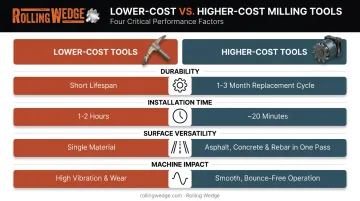
| Factor | Lower-Cost Tools | Higher-Cost Tools |
|---|---|---|
| Durability | Shorter lifespan, frequent breakage on hard surfaces | Engineered for extended wear; replacement every 1–3 months vs. twice weekly |
| Installation time | 1–2 hours per full swap | Around 20 minutes per full swap |
| Surface versatility | Often limited to one material type | Can handle asphalt and concrete, including rebar sections, in one pass |
| Operator/machine impact | More bounce and vibration; higher fatigue and hydraulic wear | Smoother, bounce-free operation |
This durability gap isn't unique to Rolling Wedge. Caterpillar sees similar results with its own diamond bits. According to Caterpillar's Cold Planer Parts Reference Guide, diamond bits last 40 to 80 times longer than standard 35g carbide bits. That means fuel savings of up to 15% from reduced drag.
Long-term value is where the comparison actually matters. Premium systems cost more per unit upfront, but the total lifecycle cost often favors the "expensive" option once you factor in:
- Fewer replacements over the tool's working life
- Faster swaps that cut downtime
- Less wear on hydraulics and other machine components
Rolling Wedge publishes a Milling Cost Comparison Tool so contractors can run their own numbers instead of guessing.
How to Estimate the Right Budget for Milling Tools
Match your tool choice to actual workload, not the lowest sticker price. Consider:
- Volume and frequency of milling jobs per month or year
- Surface mix, asphalt-only versus concrete or rebar-reinforced sections
- Machine type, since skidsteer planers and large-scale milling equipment often require different tooling
- Downtime tolerance for your specific project timelines
- Long-term maintenance costs tied to vibration and heat from your chosen tooling
Common budgeting mistakes include:
- Focusing only on per-tool price while ignoring replacement frequency and labor time
- Overlooking machine wear, since hydraulic and drum stress from bouncier tooling adds real costs never listed on the tool invoice
- Underestimating downtime caused by frequent mid-project tool swaps
- Choosing tools not rated for mixed-material surfaces, which can cause jams and broken tools mid-job
If you're unsure which tier fits your workload, Rolling Wedge's limited Try & Buy program (20-day evaluation for qualifying customers - not a general rental program) lets you test a Rolling Wedge Milling Drum on your own equipment before committing to a bulk order.
Conclusion
Milling tool cost comes down to more than what's printed on the invoice. Technology, surface type, replacement frequency, and installation time all shape what you actually pay over the life of a project.
Understanding each of these components, not just comparing sticker prices, leads to smarter budgeting.
The right milling tool cost balances upfront investment against durability, uptime, and the operating savings that show up months later, not on day one — savings Rolling Wedge tools are engineered to deliver.
Frequently Asked Questions
How much does CNC milling cost?
CNC milling is a manufacturing process for cutting metal or plastic parts, entirely separate from road and pavement Milling Tools. Costs there depend on material, machining time, batch size, and tooling — not asphalt or concrete surface type.
What is the price of a milling cutter?
Standard carbide picks cost less per unit, but advanced systems like Rolling Wedge Milling Tools are competitively priced with quantity discounts available - contact Rolling Wedge for current pricing. Fewer replacements make the total cost of ownership favorable over time.
How do you calculate milling cost?
Add the tool purchase price to labor and downtime costs for each replacement, plus any machine wear impact, then divide by your coverage area or output. Replacement frequency has the biggest effect on this number.
How often should milling teeth or picks be replaced?
Standard carbide picks often need replacement twice a week on demanding jobs. Rolling-wedge alternatives are built for 1–3 month intervals under similar conditions, based on manufacturer specifications.
Are premium Milling Tools worth the higher upfront cost?
Usually, yes, once you factor in total cost of ownership. Fewer replacements, faster installs, and less machine wear typically outweigh the higher per-unit price over a project's lifecycle.
What's typically included when purchasing a milling tool system?
Purchases generally include the tools themselves. Mounting hardware, installation labor, and drum-compatibility parts are usually billed separately, so budget for them as distinct line items.