Rolling Wedge takes a fundamentally different approach. Instead of hammering asphalt into submission, Rolling Wedge Asphalt Milling tools roll through it - using the material's own tensile weakness against itself to lift and fracture the surface cleanly. That single mechanical difference is what separates a tool that lasts days from one that lasts months.
Key Takeaways
- Traditional carbide picks cut through compressive impact, concentrating stress and heat at the tip until the tool fails
- Rolling Wedge uses a rolling-wedging-lifting action that exploits asphalt's low tensile strength, requiring far less force
- Rolling Wedge Milling Tools carry 9 carbide teeth with substantial carbide content per tooth
- Because the tool rolls instead of striking, it never seizes and never overheats the way a fixed pick can
- Operating lives of 10x and longer than conventional carbide picks have been reported, with tool changes dropping from twice a week to once every one to three months
- One tool handles asphalt, concrete, some grades of rebar, and tree stumps — no swaps required
The Problem with Conventional Milling Picks
A standard carbide pick is a fixed-geometry cutting tool. It is mounted at a fixed angle and does not rotate on its axis. As the drum turns, each pick is driven into the pavement face-first, applying direct compressive force to crack and dislodge material.
The failure modes are well understood by anyone who runs a milling crew:
- Seizure in the holder. Picks are designed to rotate slightly to distribute wear, but in practice they seize in their block due to heat and debris. A seized pick stops self-indexing and wears unevenly, cutting down to a stub or shearing off rather than wearing out gradually.
- Heat generation. The friction-intensive impact cycle generates heat at the carbide tip. Sustained high temperatures soften binders, accelerate tool wear, and can degrade the milled material itself.
- High replacement frequency. A typical carbide pick needs to be replaced roughly twice per week on an active milling project. Each replacement cycle costs both parts and labor — with installation taking one to two hours for a full drum change.
- Vibration and machine stress. The pound-and-impact cutting method transmits significant vibration back through the drum and into the machine's hydraulic system, adding wear to the equipment itself beyond just the tooling.
These are not edge cases. They are the accepted operating reality for contractors running conventional milling drums — accepted because there was no alternative.
How Rolling Wedge Is Different: The Rolling-Wedging-Lifting Action
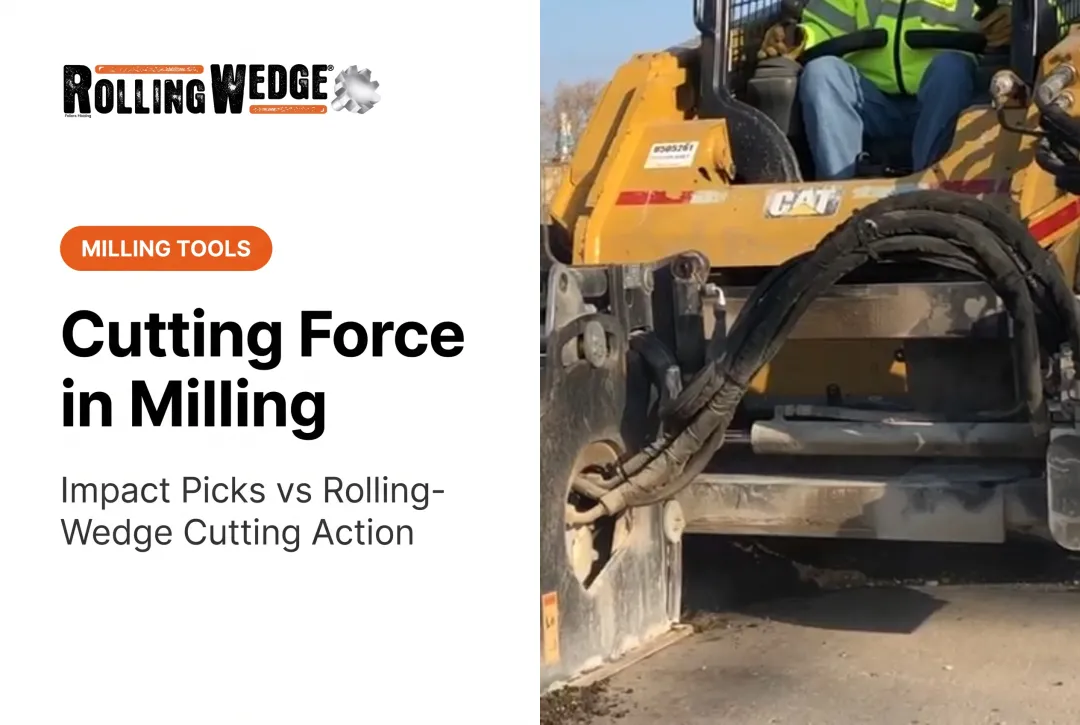
Rolling Wedge Milling Tools do not impact asphalt. They roll against it.
The tool is mounted so that it can spin freely on its axis as the drum rotates. As the carbide teeth contact the asphalt surface, the tool rolls — wedging its leading edge under the material and then lifting it away. The cutting action works with the pavement's structural properties rather than against them.
Here is why that matters at a material science level: asphalt has relatively low tensile strength compared to its compressive strength. It resists being crushed far better than it resists being pried apart or lifted. Conventional picks attack the strong axis. The Rolling Wedge tool attacks the weak one.
The Cutting Action Explained
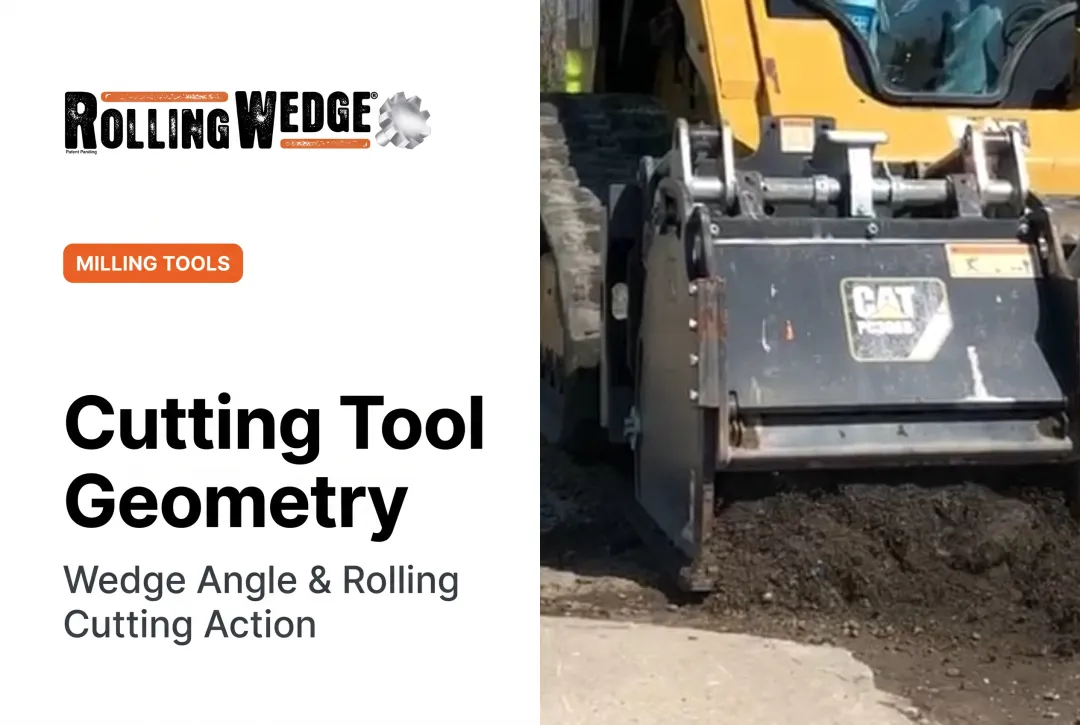
As the drum turns, Rolling Wedge Milling Tools spin freely on their axis and roll continuously over the asphalt surface - they do not hammer or get driven into the material. While rolling, the carbide teeth exploit the material's low tensile strength: asphalt is far easier to fracture under tension than under compression, so the rolling wedge geometry lifts and separates the material cleanly rather than crushing it.
This is the core difference from a conventional carbide pick, which is fixed in its holder and slams into the pavement face-first on every drum revolution. Because Rolling Wedge Milling Tools roll rather than impact, there is no repeated hammer blow on a single tip, heat does not build at one point, and the tool never seizes in its holder. The result is a precise, consistent cut with controlled chip size and minimal fine dust generation - which also makes it a cleaner option for asphalt removal work where surface prep quality affects what comes next.
Rolling Wedge Milling Tool Specifications
The Rolling Wedge Milling Tool is Rolling Wedge's primary tool for asphalt and concrete milling applications. Its carbide configuration is engineered specifically for the rolling-wedging-lifting action.
| Specification | Value |
|---|---|
| Model | Rolling Wedge Milling Tool; RW127-B (Milling Tool Mount) |
| Diameter | 2.5 in skidsteer; 3.75 in large road mills |
| Carbide teeth per tool | 9 |
| Drum widths | 18, 24, 30, 40 in |
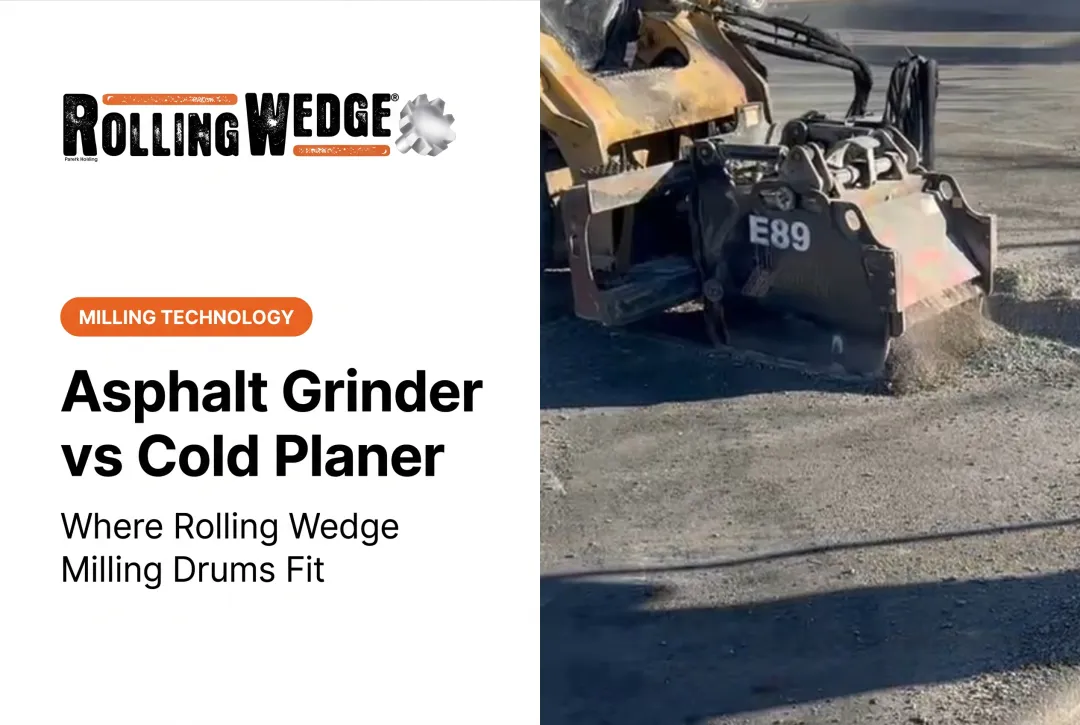
| Compatible platforms | Skidsteer-mounted planer attachments; large mills including Roadtec |
Each tool carries nine carbide teeth and stays usable with one or two missing; at three or more, replace it. For a clean finished cut and maximum tool life, Rolling Wedge recommends keeping wear even across the drum rather than mixing one new tool into a worn set.
Why the Tool Never Seizes and Never Gets Hot
Seizure is the number-one failure mode for conventional picks in their holders. It happens when a combination of heat, debris, and compressive loading locks the tool in place so it can no longer rotate to distribute wear.
Rolling Wedge Milling Tools are immune to this failure mode by design. Because the tools roll continuously on their axis during the cutting cycle, there is no static friction buildup to create seizure. The rolling motion keeps the tools in constant, low-friction rotation — the exact mechanical condition that prevents a pick from locking up.
The heat problem is solved by the same mechanism. Conventional picks generate heat because high-velocity impact creates friction concentrated at one small tip with no pathway to dissipate it quickly. Rolling Wedge Milling Tools never hammer a single tip into the pavement, and the continuous rotation carries heat away from the contact zone continuously rather than letting it build at a single point.
No seizure. No heat concentration. No sheared stems. The mechanical failure modes that drive conventional pick replacement simply do not apply.
The Result: 10x and Longer Reported Lifespan, Near-Zero Downtime
Rolling Wedge's documented performance data shows tool replacement intervals of one to three months under normal operating conditions, compared to roughly twice per week for conventional carbide picks. Operating lives of 10x and longer than carbide picks have been reported.
The downstream impact on a milling operation is significant:
- Reduced parts cost. Fewer tools consumed per project-mile directly lowers material spend. Pricing for Rolling Wedge Milling Tools is available on request and subject to change - contact Rolling Wedge for current pricing.
- Faster changeover. When tool replacement does occur, a full drum change takes approximately 20 minutes with the Rolling Wedge system versus one to two hours with conventional picks.
- Continuous uptime. Eliminating the twice-weekly shutdown for tool changes keeps the milling drum running. On a large project, that recovered time compounds quickly into measurable productivity gains.
- Lower machine wear. Reduced vibration from the rolling cutting action can reduce stress through the machine and helps protect its hydraulic components.
One Minnesota-based contractor documented significant efficiency and productivity improvements after switching to Rolling Wedge milling drum technology — gains that showed up not just in tool costs but in overall project throughput.
One Tool for All Applications
Conventional carbide pick selection requires matching the tool to the material. Concrete picks differ from asphalt picks. Encountering rebar or a mixed-surface condition mid-job means stopping, assessing, and potentially swapping tooling before proceeding. Each stop is a delay, and each delay adds cost.
Rolling Wedge Milling Tools eliminate that decision entirely. The rolling-wedging-lifting action is effective across a range of hard materials:
- Asphalt — the primary application, including standard hot-mix and aged pavement
- Concrete — including standard Portland cement concrete pavement
- Rebar-reinforced concrete — the tool cuts through some grades of rebar without jamming, stalling, or breaking
- Tree stumps — an additional application that demonstrates the tool's versatility beyond road milling
A single drum loaded with Rolling Wedge Milling Tools can move across a surface that transitions from asphalt to concrete to a rebar-reinforced patch without the operator stopping to change tooling. That capability is unique in the milling industry.
Rolling Wedge: The Only Singular Solution in Milling
Rolling Wedge, LLC is the only company in the milling industry offering a single tool that handles concrete, asphalt, and some grades of rebar without switching tools. That is not a marketing position — it is a function of the rolling-wedging-lifting cutting mechanism, which does not rely on material-specific tip geometry the way conventional picks do.
Rolling Wedge Milling Tools are available for outright purchase at quantity-tiered pricing. Rolling Wedge also offers a Try & Buy program: companies receive a Rolling Wedge Milling Drum for a 20-day hands-on evaluation on their own equipment. Before the end of 20 days, they can purchase the drum or have it returned — and not a single drum has ever come back. The tools are compatible with skidsteer-mounted planer attachments.
For contractors and municipalities looking to reduce tool cost, eliminate downtime from pick seizure, and simplify their tooling inventory, Rolling Wedge Milling Tools are a straightforward upgrade for existing milling equipment, working with carbide picks kept at the drum ends for square edges.
Frequently Asked Questions
How does the Rolling Wedge cutting action differ from a conventional carbide pick?
A conventional carbide pick is fixed and delivers compressive impact blows to the pavement surface. Rolling Wedge Milling Tools roll on their axis and use a wedging-and-lifting motion that exploits asphalt's low tensile strength to fracture material with far less concentrated force.
Why do Rolling Wedge Milling Tools last so much longer than conventional picks?
The rolling action eliminates seizure — the primary failure mode for picks — and prevents heat concentration at the cutting tip. With no hammer blows and continuous rotation, the tools wear gradually and uniformly rather than failing suddenly.
How many carbide teeth do Rolling Wedge Milling Tools have?
Rolling Wedge Milling Tools have 9 carbide teeth each.
Can Rolling Wedge Milling Tools cut both asphalt and concrete without changing tools?
Yes. Rolling Wedge Milling Tools are effective on asphalt, concrete, rebar-reinforced concrete (some grades), and tree stumps — all without tool changes. This single-tool capability is unique to Rolling Wedge in the milling industry.
What milling machines are Rolling Wedge Milling Tools compatible with?
Rolling Wedge Milling Tools are compatible with skidsteer-mounted planer attachments.
Is a Try & Buy program available?
Yes. Rolling Wedge offers a Try & Buy program: companies receive a Rolling Wedge Milling Drum for a 20-day hands-on evaluation on their own equipment. Before the end of 20 days, they can purchase the drum or have it returned. Not a single drum has ever been returned. Outright purchase pricing is available on request with quantity-tiered discounts - contact Rolling Wedge for current pricing.