Pricing swings hard depending on where you source it, how much you need, and whether someone else is doing the hauling and compaction. This guide breaks down the 2026 numbers, what actually drives cost up or down, and how contractors and municipalities can budget without getting blindsided by hidden fees.
TL;DR
- Material cost: $10–$20/ton; installed runs $2–$5/sq ft depending on depth
- Biggest cost swings: source, delivery distance, order size, and compaction depth
- Cost savers: self-haul pickups, bulk DOT-adjacent orders, full-truckload deliveries
- Cost drivers: small residential deliveries, long haul distances, thick installed layers
How Much Do Asphalt Millings Cost? (Pricing Overview)
Millings pricing isn't one fixed number. It depends on where the material comes from, how much you're buying, and whether you're paying for delivery and installation on top.
Budgets most often slip for the same reasons:
- Underestimating tonnage needed for the actual depth and area
- Ignoring delivery and labor costs entirely
- Assuming "free" millings have no real cost attached
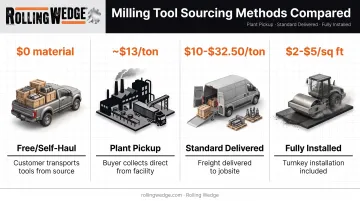
Typical 2026 cost ranges:
| Sourcing method | Cost | Notes |
|---|---|---|
| Free/self-haul | $0 material | Hauling equipment and fuel still cost money |
| Plant pickup | ~$13/ton | Sample U.S. plant rate; minimums often apply |
| Standard delivered | $10–$32.50/ton | Distance and quantity dependent |
| Fully installed | $2–$5/sq ft | Bundles material, delivery, grading, compaction |
These ranges typically exclude site prep, drainage work, and long-term maintenance. Get those quoted separately.
Free or Low-Cost Millings
Lowest material price, highest logistics burden: you handle hauling, and quality varies because loads are often unscreened.
Typically includes:
- Raw millings only (no delivery, grading, or compaction)
- Variable gradation and contaminant risk
Best for:
- Contractors staged near an active milling job
- Farm lanes, temporary access, and other low-spec surfaces
- Crews with trucks and loaders already on hand
Delivered/Contractor-Sourced Millings
Material plus trucking, usually with more consistent quality than free roadside pickup.
Typically includes:
- Screened or plant-supplied millings
- Delivery to the site (distance-based freight)
Best for:
- Municipalities and contractors without spare haul capacity
- Projects that need predictable volume and timing
- Sites where labor is available but material logistics are not
Fully Installed Millings Projects
Turnkey path: material, delivery, grading, and compaction in one price for a finished, drivable surface.
Typically includes:
- Millings, trucking, placement, and compaction labor
- A surface ready for light or standard traffic after rollout
Best for:
- Driveways, parking lots, and yard areas that must open quickly
- Municipal patches and low-volume road segments
- Buyers who want one quote instead of juggling haulers and crews
Key Factors That Affect the Cost of Asphalt Millings
Cost depends on sourcing method, project scale, and site conditions, not a flat rate card. What you pay is almost always material plus haul plus placement—not a single per-ton sticker price.
Source, Quality, and How You Obtain Material
Paving contractor pickup, quarry or aggregate suppliers, and delivered loads all price differently. Free DOT or contractor millings can wipe out the material line entirely, but someone still has to haul it, which shifts cost to equipment and fuel instead of a purchase order.
Screened or graded millings cost more and bring fewer surprises. Unscreened free RAP may carry debris or contamination that hurts compaction and long-term performance, so the cheaper pile is not always the lower total cost.
Quantity, Depth, and Labor
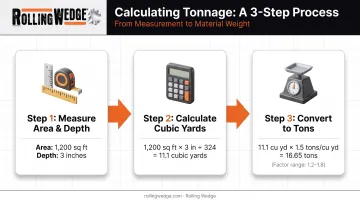
Tonnage scales directly with area and depth. Use this standard formula:
- Cubic yards = area (sq ft) × depth (inches) ÷ 324
- Tons = cubic yards × tons per cubic yard (typically 1.2-1.8, depending on supplier)
Larger orders usually cut per-ton pricing. Small residential jobs pay a premium because minimum-load charges spread over less material.
Depth multiplies both material and labor. A 2-inch application uses less tonnage and less compaction effort than a 4-inch layer, so the depth you specify changes hours on site as well as the size of the order.
Delivery Distance and Regional Supply
Truckload capacity (typically 12-16 tons for a standard dump truck) and haul distance drive delivered pricing. Small deliveries carry the highest cost per ton because fixed trip costs spread across less material.
Local road resurfacing activity and asphalt plant output shape regional supply. Areas with active resurfacing nearby often see lower millings prices simply because more material is available.
Cost Breakdown of Asphalt Millings
Total project cost extends well beyond the per-ton price tag. Delivery, site prep, and compaction often match or exceed what you pay for the millings themselves.
| Line item | Frequency | What it covers |
|---|---|---|
| Material purchase | One-time | Per-ton cost, $10-$20 depending on source |
| Delivery | One-time | Truckload charges based on distance and tonnage |
| Site prep and grading | One-time | Excavation, drainage grading, base compaction |
| Installation/compaction labor | One-time | Spreading and multi-pass compaction to activate binder |
| Ongoing maintenance | Recurring | Periodic re-compaction and inspection |
Delivery is usually the line item that swings most with location. Bulk-hauling benchmarks from independent dump trucks run $75-$120 per hour or $1.75-$4.00 per mile. Use those figures as a delivery reference even though they are not RAP-specific.
Site condition drives the rest of the variance:
- Stable, well-drained bases need little grading
- Soft spots or poor drainage add excavation and base work
- Thicker lifts need more compaction passes to activate the binder

Free vs Paid Millings — What's the Difference?
Free millings can look like a bargain until you factor in hauling, screening, and how the material holds up. Paid millings cost more upfront, but they usually arrive more consistent and closer to ready-to-place.
| Factor | Free Millings | Paid Millings |
|---|---|---|
| Material quality | Variable, often unscreened, may contain debris | More consistent, frequently screened |
| Logistics/effort | Self-haul required; more time investment | Often delivered; less labor for the buyer |
| Long-term value | Higher risk of rework or early replacement | More predictable performance and lifespan |
Neither option guarantees performance on its own. Screening controls debris and gradation, but proper compaction matters just as much as source quality.
How to Estimate the Right Budget for Your Millings Project
Matching sourcing method and quantity to actual project needs prevents both overspending and underbudgeting.
Factors to weigh:
- Project size and required application depth
- Intended use (driveway, lot, roadway base) and expected traffic load
- Access to hauling equipment versus needing delivery
- Site prep needs like grading, drainage, or old surface removal
If you produce millings on the job instead of buying them, tooling belongs in the same budget as material and haul. On municipal and large-scale work, tool wear is a real line item—not just a maintenance detail.
Traditional carbide picks need replacing roughly twice a week. Rolling Wedge's Rolling Wedge milling tool typically lasts 1-3 months between changeouts.
Changeout time adds up too. A full drum swap runs 1-2 hours with carbide picks versus about 20 minutes with Rolling Wedge on a 24-inch drum. Fewer stoppages mean more milling hours per week and a lower effective cost for self-produced material. Rolling Wedge's Milling Cost Comparison Tool lets you run those numbers against your current carbide-pick spend.
What Most People Miss When It Comes to Asphalt Millings Cost
These mistakes inflate real asphalt millings cost more often than the per-ton quote:
- Focusing only on per-ton price while ignoring delivery and labor, which can double the effective cost
- Assuming free millings are free when hauling equipment, fuel, and screening time still cost real money
- Underestimating tonnage due to incorrect depth or area math (always use the cubic yard formula)
- Skipping proper compaction, which leads to soft spots and costly re-compaction later
Frequently Asked Questions
How many square feet does 1 ton of asphalt millings cover?
One ton typically covers 45-60 square feet at a 3-4 inch compacted depth, depending on the supplier's density factor. Always confirm the specific tons-per-cubic-yard number with your source before ordering.
Are asphalt millings cheaper than gravel?
Installed millings generally run $2-$5 per sq ft, compared to $4-$10 per sq ft for gravel driveways. Millings often compact into a firmer, more durable surface once properly installed.
Do asphalt millings make a good driveway?
Yes. They're a durable, budget-friendly surface that hardens over a season with proper compaction and drainage. They won't match new asphalt in smoothness, but they hold up well for the price.
What is the lifespan of asphalt millings?
Contractor guidance suggests 7-15 years or longer with proper installation and drainage, though this varies by climate, traffic, and maintenance. No universal national benchmark exists yet.
How many tons of millings can a dump truck hold?
A standard tandem-axle dump truck typically hauls 12-16 tons legally, depending on the truck's GVWR and tare weight. Always confirm state axle limits before planning deliveries.
How much do asphalt millings cost per ton in 2026?
Expect $10-$32.50 per ton depending on sourcing and delivery. Plant pickup runs cheaper, while delivered material adds trucking costs based on distance and load size.