Storage outcomes vary a lot. Climate, available space, attachment type, and how well you clean and prep before parking it all factor in. A grapple stored bone-dry in a heated shop ages very differently than an auger left muddy under a tarp in a Midwest winter.
This guide walks through the exact step-by-step storage process, the racks and bucket bunkers worth considering, tips specific to each attachment type, and the mistakes that cause most preventable repair bills.
Key Takeaways
- Cleaning, inspecting, and lubricating before storage prevents most rust and hydraulic damage
- Indoor, off-ground storage is ideal; outdoors requires weatherproof covers and pallets
- Match storage method to attachment type—buckets, augers, breakers, and cutting tools fail differently when stored wrong
- Racks and bucket bunkers protect equipment, save yard space, and speed up hook-up
- Skipped prep steps, not attachment quality, cause most spring repair costs
How to Store Skidsteer Attachments Properly: Step-by-Step
A consistent routine protects hydraulics, cutting edges, and structural components far better than just parking an attachment in a corner and forgetting about it until next season.
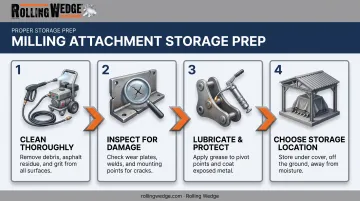
Step 1: Clean Every Attachment Thoroughly
Mud, sap, salt, and general debris trap moisture against bare metal, and that's exactly what starts corrosion. Pressure wash every surface, paying close attention to joints and pivot points where grime tends to hide.
- Rinse pivot pins, bushings, and cylinder rods where dirt collects
- Flush out mud packed into bucket corners or auger flighting
- Remove road salt residue completely if the attachment was used on winter jobs
Let everything dry completely before it goes into storage. Sealing in trapped moisture is one of the fastest ways to trigger rust on components you won't inspect again until spring.
Step 2: Inspect for Damage and Repair Before Storing
This is the point to check pins, bushings, teeth, blades, and hoses for cracks or wear, and to fix what you find now rather than during your first job of the season.
- Look for hairline cracks in teeth, blades, and welded joints
- Check hose fittings and couplers for cracking or brittle rubber
- Test pins and bushings for excessive play or binding
Keep a simple maintenance log for each attachment. It sounds basic, but it's the difference between remembering a worn bushing in March and discovering it mid-job.
Step 3: Lubricate, Coat, and Protect Components
Grease every pivot point, hinge, and cylinder rod before storage. Apply rust-inhibiting spray or paint to any bare metal exposed by wear, since that's where corrosion starts fastest.
For hydraulic attachments, close the contamination path before the unit sits:
- Relieve system pressure before you disconnect
- Wipe down flush-face couplers
- Cap or bag every coupler and plug exposed nipples
Donaldson's technical guidance on hydraulic contamination flags attachment changes as a direct contamination pathway and recommends protecting couplers with caps or plugs during storage.
Step 4: Choose and Prepare the Storage Location
Indoor storage offers stable temperatures and humidity control, keeping components away from direct sun, rain, and freeze-thaw cycles. Outdoor storage works, but only with weatherproof covers and elevation off bare ground.
Either way, prep the spot before you park the attachment:
- Elevate units on pallets, stands, or racks
- Keep bases clear of standing water that can freeze overnight
- Use weatherproof covers for any outdoor storage
No published study isolates storage habits alone as a repair-cost driver, but hydraulic contamination research offers a useful benchmark. Finning's hydraulic maintenance guide attributes 75% to 85% of pump, motor, cylinder, and valve failures to contamination, much of which enters during attachment changes and improper storage of exposed couplers.
Best Storage Racks, Bucket Bunkers & Organization Solutions
Dedicated storage systems keep attachments off the ground, organized by type, and ready to hook up fast, which matters when a crew is on the clock.
What Are Good Storage Racks for Skidsteer Attachments?
Rack types generally fall into a few categories: auger racks, tiered bucket racks, and mixed-attachment racks that hold several tool types in one footprint.
- Auger racks: Star Industries' Drop-N-Go models hold up to 10 augers and bits up to 28 inches, with individual safety chains
- Tiered bucket racks: Star's stacked models hold 2, 4, or 6 buckets; upper arms rated at 1,200 pounds
- Mixed racks: Combine bucket, fork, and breaker storage in one frame
Look for stable footing and a weight capacity that matches your heaviest attachment, not a rough estimate. Some operators skip catalog racks and build their own from well-casing pipe or heavy channel steel when standard designs don't fit the yard.
What Is a Bucket Bunker and When Should You Use One?
A bucket bunker is a ground-level or raised cradle that holds multiple buckets upright. It stops tipping and keeps cutting edges off the dirt.
Manufactured "Load & Go" frames use heavy-gauge steel to keep attachments out of mud and make hookups faster. The setup pays off most when you run several bucket types—grapple, skeleton, concrete placement—and swap them often.
Smaller fleets can wait on a purchase. A concrete pad, wood pallets, or repurposed pipe sections cover the basics until volume justifies a manufactured rack.
A few layout habits also cut grab time in the yard:
- Group attachments by job type (grading, digging, milling) so crews reach the right tool first
- Leave approach paths wide enough for the skidsteer to square up to each rack
- Label rack bays or color-code mounts on multi-crew or seasonal sites
How to Store Different Types of Skidsteer Attachments
A one-size-fits-all approach fails here because attachment mechanisms differ enough that generic advice misses the details that actually prevent damage.
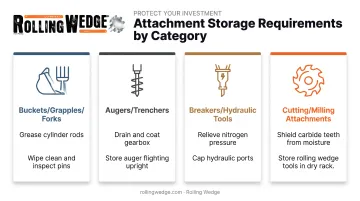
Buckets, Grapples & Forks
- Keep tines and cutting edges elevated and covered so they stay off wet ground
- Grease exposed cylinder rods and seal hydraulic couplers together before extended storage — damaged rod surfaces are a common cause of cylinder failure
- Secure pallet forks so they can't tip or fall while sitting unused
Augers & Trenchers
Clear all soil from the flighting before storage and check gearbox oil condition. Land Pride's auger documentation recommends weekly gearbox oil checks during active use and an oil coating on spiral flighting to reduce oxidation during storage. Store augers supported on a level, dry surface so nothing bends under its own weight.
Breakers & Hydraulic Tools
Relieve hydraulic and nitrogen pressure fully before storing a breaker, and retract the piston to protect the internal seals. CASE's breaker manual specifies discharging nitrogen completely, pushing the piston to its upper position, and storing horizontally. Other manufacturers recommend vertical storage instead, to avoid flattening seals under piston weight. Check your specific model's manual. Orientation guidance isn't universal across brands.
Cutting & Milling Attachments
Carbide-tooth cutting components - including Rolling Wedge Milling Tools on a skidsteer planer - need extra protection from moisture and impact. The teeth are precision parts; they lose edge quality when banged around or left wet against bare metal.
Before you park a cutting attachment for any length of time:
- Clean debris from around the teeth and mounting hardware before storage
- Store indoors or under cover to keep moisture off exposed carbide
- Avoid stacking anything on top of the cutting drum
- Check for chipped or worn teeth before the next job, not during it
Each Rolling Wedge Milling Tool has nine carbide teeth: one or two missing is still usable, but three or more means replace it. Rolling Wedge provides technical documentation on request, including installation drawings and parts lists. Request the docs for any attachment you run regularly — model-specific guidance is more reliable than generic storage advice.
Common Mistakes to Avoid When Storing Skidsteer Attachments
Most attachment damage traces back to a handful of repeated mistakes, not bad luck or bad equipment.
- Storing attachments dirty or wet: Trapped moisture against metal accelerates rust far faster than exposure to open air ever would.
- Leaving couplers exposed: Uncapped couplers let dirt and weather into a hydraulic system, and contamination is a leading cause of pump, cylinder, and valve failure.
- Skipping the pre-storage inspection: Worn pins, cracked teeth, and seized joints don't announce themselves until you're mid-job and losing time.
- Ignoring orientation guidance: Storing a breaker or hammer in the wrong position for its model can flatten seals before the season even starts.
An hour of prep prevents all four. Once you're three jobs into the season and something fails, that window is gone.
Conclusion
Proper skidsteer attachment storage comes down to three habits:
- Clean and inspect before you put anything away
- Protect with lubrication and the right storage location
- Organize on racks or bunkers suited to each attachment type
Most spring repair bills trace back to a skipped prep step, not a weak attachment. From buckets and augers to a specialty cutting tool like a Rolling Wedge Milling Drum, treat storage as part of regular maintenance. That habit protects the investment and keeps every attachment job-ready when the season starts.
Frequently Asked Questions
What are good storage racks for skidsteer attachments?
Look for bucket, auger, or fork racks built with sturdy steel and a weight rating that matches your heaviest attachment. Custom-built racks make sense when off-the-shelf options don't fit your yard layout or attachment mix.
What is a bucket bunker for skidsteers?
A bucket bunker is a cradle-style rack that holds multiple buckets upright and organized in one place. It prevents tipping and keeps cutting edges from resting on the ground.
How often should skidsteer attachments be inspected during storage?
Check monthly for rust spots, cover damage, and moisture buildup, especially during extended off-season storage. Catching a small tear in a cover early prevents a much bigger corrosion problem later.
Can skidsteer attachments be stored outside year-round?
Yes, with weatherproof covers and elevation off the ground using pallets or stands. Indoor storage still extends component life significantly compared to outdoor setups.
Do hydraulic attachments need special storage steps compared to manual ones?
Yes. Hydraulic attachments need pressure relief, capped or bagged couplers, and retracted cylinders before storage, none of which apply to purely mechanical attachments.
What is the biggest cause of skidsteer attachment damage during storage?
Moisture trapped by dirt and debris, combined with unprotected hydraulic couplers, causes most rust and hydraulic failures. Both are preventable with a thorough cleaning and capping routine before storage.