This guide is written for contractors, municipalities, and surface prep crews across the US construction and infrastructure sector, where bonding failures and safety violations carry real costs. Scabbling gets confused with scarifying, grinding, and milling constantly, despite each having distinct mechanisms and outcomes.
Here's what you'll learn: how scabbling actually works, where it fits in a project lifecycle, what factors change your results, and when you should reach for a different tool entirely.
TL;DR
- Scabbling uses pneumatic piston tools to fracture concrete, achieving CSP 7-9 per Sika's method chart
- Preps surfaces for overlays, coatings, and repairs by exposing aggregate
- Results depend on concrete strength, equipment configuration, and operator technique
- Silica dust and vibration exposure require documented safety controls under OSHA
- Wrong call for thin coatings or jobs where microcracking risk must stay low
What Is the Scabbling Process?
Scabbling is a mechanical impact method. Tungsten-carbide-tipped pistons (or rotary flailing heads, depending on the machine) strike the concrete surface repeatedly, chipping away the top layer until you hit a target profile.
The goal is a coarse, textured surface with exposed aggregate, giving new material something to mechanically grip. Compare that to:
- Scarifying — uses a rotating cutter drum or toothed wheel, producing a grooved texture in the CSP 6-9 range
- Grinding — uses abrasive discs (diamond, ceramic, or silica-based), typically landing at CSP 1-3 for a smoother finish
According to Sika's surface prep guide, scabbling sits at the top of the roughness scale, at CSP 7-9. That aggressive profile comes with a trade-off: higher microcracking risk than either grinding or scarifying produces.

Why Scabbling Is Used in Concrete Surface Preparation
Smooth concrete doesn't bond well with overlays, coatings, or repair material. Contractors and municipalities need a mechanical key, not just a clean surface.
Research from the American Concrete Institute confirms that tensile bond strength increases with substrate coarseness, as long as the roughening method doesn't damage the substrate in the process. The same research cites typical project bond-strength requirements of 100-250 psi, with the upper limit set by the existing concrete's own tensile strength.
Skip adequate roughening, and here's what typically goes wrong:
- Delamination — the new layer separates from the old
- Coating failure — adhesives and sealants peel prematurely
- Repair breakdown — patches fail well before their expected service life
Scabbling isn't legally mandated. ICRI (International Concrete Repair Institute) surface profile guidelines specify it as an industry best practice for high-CSP applications, not a code requirement.
How the Scabbling Process Works
Pneumatic pistons or flailing cutters strike the surface repeatedly, fracturing the top layer until you reach the target depth and profile. Compressed air (or hydraulics on larger units) powers the tool head, while the operator controls pass speed and downward pressure.
Each strike crushes and chips weak surface material, dislodging debris and exposing aggregate underneath. Operators dial in the finish with three main controls:
- Depth adjustment handles
- Pass count
- Piston configuration (single, three-point, or multi-point heads)

The full job usually follows three stages.
Step 1: Surface Assessment and Setup
Inspect the slab for unsound concrete, contaminants, and existing coatings. Choose handheld or walk-behind equipment based on the area's size and access constraints.
Step 2: Scabbling Pass
Run the tool across the surface at a controlled depth. Manufacturer rates vary. EDCO's five-head Crete Crusher claims up to 1/4 in (6.35 mm) per pass at 1,200 hits/min. Typical field removal sits closer to 1/8 in (3.18 mm) per pass on a 12-inch machine. Repeat passes until you hit the target profile.
Step 3: Debris Removal and Profile Verification
Clear dust and debris, then compare the finished texture against ICRI rubber comparator chips. Don't eyeball this step — visual guesswork doesn't confirm you've actually hit the specified CSP rating.
Where the Scabbling Process Is Applied
Scabbling shows up most often in:
- Bridge deck rehabilitation before overlay placement
- Parking structure repairs
- Industrial floor prep before coating
- Road marking removal
- Pre-overlay repair work on aging slabs

It typically appears at specific lifecycle points:
- Pre-repair surface prep
- Planned rehabilitation projects
- Partial demolition of low-profile concrete structures
Common triggers include failed coatings, scheduled overlays, structural repairs, and code-driven resurfacing.
Unlike sweeping or routine maintenance, scabbling is generally a one-time, project-based process rather than something you schedule on a recurring basis.
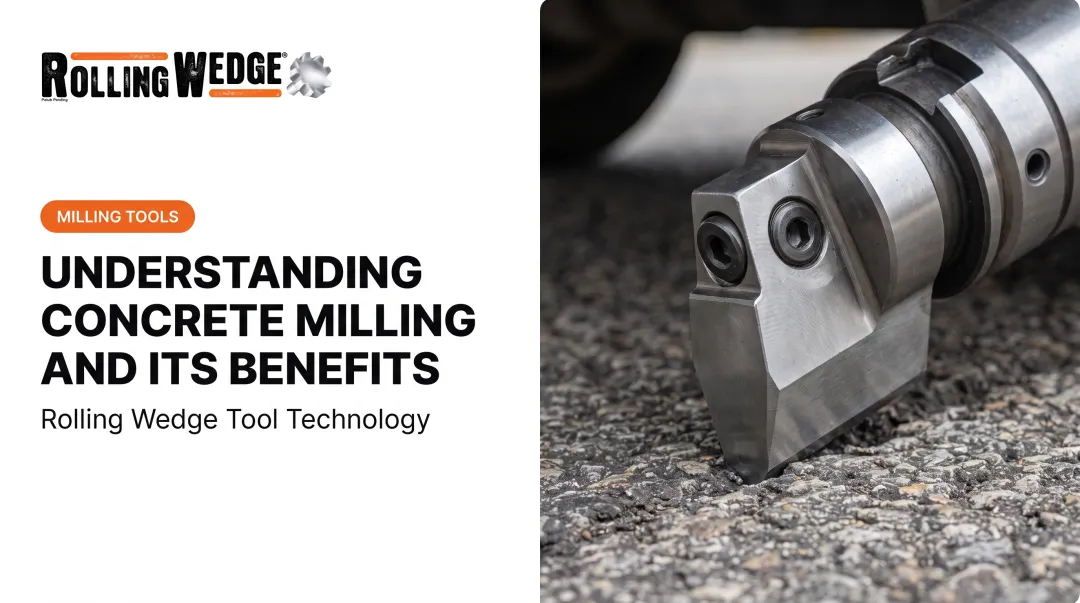
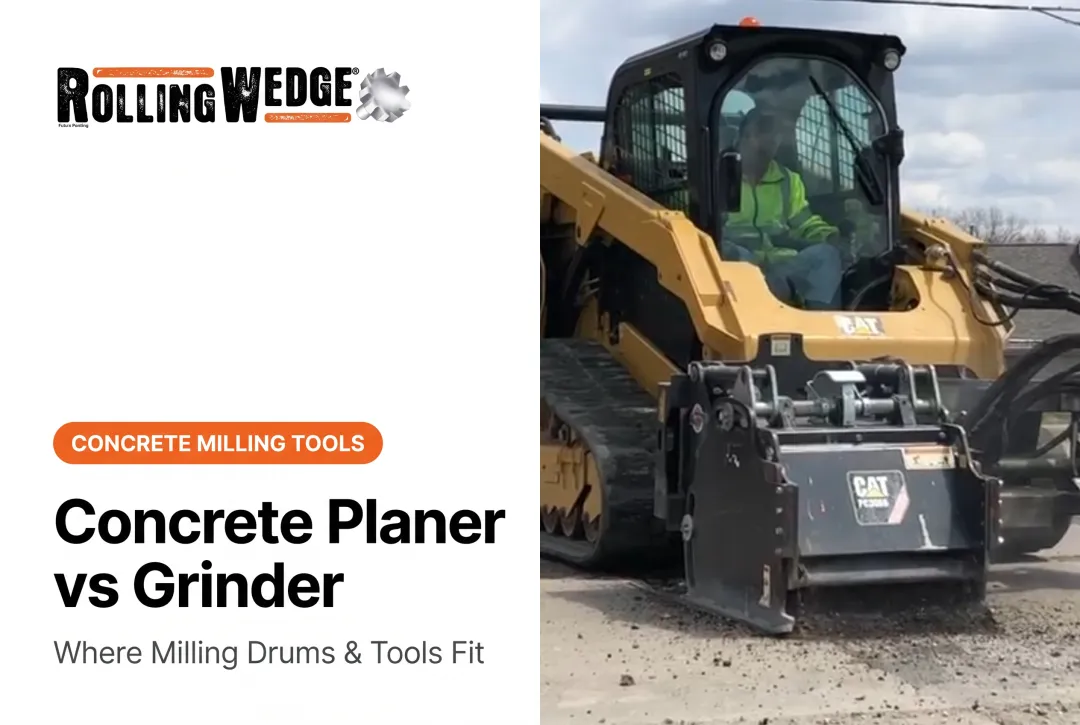
That application picture changes when asphalt and concrete sit side by side on the same job. Some contractors move away from scabbling-only workflows in those cases. Milling drum systems like the Rolling Wedge Concrete Milling Rolling Wedge Milling Tool handle concrete, asphalt, and some grades of rebar in a single pass without swapping tool heads between materials - useful when both surface types share one site.
Key Factors That Affect the Scabbling Process
Results vary more than most contractors expect. Here's what moves the needle:
- Concrete strength and age: harder, fully cured concrete fractures differently than a newer pour, often requiring more passes for the same profile
- Equipment type: handheld single-piston tools cover less ground than walk-behind multi-piston machines, but offer more precision in tight spaces
- Pass count and pressure control: both directly influence the final CSP rating; more pressure isn't automatically better
- Rebar or reinforcement presence: can slow progress significantly and damage standard carbide-tipped scabbling tools
- OSHA silica and vibration limits: dictate which equipment and PPE combinations are actually compliant on a US jobsite
Common Issues and Misconceptions
A few claims about scabbling show up often on job sites. Here's what they get wrong.
"Scabbling and scarifying are the same thing." They're not. Scarifying uses a rotating cutter drum; scabbling uses piston impact. The mechanisms differ, and so do the CSP outcomes.
"More passes always mean a stronger bond." Not true. ACI's guidance on bruising (defined in PRC-364.7-21) flags a real risk: excessive impact preparation leaves a bruised layer extending 3-10 mm or more below the surface. That layer is fine, interconnected cracking that can weaken the substrate and lower repair bond strength if you don't remove it.
"Roughening and CSP rating are the same measurement." Roughening is the process. CSP rating is the measurable outcome, confirmed against ICRI comparator chips, not visual impression.
"Scabbling is safe without dust and vibration controls." Scabbling ranks as high-risk for both silica exposure and hand-arm vibration syndrome (HAVS). Skip the controls and you take on real liability.

When the Scabbling Process May Not Be Appropriate
Scabbling isn't the default answer for every prep job. Skip it—or choose another method—when the job falls into one of these cases:
- Thin coatings: Sealants and light films usually need only acid etching or grinding—high-impact chipping can over-roughen the surface
- Vertical or overhead surfaces: Uniform results are harder than on horizontal slabs, and long-reach scabblers are not standard equipment
- Mixed asphalt/concrete or heavy rebar: Purpose-built milling systems handle these surfaces more cleanly than impact scabbling
- CSP not confirmed yet: Specifying scabbling before the coating or overlay maker’s ICRI CSP requirement is a common, costly default
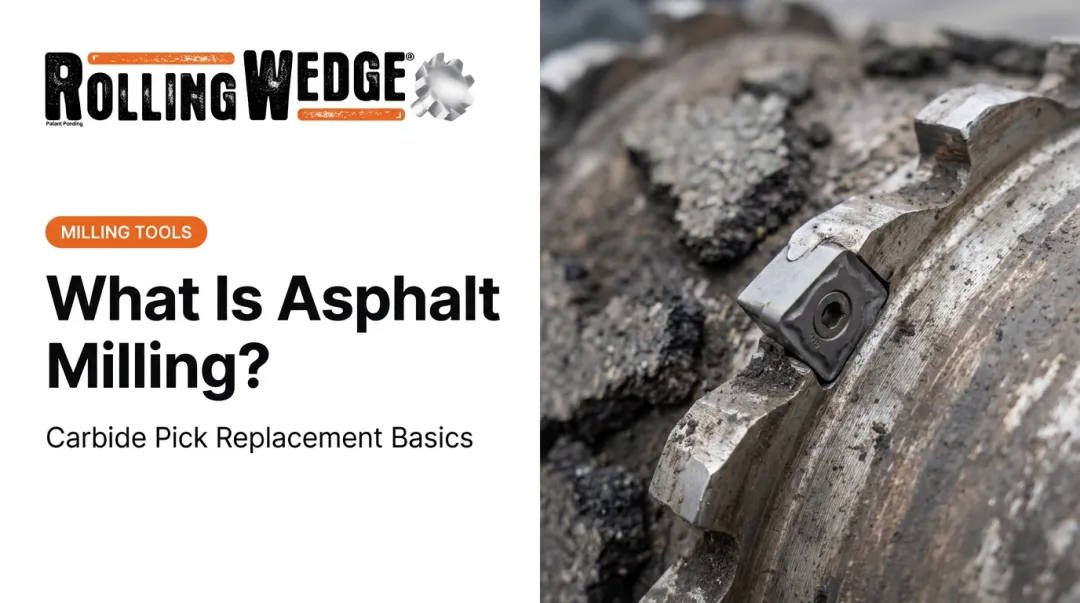
For mixed-material or rebar-heavy work, tools such as Rolling Wedge’s rolling-wedging-lifting cutters are built for asphalt, concrete, and some rebar in one setup. Documented replacement intervals run about 1–3 months versus twice weekly for carbide picks, with install times around 20 minutes versus 1–2 hours for a full drum changeout.
Conclusion
Scabbling remains one of the most effective mechanical methods for roughening concrete when a strong bonding surface is the goal. But understanding CSP requirements, matching equipment to the job, and building in proper safety controls all matter as much as the technique itself.
Match the method and the tool to what the project actually needs. Don't default to scabbling because it's familiar—especially on mixed-material or rebar-heavy jobs, where alternatives like Rolling Wedge milling tools can save both time and tool costs.
Frequently Asked Questions
What is scabbling in concrete?
Scabbling is a mechanical process using pneumatic piston tools to chip away the top layer of concrete, creating a rough surface profile for bonding new material. It typically produces CSP 7-9 profiles.
What does a floor scabbler do?
A floor scabbler is a walk-behind or handheld machine with carbide-tipped pistons that pound and fracture the concrete surface. It's used to reduce slab height or create a textured bonding profile.
Can flaking concrete be repaired?
Yes. Flaking concrete is typically repaired by scabbling or grinding away unsound material first, then applying a bonding agent followed by an overlay or patch material.
How rough should a concrete surface be before applying an overlay?
Roughness is measured using ICRI CSP ratings. Most overlays require CSP 3-6. Scabbling produces more aggressive CSP 7-9 profiles for heavy bonding applications.
Is scabbling dangerous to perform?
Scabbling generates high silica dust and vibration exposure. OSHA requires respiratory protective equipment, dust extraction or water controls, and trained operators for scabbling work.
What's the difference between scabbling and milling?
Scabbling uses piston impact to texture concrete surfaces only. Milling systems, like Rolling Wedge Milling Tools, use a rolling-wedging-lifting action that pulls material apart in tension, removing asphalt, concrete, and rebar in a single pass without tool swaps.