Introduction
Picture a two-mile stretch of city arterial covered in potholes, alligator cracking, and rutted wheel paths. The road isn't gone, but it's tired. Full reconstruction would mean weeks of lane closures and a budget line nobody wants to sign off on.
This is where cold planing earns its keep. It strips away the damaged surface, restores the profile, and gets the road ready for a fresh layer, often in a fraction of the time reconstruction would take.
Here's the catch: contractors, municipal engineers, and equipment operators often use "cold planing," "milling," and "profiling" as if they mean the same thing. Sometimes they do. Sometimes they don't, and that confusion can complicate specs and bids.
This article breaks down what cold planing actually is, how it relates to milling, how the equipment works, and where it delivers the most value on real job sites.
Key Takeaways
- Cold planing removes pavement at ambient temperature, preserving material for reuse as Reclaimed Asphalt Pavement (RAP)
- "Cold planer" and "milling machine" describe overlapping equipment, but modern cold planers add GPS and laser grade control
- ARRA/FHWA Classes I-V define scope, from surface correction to full-depth removal
- Mixed asphalt-concrete-rebar sites are the biggest wear challenge for standard carbide-pick drums
- Milling paired with an overlay typically costs less than full reconstruction
What Is Cold Planing?
Cold planing is the controlled mechanical removal of asphalt or concrete pavement down to a specified depth and cross-slope. No heat, no torches, no softening agents. Just a rotating drum grinding away the top layer at whatever temperature the pavement already is.
That's the "cold" part. The Asphalt Recycling and Reclaiming Association defines cold planing as controlled cold milling that restores a pavement's surface to a specified profile. Because the process happens at ambient temperature, it keeps the removed material structurally intact and skips the emissions associated with hot-mix heating equipment.
That removed material becomes Reclaimed Asphalt Pavement (RAP), which gets recycled into:
- New asphalt mixes
- Compacted road base layers
- Trench backfill for utility work
The Five ARRA/FHWA Classes of Cold Planing
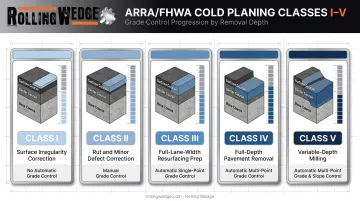
Not every milling job has the same scope. The ARRA/FHWA Basic Asphalt Recycling Manual splits cold planing into five classes:
| Class | Purpose |
|---|---|
| I | Fix irregularities; no automatic grade control required |
| II | Mill to uniform depth with automatic grade control |
| III | Mill to depth and cross-slope with automatic controls |
| IV | Full-depth removal down to base or subgrade |
| V | Variable-depth milling per project plans |
A Class I job might just smooth out a rough patch before an overlay. A Class IV job tears the pavement structure down to the granular base. Same basic equipment, very different scope.
Cold Planing vs. Milling: What's the Real Difference?
Short answer: they're largely the same thing. Cold planing and pavement milling both describe mechanically grinding away pavement without heat, and industry bodies like the Asphalt Recycling & Reclaiming Association (ARRA) use the terms interchangeably.
Where it gets more specific is equipment terminology. "Milling machine" is the umbrella term for any drum-cutting equipment. "Cold planer" typically refers to modern machines with precision depth and grade control, GPS guidance, and automated cross-slope adjustment.
The practical divide shows up in project scale:
- Older, manually operated milling machines handle small patches, pothole repairs, and utility cuts where tight tolerances don't matter as much
- GPS/laser-guided cold planers run large-scale resurfacing jobs where consistent depth across a lane, or several lanes, is non-negotiable
There's also micro-milling, a specialty variation. It uses a denser-toothed drum to leave a finer, smoother texture. FHWA notes that conventional milling usually preps a surface for an overlay, while micro-milling can be smooth enough to open to traffic on its own.
| Factor | Older Milling Machines | Modern Cold Planers | Micro-Milling |
|---|---|---|---|
| Scale | Small patches | Full lane/highway | Surface texture work |
| Precision | Manual grade checks | Laser/GPS automated | Fine-tooth finish |
| Typical use | Repairs, utility cuts | Large resurfacing | Open-to-traffic finish or thin overlay prep |
How Cold Planing Works: Process and Equipment
The core mechanism is straightforward. A large rotating drum, fitted with carbide-tipped cutting teeth, grinds into the pavement surface. A scraper blade gathers the milled material, and a conveyor belt carries it up into a waiting truck or hopper.
Depth and slope control is what separates a rough job from a precise one. Contractors rely on:
- String-lines for basic reference on smaller jobs
- Laser guidance, accurate to roughly ±3 mm on some systems
- GPS-guided automatic grading that maintains tight tolerances across long stretches
Crews also spray water on the drum during milling. That spray manages heat buildup on the cutting teeth and keeps dust down — important for air quality and silica exposure compliance.
Cutting Technology Matters: Carbide Picks vs. Newer Alternatives
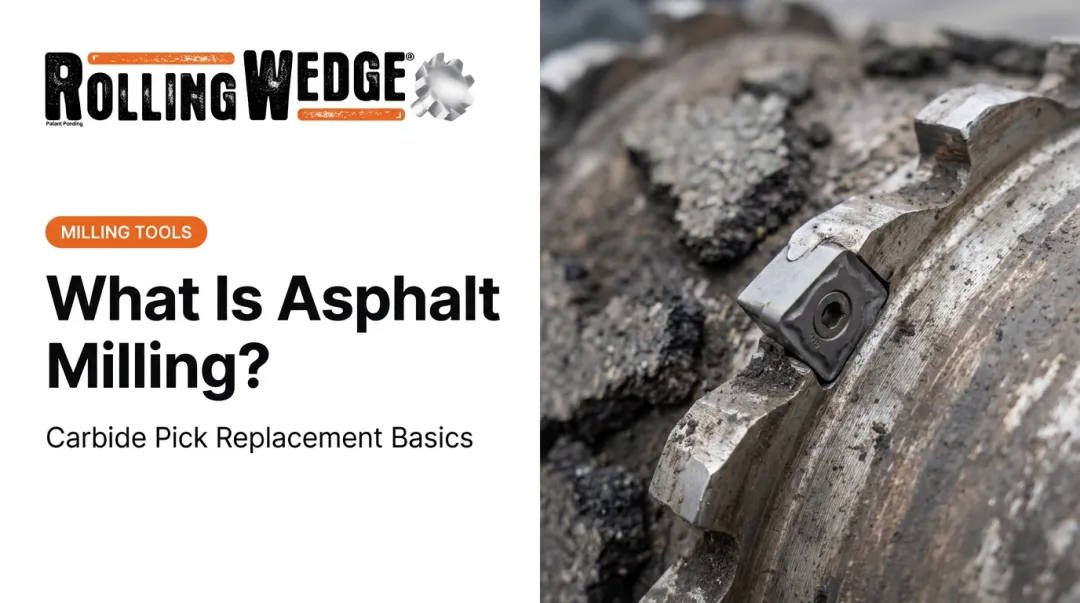
Traditional carbide pick teeth do the job, but they wear down fast, especially on reinforced concrete or mixed-material surfaces. Frequent tooth changes mean downtime, and downtime on a paving crew is money walking off the site.
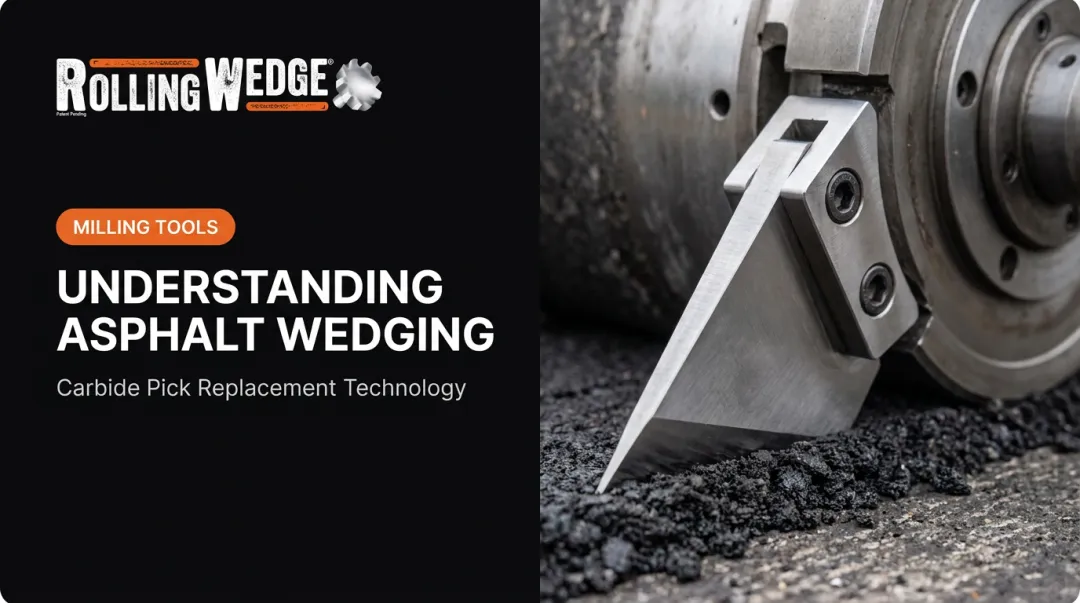
Rolling Wedge Cold Milling takes a different approach. Instead of chiseling into the pavement with repeated impacts, its rolling-wedging-lifting action rotates continuously. That motion exploits the low tensile strength of asphalt and concrete - roughly 20% of their compressive strength - so material breaks away with less resistance.
Each Rolling Wedge Milling Tool carries nine carbide teeth, and the tools roll over and away from the surface rather than striking it. In practice, that translates to:
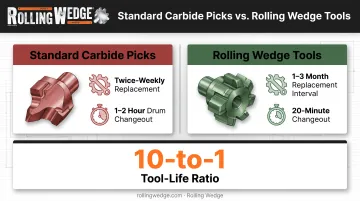
- Tool replacement every 1-3 months, compared to roughly twice a week for standard carbide picks
- A full 24-inch drum changeout in about 20 minutes, versus 1-2 hours for conventional picks
- Reported operating lives of 10x and longer than carbide picks in asphalt-milling environments
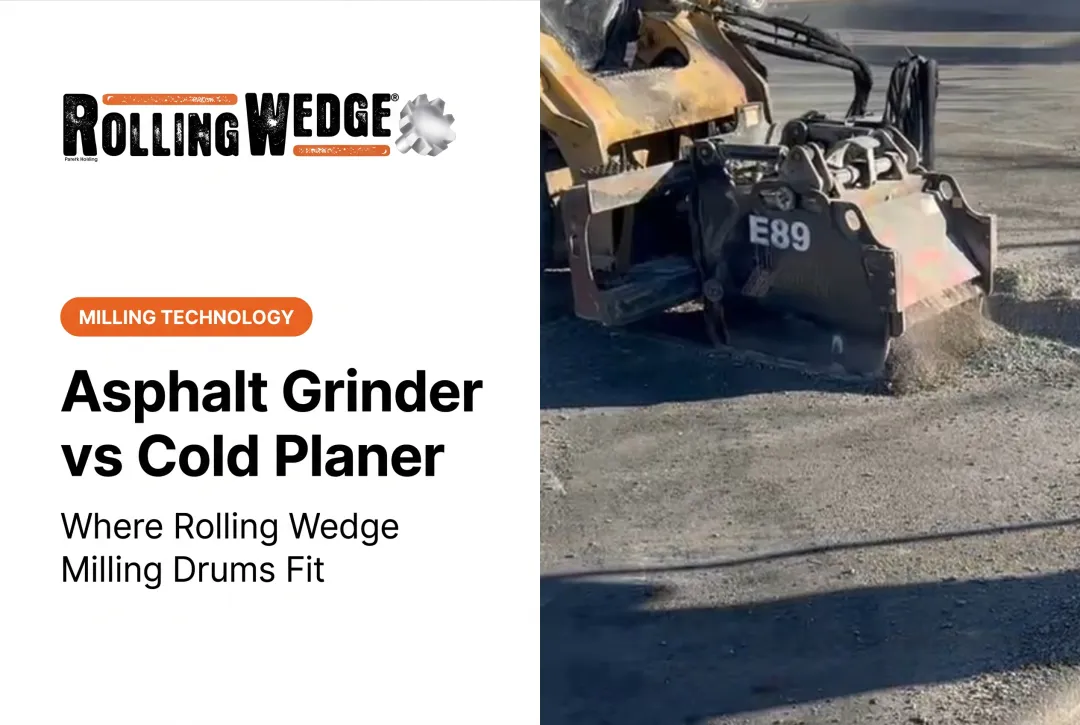
The same cutting principles apply across equipment sizes. Skidsteer attachments (compatible with machines like the Caterpillar 246D) handle tight urban jobsites, while large self-propelled cold planers can cut a full lane in a single pass.
Common Uses and Applications of Cold Planing
Most cold planing work falls into a handful of categories, and knowing which one you're dealing with shapes both equipment choice and depth of cut.
Partial-depth removal is the most common application. It corrects surface distresses like rutting, raveling, potholes, and alligator cracking before laying a new overlay. This is Class I or II territory, usually just an inch or two deep.
Full-depth milling (Class IV) removes the entire asphalt layer and reaches the base material. It's a faster, cheaper alternative to tearing out and rebuilding a road from scratch.
Full-depth reclamation is related but separate: it pulverizes and stabilizes material in place rather than removing it.
Beyond those two, cold planing covers a handful of specialty jobs:
- Leveling for utility trench patching
- Taper and transition milling at intersections and highway ramps
- Cutting rumble strips into shoulders
- Adjusting pavement height near curbs, manholes, and guardrails
Mixed-Material Job Sites: A Growing Challenge
Urban and infrastructure projects increasingly mean milling through asphalt bonded to concrete, or concrete reinforced with rebar and dowel bars. Standard carbide-pick drums often stall or break teeth when they hit steel unexpectedly.
Advanced drum designs address this directly. Rolling Wedge tools mill through many grades of rebar, wire-mesh-reinforced concrete, and roadway joints with dowel bars without jams or stalls. On one demonstrated job, crews milled concrete on one side and asphalt on the other in a single pass, with no tool swaps required.
Key Benefits of Cold Planing
The advantages of cold planing show up in three places: the environment, the budget, and the crew's day-to-day workload.
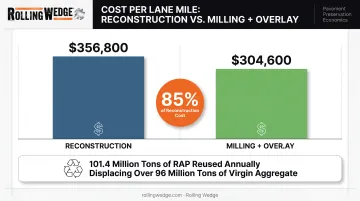
Sustainability. RAP reuse cuts demand for virgin aggregate substantially. NAPA's 2024 industry survey reports 101.4 million tons of RAP used in asphalt mixtures that year. That volume displaced more than 96 million tons of virgin aggregate and conserved 5.1 million tons of asphalt binder. More than 99% of RAP returns to use, per the same report.
Cost and time savings. Milling and overlay work generally costs less than full reconstruction. A TxDOT cost-control analysis found that milling 4 inches and applying a structural overlay ran $304,600 per lane-mile, about 85% of the $356,800 reconstruction baseline. That's real budget headroom on a multi-mile project.
Operational benefits. The process also lightens the crew's daily load compared with full reconstruction:
- Selective depth control fixes ruts and surface defects without full-depth demolition
- On-board conveyors load millings directly, cutting material-handling steps
- Faster lane reopening shortens work windows and eases traffic control
For crews running large paving jobs where every hour of uptime counts, these operational gains often matter as much as the material savings.
Frequently Asked Questions
What is cold planing?
Cold planing is the mechanical, non-heated removal of a paved surface using a rotary drum with carbide-tipped teeth. It prepares the surface for repaving, overlay, or full reclamation.
What is the difference between cold planing and milling?
The terms are largely interchangeable in industry use. "Cold planer" often refers more specifically to modern, precision-guided machines within the broader milling machine category.
How deep can a cold planer cut into pavement?
Depth ranges from under an inch for surface correction (Class I) to full-depth removal reaching a foot or more (Class IV), depending on machine size and project specs.
Is the material removed during cold planing wasted?
No. Milled material becomes Reclaimed Asphalt Pavement (RAP), commonly reused in new asphalt mixes, road base layers, or utility trench backfill.
How long does a cold planed surface typically last before it needs repaving?
Milling is surface prep, not a standalone long-term fix, so it is usually paired with an overlay on the same project timeline.
What kind of equipment is used to cut through both asphalt and concrete during milling?
The mill’s cutting drum and tools decide what you can run in one pass. Standard carbide-pick drums often wear fast or stall on mixed or rebar-reinforced surfaces. Tools built on a rolling-wedging-lifting action, such as Rolling Wedge Milling Tools, are designed to cut asphalt and concrete together without the same tool damage.