That's where asphalt milling comes in. Asphalt milling is the mechanical process of grinding away a layer of deteriorated pavement using a specialized machine, often called a cold planer. You'll also hear it referred to as cold planing or profiling.
This guide breaks down how the process works, the equipment and cutting-tool technology behind it, the real cost and environmental benefits, the different milling classes, and where milled material ends up once it's hauled away.
Key Takeaways
- A rotating drum strips damaged pavement, leaving a clean base for repaving
- Recycled asphalt becomes RAP, cutting material costs and landfill waste
- Rolling-cut tools reduce downtime and cost versus traditional carbide picks
- Milling depth ranges from light surface leveling to full-depth removal
What Is Asphalt Milling?
Asphalt milling is a grinding operation. A cold planer's rotating drum, fitted with cutting teeth, chews through the top layer of pavement to a set depth and grade. The goal is to strip away the cracks, ruts, potholes, and bleeding while leaving the structurally sound base intact underneath.
A few terms come up constantly in this line of work:
- Millings: the ground-up material that comes off the drum during milling
- RAP (Reclaimed Asphalt Pavement): the broader industry term for that removed material once it's processed for reuse
- Cold planer: the self-propelled machine that does the actual milling
Milling is almost always the first step in a resurfacing project. After the drum passes through, crews sweep debris, apply a tack coat to help the new layer bond, and then repave. Skip milling, and you're just piling new asphalt on top of old problems.
Why Contractors Choose Milling Over Full Reconstruction
Full-depth reconstruction means tearing out the entire pavement section, hauling it away, and rebuilding from the subgrade up. That's expensive, slow, and disruptive to traffic.
Milling and overlay is the faster, lower-cost alternative when the base is still sound. FHWA's guidance on maintaining composite pavements describes milling as a quick, effective way to remove deteriorated surface material and prepare it for a new overlay.
The agency cites rapid construction, faster reopening to traffic, and reuse of the existing pavement structure without demolition or landfilling as key benefits.
Full reconstruction still makes sense in specific cases:
- Traffic loads have outgrown the original pavement design
- Roadway geometry is outdated (lane widths, drainage slopes, etc.)
- The underlying pavement shows severe structural distress, not just surface wear
For everything short of that, milling gets the job done faster and at lower cost.
How the Asphalt Milling Process Works
The Milling Machine and Cutting Drum
The cold planer's rotating drum is the workhorse of the entire operation. Hardened cutting teeth mounted around the drum grind into the asphalt surface as the machine crawls forward, breaking the pavement into small, manageable pieces. A conveyor system then carries that milled material out of the cutting chamber and loads it directly into waiting dump trucks for recycling.
Here's where things get interesting for anyone running a fleet: tooth failure comes in three distinct forms, and any one of them can stop a machine cold. Gradual tooth wear grinds down the carbide tip until it can no longer cut efficiently. Complete seizing occurs when a pick locks up and stops rotating in its holder - friction does the rest. Breaking or shearing happens when a pick snaps entirely under load, leaving nothing but a stub. Together, these three failure modes are what drive milling downtime - and they are not equally hard to solve.
Traditional carbide pick teeth are impact tools. They're forced into the pavement and rely on brute compressive force to break it apart. That impact generates heat, causes uneven wear, and on abrasive surfaces, picks can need replacing multiple times a week. Crews lose real hours every month just swapping teeth.
Rolling Wedge Roadway Milling tools are engineered to eliminate two of those three failure modes entirely. Because the tool's wheel-and-shaft design rolls over the surface rather than hammering into it, it never seizes in the holder and never generates the heat that causes carbide picks to lock up. That takes seizing and heat-driven shearing off the table completely. On the third front - gradual wear - operating lives of 10x and longer than traditional carbide picks have been reported.
The rolling-wedging-lifting action works by wedging into the material at a critical contact angle and exploiting asphalt and concrete's tensile weakness. Asphalt and concrete have tensile strength that's only about 20% of their compressive strength - Rolling Wedge exploits that gap instead of fighting it with brute force. It's also why the same tools can mill asphalt and concrete in a single pass, with no tool swaps.
The practical difference shows up in two numbers contractors actually care about:
| Metric | Carbide Picks | Rolling Wedge |
|---|---|---|
| Replacement frequency | Twice a week | Every 1-3 months |
| Full drum changeout time | 1-2 hours | About 20 minutes |
That gap adds up fast. A crew swapping picks twice weekly at 1-2 hours per changeout can burn 8+ hours a month on tool replacement alone, not counting the machine sitting idle while it happens.
Step-by-Step Milling Workflow
A milling job typically runs through three phases:
- Site evaluation - Crews inspect pavement condition, mark utilities and manholes, and determine the required milling depth before the machine ever touches the surface.
- Active milling - The operator controls machine speed and cutting depth while the drum grinds material and the conveyor loads it into trucks for hauling.
- Surface preparation - Once milling is complete, crews sweep loose debris and apply a tack coat, setting up the surface for the new asphalt layer.
Benefits of Asphalt Milling
Cost, sustainability, and speed explain why milling has become the go-to choice over full reconstruction.
Cost savings are the obvious draw. Milling avoids the demolition, hauling, and rebuild costs of full reconstruction, and the material that comes off the drum doesn't go to waste. It gets recycled directly into new asphalt mixes.
Environmental benefits are substantial and increasingly hard to ignore. According to NAPA's 2024 industry survey, the recycling numbers for reclaimed asphalt pavement (RAP) speak for themselves:
- More than 99% of RAP generated in 2024 was put back to use
- Producers used an estimated 101.4 million tons of RAP in new asphalt mixtures
- This conserved 5.1 million tons of asphalt binder and replaced 96 million tons of virgin aggregate
- The recycling also saved an estimated 72.5 million cubic yards of landfill space
Speed and practical benefits matter just as much to the crews and municipalities running these jobs:
- Localized repairs mean less traffic disruption than full closures
- Faster project completion gets lanes and lots back in service sooner
- Resurfaced pavement typically drains better and rides smoother than what it replaced
None of these benefits happen, though, if the milling equipment itself is spending more time in the shop than on the road. That's the operational bottleneck that cutting-tool technology like Rolling Wedge's rolling design is built to address.
Types and Classes of Asphalt Milling
Not every milling job calls for the same depth or approach. FHWA and the Asphalt Recycling and Reclaiming Association recognize five classes of cold milling, each defined by objective rather than a fixed depth:
| Class | Objective |
|---|---|
| I | Remove surface irregularities (bumps, ruts, minor defects) |
| II | Mill to a uniform depth specified in project plans |
| III | Mill to a uniform depth and cross slope |
| IV | Remove the entire surfacing depth down to base or subgrade |
| V | Mill to variable depths as specified in plans |
There's no universal inch range attached to each class. The depth is whatever the project plans call for, based on how deep the damage runs and what the pavement structure needs.
Beyond these five standard classes, micro-milling stands out as a specialty variation. It uses a much denser tooth pattern, closely spaced teeth rather than the standard drum layout, to produce a smoother, quieter final texture. It's commonly used ahead of thin overlays or where noise reduction matters, such as urban roadways.
Choosing the right class depends on:
- Current pavement condition and depth of visible distress
- Project budget and timeline
- Whether the underlying base is still structurally sound
Common Applications of Asphalt Milling
Road and highway rehabilitation is the largest use case. Milling resets pavement elevation, corrects cross slope, and prepares a clean surface for overlay, all without shutting down a corridor for full reconstruction.
Parking lots and driveways are smaller in scale but follow the same logic. Project size, milling depth, and how the crew sources or hauls the removed material all affect what a driveway milling job costs. Because those variables shift from site to site, getting a local quote is the only reliable way to nail down pricing.
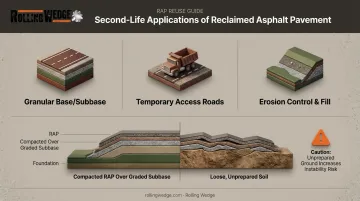
Recycled millings get a second life well beyond the original project. Once processed, this material, known as reclaimed asphalt pavement (RAP), commonly shows up as:
- Granular base or subbase material for new roads and paved areas
- Temporary access roads on active job sites
- Erosion control and general fill applications
One caution here: millings need to go over a properly graded and compacted subbase, not loose dirt. RAP behaves like an engineered granular layer. Dump it on unstable soil and it will shift, rut, and fail well before its time. Compaction over a prepared base is what makes it stable.
Frequently Asked Questions
What does roadway milling mean?
Roadway milling is the process of grinding away a layer of worn asphalt with a specialized cold planer machine, preparing the surface for a fresh overlay. It's typically the first step in any resurfacing project.
How long does road milling take?
Timing depends heavily on project size and milling depth. Small areas like driveways can take a few hours, while highway projects may run several days, usually followed by one to two days of paving.
How much does a millings driveway cost?
Costs vary based on driveway size, milling depth, and where the material is sourced from. Because these factors differ by project, getting a local quote is the best way to get accurate pricing.
Can you put asphalt millings over dirt?
Millings should go over a properly graded and compacted base, not loose dirt. Without a stable subbase, the material will shift and settle unevenly over time.
What's the difference between asphalt milling and resurfacing?
Milling removes the damaged top layer of existing pavement. Resurfacing follows afterward, applying a fresh layer of new asphalt to restore the surface. One prepares the ground; the other finishes the job.
How often do milling machine cutting teeth need to be replaced?
Traditional carbide picks often need replacing twice a week under normal wear conditions. Newer cutting technologies, like Rolling Wedge's rolling-wedging-lifting design, extend that interval to every 1-3 months.